



By: Chavez, Omar, Ivon, Alanis, Bravo, David Israel, Luis, Jorge, Bárcenas, Max, Martín, Flores, Flores-Jiménez, Alvarado-Hernández, Jimenez, Bertha Alejandra, Olmos, Francisco
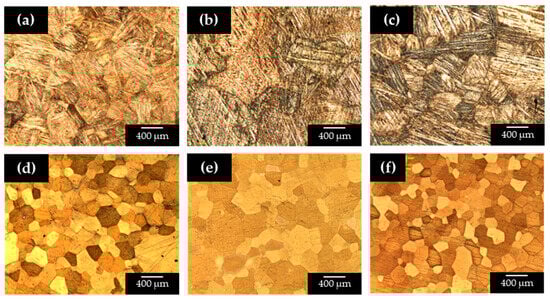
Cu–Al–Ni shape memory alloys (SMAs) are attractive for structural and functional applications due to their cost-effectiveness and shape memory behavior. This study systematically investigated the effect of beryllium (Be) addition on the phase stability, microstructure, transformation temperatures, mechanical hardness, corrosion resistance, and wear behavior of Cu–Al–Ni alloys. Alloys with Be contents ranging from 0 to 1.5 wt.% were fabricated via arc melting and subjected to thermal treatment. Characterization techniques included dilatometry, X-ray diffraction (XRD), microhardness testing, potentiodynamic polarization, and pin-on-flat wear testing. The results showed that Be additions ≤ 0.4 wt.% stabilized the martensitic β′ phase, while higher concentrations favored the formation of austenitic β phase with a BCC structure. Hardness increased with Be content, especially in austenitic samples. Corrosion tests revealed that while the 0.2 wt.% Be alloy exhibited the most positive corrosion potential (Ecorr), it also had a higher corrosion rate. Overall, corrosion resistance declined with Be concentrations ≥ 0.6 wt.%. Wear tests demonstrated improved resistance in martensitic alloys, attributed to pseudoplastic deformation. These findings highlight the dual role of Be in modifying phase stability and functional properties, offering useful guidance for designing Cu-based SMAs with tailored performance.