




By: Sarah M, Reisner, Malik, Goldenberg, Amber L, Peitzmeier, Sari L.
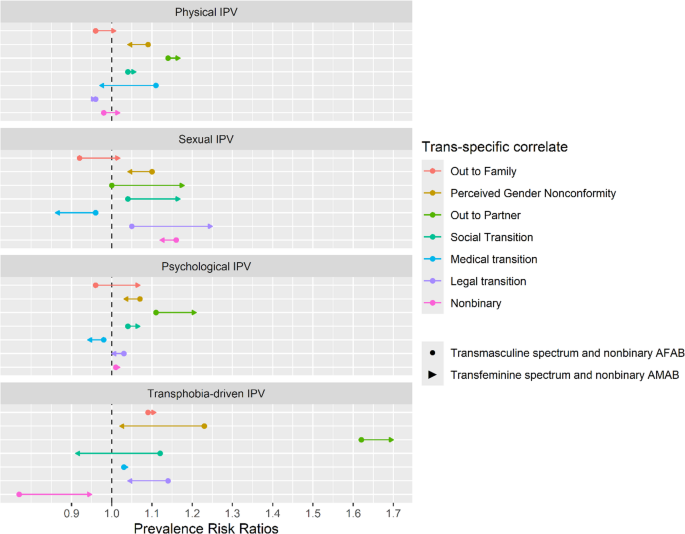
Purpose Transgender individuals are at high risk for intimate partner violence (IPV). Elucidating transgender-specific correlates of IPV may guide the timing and content of screening and prevention guidelines for transgender communities. Methods We used secondary data from 2015 US Trans Survey (n = 27,715, ages ≥18), restricted to individuals who reported ever having a partner (n = 24,736, 89.3%). We used multivariable Poisson regression with robust error variances to estimate prevalence risk ratios for IPV outcomes based on transgender-specific correlates. Physical, sexual, psychological, and transphobia-driven IPV were the measured outcomes. Correlates included nonbinary identity; “outness” to family; “outness” to intimate partners; perceived gender conformity; and social, medical, and legal transition. We tested for interaction effects to examine effect modification by sex assigned at birth. Results Almost 60% of participants had experienced lifetime IPV. Being “out” to one’s partner was the strongest predictor for experiencing multiple types of IPV. Perceived gender nonconformity was associated with all four types of IPV in transmasculine spectrum and nonbinary AFAB individuals (7-23% higher prevalence), but no IPV types in transfeminine spectrum and nonbinary AMAB individuals. Nonbinary identity was associated with 23% lower prevalence of transphobia-driven IPV in AFAB individuals but unassociated in AMAB individuals, and higher prevalence of sexual IPV in both groups (12-16%). Conclusions Transition and outness were associated with elevated risk for some kinds of IPV regardless of sex assigned at birth. Medical professionals, particularly those providing gender-affirming care, should follow clinical guidelines around routine screening for trans patients and consider universal patient education on IPV.