



By: Roy, Shyam Nandan, Wabhitkar, Patel, Bhaskar, Shailendra, Kumar, Surat
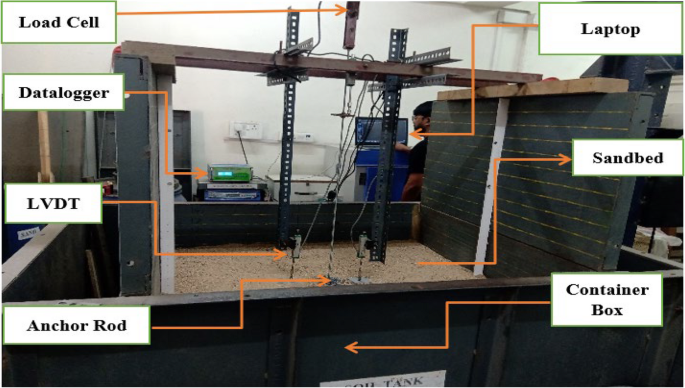
This study investigated the uplift performance of geotextile-encased granular pile anchors (GEGPA) in sandy soil using three-dimensional finite element analysis. The numerical model was validated against published experimental data and used to evaluate the effects of embedment ratio (ER = 5, 7.5, 10, 12.5, and 15), sand relative density (RD = 40%, 60%, and 80%), and geotextile encasement length (0%, 25%, 50%, 75%, and 100%) on uplift behaviour. The results showed that uplift resistance increased with increasing ER, RD, and encasement length. Increasing the ER from 5 to 15 improved uplift capacity by approximately 42%, while increasing the RD from 40% to 80% enhanced uplift resistance by nearly 35%. Fully encased granular pile anchors exhibited up to 50% higher uplift capacity than un-encased piles because of improved lateral confinement and reduced bulging deformation. The load-transfer mechanism shifted from base resistance to shaft friction at ER of 10 and above. A 50% encasement increased uplift capacity by about 22%. The highest uplift resistance was achieved for fully encased anchors in dense sand (RD = 80%) at an ER of 15. These findings demonstrated the effectiveness of geotextile encasement in improving the uplift performance of granular pile anchors systems in cohesionless soils.