



By: Lauren J. Medwell, Hannah J. Sadler, Hannah Sadler, Laura Sevenoaks, Anila Viepadan, Aneeta A. John, Sophie Thomas
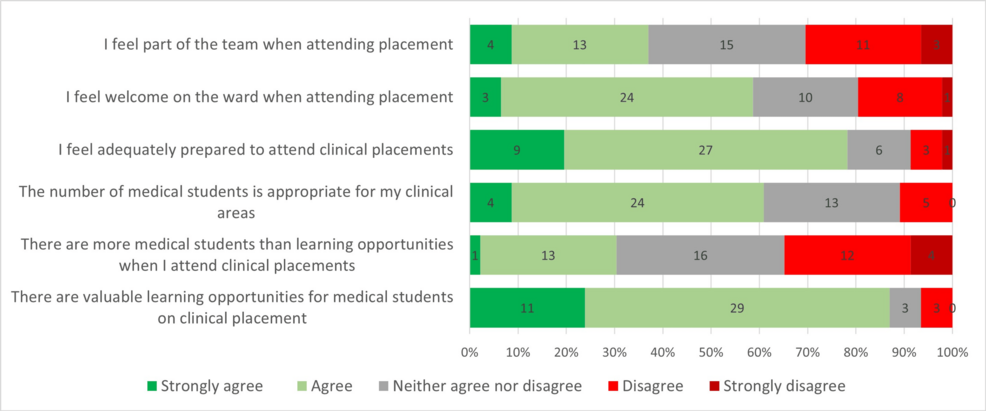
BackgroundMedical students are expected to spend a significant amount of time on clinical placement as part of their training. However, attendance rates at placements are often low, and engagement is inadequate. This has a negative impact on medical student learning and wastes NHS and university resources.AimsThis study aims to gain insight into both medical student and clinical staff experiences of placements to identify reasons behind low attendance and possible improvements.MethodsThis study utilised an exploratory mixed-methods design using questionnaires to collect both qualitative and quantitative data including Likert scales and multiple-choice and ranking questions from staff and student respondents at one large NHS trust, UK. Participants included staff working in clinical areas in which students are based as well as medical students on placement at the trust from three different UK universities. Data were analysed using R (R Foundation for Statistical Computing, Vienna, Austria), and between-group comparisons were performed for four thematically matched items using the Mann-Whitney U test. Statistical significance was set at p < 0.05. Qualitative analysis was undertaken using inductive thematic analysis by multiple researchers to ensure coding consistency.ResultsWe received 87 responses (46 from students and 41 from staff). Quantitative data revealed that 63.0% of students had been turned away from clinical placement and 30.0% did not feel part of the team when attending. Students rated the availability of valuable learning opportunities lower (median = 4) compared with staff (median = 5), with a significant difference (U = 561.5, p < 0.001, r = -0.40). Conversely, students perceived that there were more medical students than opportunities (median = 3) compared with staff (median = 2), also significantly different (U = 1328.5, p < 0.001, r = 0.41). No significant difference was observed regarding whether the number of students was appropriate (U = 994.0, p = 0.64, r = 0.05). Similarly, perceptions of student preparedness did not differ significantly (U = 1,122.5, p = 0.087, r = 0.19), although staff ratings trended lower. Qualitative analysis identified overlapping themes from students and staff, including organisation and integration into the team, alongside student-specific themes of workplace-based teaching, staff awareness, feeling welcome, and responsibility, and staff-specific themes of communication and cultural attitudes towards education.ConclusionThis study highlighted several key reasons behind poor engagement and attendance of medical students in clinical placements. These include communication barriers, poor organisation, lack of team integration, and overcrowding. These can be overcome with simple, practical solutions such as pre-allocating students to staff, sharing student timetables with clinical staff, careful timetabling to avoid student clashes, and improved availability of teaching in the clinical environment.