



By: Vidya Sagar
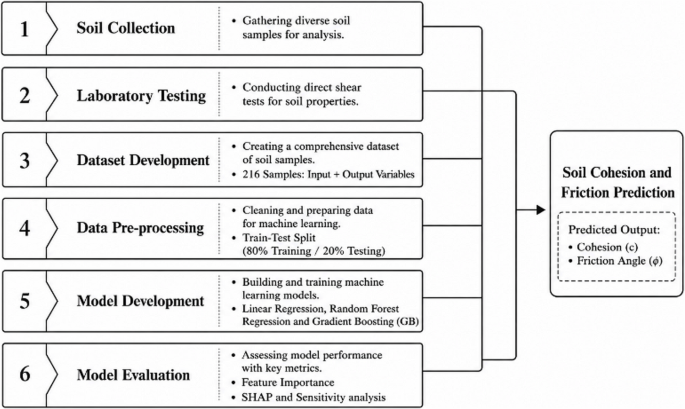
A database of 216 direct shear tests on Bhimal fiber-reinforced expansive soil was generated to predict the shear strength parameters under Unconsolidated Undrained and Consolidated Drained conditions. The cohesion and angle of internal friction were predicted using nine input variables related to fiber reinforcement, compaction characteristics, moisture condition and curing period. Three machine learning models were trained and evaluated (Linear Regression, Random Forest and Gradient Boosting) using an 80:20 train-test split. Model performance was evaluated using the coefficient of determination, root mean square error, and mean absolute error. The results indicated that ensemble learning models outperformed the linear model in all prediction tasks. The best prediction accuracy was obtained by Gradient Boosting, with coefficient of determination values ranging from 0.975 to 0.998 and the lowest prediction errors among all models. Feature importance, sensitivity analysis and Shapley additive explanation analysis were performed to interpret model predictions and identify the governing parameter. The most important variable influencing shear strength behaviour was the fiber content. The developed framework demonstrated the capability of machine learning to reliably predict shear strength parameters and reduce the experimental effort required for preliminary geotechnical assessment and design.