
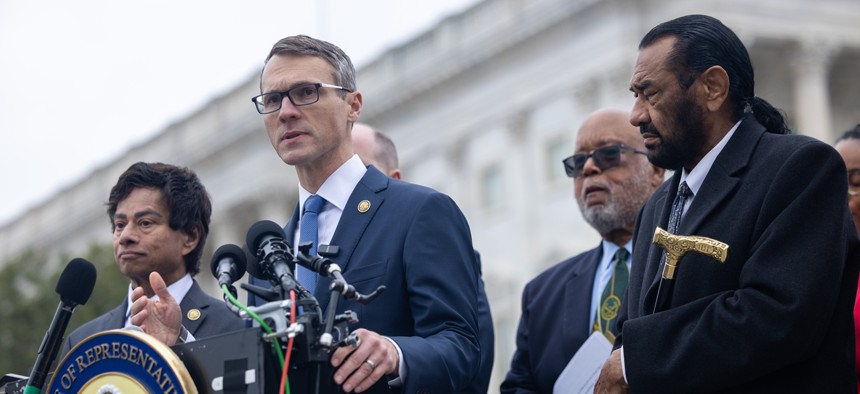
Congressman James Walkinshaw (D-VA) speaks at a press conference with other Democratic members of House Homeland Security Committee outside the U.S. Capitol in Washington, DC on January 14, 2026. By D...
In the past week, several significant developments in Government & Politics have emerged, particularly concerning international relations and geopolitical tensions. The U.S. Treasury's decision to buy back longer-term bonds has put pressure on the dollar, with strategists suggesting that this move could have broader implications for the U.S. economy and its global standing. Meanwhile, the U.S. has been actively involved in addressing rising bond yields, which highlights deeper fiscal challenges. In the Middle East, tensions continue to escalate as the U.S. targets Hezbollah with fresh sanctions, emphasizing its ties to Iran. This move is part of a broader strategy to counter Iranian influence in the region, which has also seen increased instability due to the ongoing U.S.-Iran conflict. Additionally, the UK and Belgium have condemned Israel's E1 settlement expansion in the West Bank, reflecting ongoing international concerns over Israeli settlement policies and their impact on the prospects for a two-state solution.
In Asia, the trial of former Tiananmen vigil organizers in Hong Kong under China's national security law underscores the ongoing suppression of pro-democracy movements in the region. This trial is a critical moment for Hong Kong's political landscape, as it highlights the Chinese government's tightening grip on the semi-autonomous region. Furthermore, Ukraine continues to seek international support for its defense needs amid escalating conflicts with Russia, with President Zelenskyy appealing for anti-ballistic missiles from allies. The situation in Ukraine remains dire, with recent Russian strikes causing significant casualties. In response to these geopolitical tensions, China has called for dialogue between the U.S. and Iran, advocating for diplomatic solutions over unilateral sanctions. These developments indicate a complex and evolving global political landscape, with various nations navigating their strategic interests amid rising tensions and conflicts.