



By: Jean Félix, Jean Marie, Ema’A Ema’A, Cebastien Joel, Jean Faustin, Germain Hubert, Mvogo Aloa, Beyala Ateba
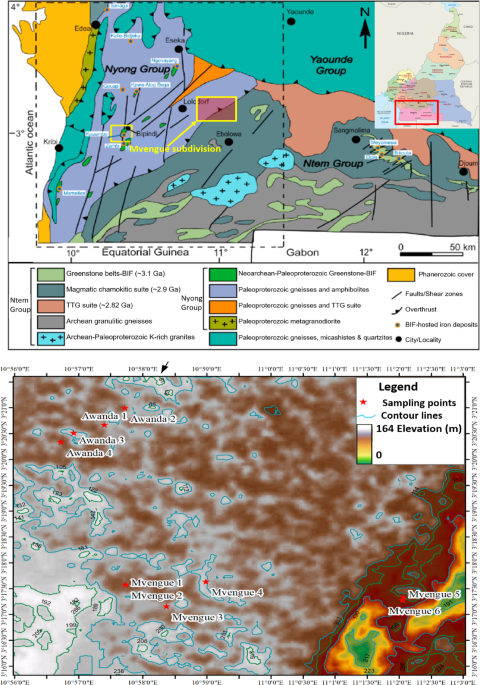
This study aimed to perform the elemental characterization of soil samples for heavy metal pollution and geological provenance close to the uranium deposit. The investigated area is located in two localities, Awanda and Mvengue, in the Mvengue Subdivision, Ocean Division, South Region of Cameroon. The elemental composition of soil samples was determined using an XEPOS EDXRF (Energy Dispersion X-ray Fluorescence) spectrometer. The Spectro XRF Analyzer Pro software interface was used for spectral acquisition and quantification. Soil elemental characterization and differentiation revealed the mass fractions of major, minor, and trace elements. SiO2 (49.81%) and Al2O3 (42.18%) were the predominant elements in all the soil samples investigated. The correlation between K₂O and Al2O3 illustrates that the mass fraction of K-bearing minerals has a notable impact on the distribution of Al. Herron’s classification of the analyzed soil samples displayed two different categories. Shale represented 70% of the analyzed materials, and Arkose made up the remaining 30%. By comparing the results with the well-established diagram for tectonic discrimination of geological provenance, the origin of the studied samples was determined to comprehend ongoing processes within the study area. It was apparent that all examined soil samples represented residual material from the passive margin. The findings of this study suggested that the examined and surrounding regions were shaped by erosion and weathering processes rather than tectonic activity.