
By: Chukwudi, Daniel, Phil, Eric W., Nicodemus, Peterson
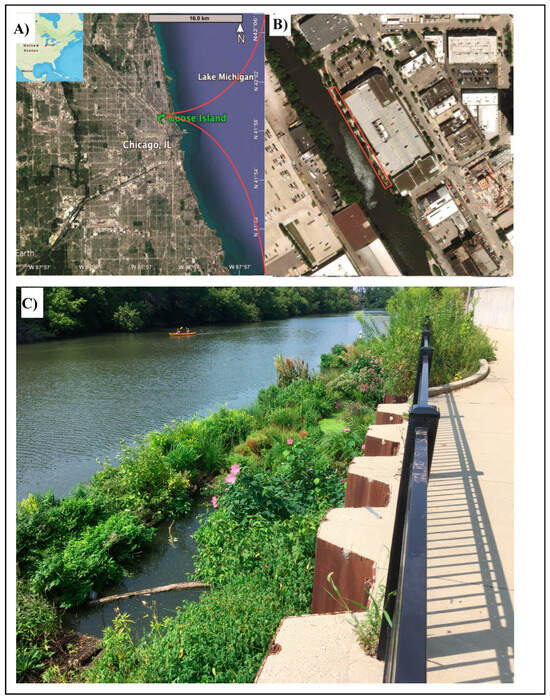
Urban streams often suffer from poor water quality, in part due to nutrient pollution, especially in highly developed areas. Poor water quality, driven by high concentrations of nitrate and phosphate entering waterways from runoff, wastewater, and stormwater systems, contributes to urban stream syndrome. This study evaluates the long-term performance of a floating wetland (FW) system installed in a canal of the North Branch of the Chicago River near Goose Island, an area heavily impacted by urban runoff. From 2018 to 2023, surface and subsurface water samples were collected upstream and downstream of a 90 m2 FW system and analyzed for nitrate as nitrogen (NO3-N) and phosphate (PO43−) using ion chromatography. A paired t-test and two-way ANOVA revealed statistically significant reductions (p < 0.001) in NO3-N (mean: 1.31 mg/L surface, 1.02 mg/L at 0.3 m) and PO43− (mean: 0.64 mg/L surface, 0.57 mg/L at 0.3 m) between waters entering and exiting the FW, with no significant seasonal differences in removal efficiency. These results highlight the FW’s consistent, year-round nutrient mitigation performance driven by plant uptake and microbial processes. Over the five-year period of the study, the FW served as a means of improving the water quality, delivering a sustainable, low-maintenance solution for urban stream management with broader implications for ecological resilience and water quality enhancement.