PR for AI Companies: What to Do (and Not Do)
- Home
- Intelligent Insights Blog
- PR for AI Companies: What to Do (and Not Do)

As AI becomes a dominant force in nearly every industry, the challenge for startups is no longer just building a strong product. It’s getting anyone to pay attention.
In Q3 2024, one in three venture capital dollars went to AI companies, a sign not only of the AI boom, but also of the rising competition for media attention.
What should you keep in mind when creating pitches and PR for AI companies and clients?
Not sure how to get your AI company to stand out from the rest?
We can help! As an AI PR company, we know how to do PR for AI companies. Book a call with one of our experts and we’ll help you refine your strategy to earn more media.
AI PR Fatigue
Some journalists will receive a hundred pitches or more in a typical week, and these days, many of those pitches will be about AI.
Startups love to talk about how they’re integrating AI tools in “groundbreaking” ways or producing an “innovative new AI solution.” It’s gotten to the point that a lot of journalists are rolling their eyes the minute they see AI in a headline.
The problem is, AI remains a central topic in newsrooms – which means ignoring it entirely isn’t a realistic option. The challenge is in how you frame your pitch.
Instead of focusing on products and features, align your outreach with what journalists are actually looking for: credible insights, relevant data, and timely perspectives on the larger world and AI’s place in it. Help journalists tell a stronger story.
Need help coming up with fresh ideas for AI PR? Our AI PR Industry Page tracks trends and updates to keep you on the cutting edge. Check it out: AI PR Industry Insights Resource
How to Make PR for AI Companies Stand Out
So how do you show journalists that you’re not just another startup pitching “10 ways our AI tool can improve your lives”?
1. Good PR for AI Companies Prioritizes Thought Leadership
First of all, you’ll already be ahead of 90% of the pitches in a journalist’s inbox if you focus on thought leadership rather than selling.
Thought leadership means you’re showing your expertise to answer questions, offer advice, and put the industry in perspective, as opposed to just shilling your product.
For example, journalists will usually be much happier to receive an email from an AI company with the subject line “How Maryland’s New Regulations Will Hurt AI Development” compared to “Why You Need AI Avatars.”
2. Show Why You’re the Right Spokesperson
Every pitch should include some kind of explanation for why you’re the right person/company to talk about the topic you’re proposing. Your differentiating factor can’t simply be that you run an AI company. Again, that’s an increasingly large field and no longer a distinction.
Some better differentiators might include:
- Time – Let’s say you have a couple decades of experience in AI development. You’ll likely have a lot to say about how it has changed over the years.
- Geographic Advantage – Particularly when you’re reaching out to local pubs, it can help you stand apart if your company operates in or understands a particular market. For example: “We have been addressing supply chain challenges in sub-Saharan Africa for the past 10 years.”
- Cultural Relevance – If you can share that your company is addressing something with well-known societal impact, like sustainability or misinformation, you may have a better chance of standing out.
Ultimately, show why journalists should talk to you over your competitor.
Not entirely sure what AI thought leadership should look like? Check out our dedicated guide: AI Thought Leadership: The Minds Shaping the Future [2024 Trends + Examples]
3. Make it Timely, Not Evergreen
I don’t know about you, but I’ve personally seen (and unfortunately sent) a number of pitches that could just as easily have been sent a year ago. This is called an evergreen pitch. “Why you should use AI in marketing,” for example, isn’t particularly timely, since companies have been using AI in marketing to different degrees ever since it became available.
That means most publications have already covered the topic extensively. Tie your idea to a current event or development to make things more interesting and timely.
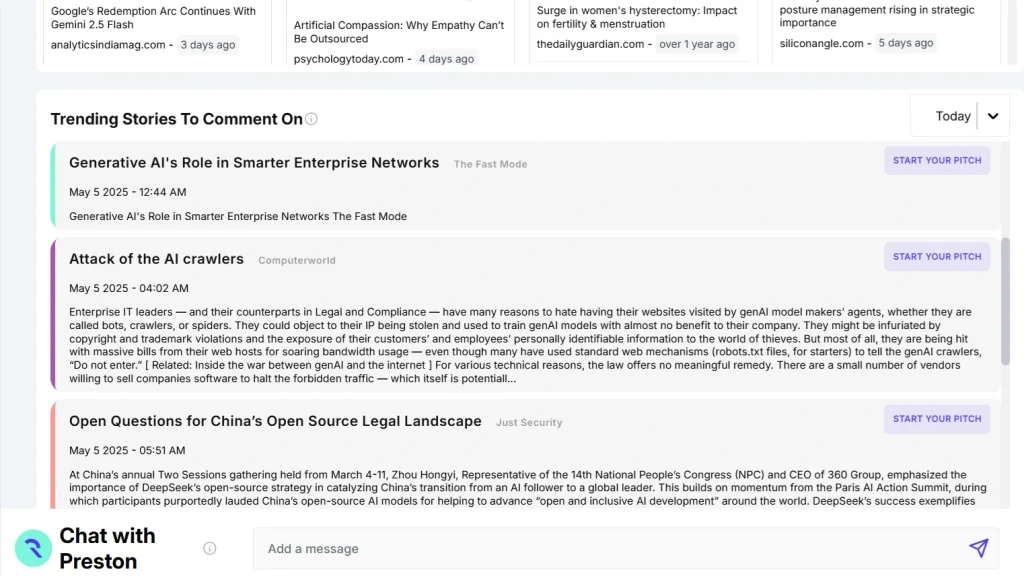
If there is a new report about AI in marketing, you can focus on one of the included statistics and say “based on [report], most marketers are using AI the wrong way.” Or if a big “AI in marketing fail” hits the news, you can use that for a pitch on how marketers can avoid similar embarrassing incidents. Our PR software, Preston, also pulls in articles with the latest AI insights so you can pitch directly on those trending stories.
4. Know Your Audience
In many cases, your pitches may not get picked up because you’re using the wrong topics for the wrong audience. Niche publications focused on technology or AI are more likely to accept technical, specific topics like “The role of edge AI in autonomous vehicles.”
High-tier publications like The New York Times would be more likely to respond to topics that are more of general interest and easier to understand.
Using a media database allows you to refine your search for journalists based on subtopics so you can get more specific with your contact lists when you need to.
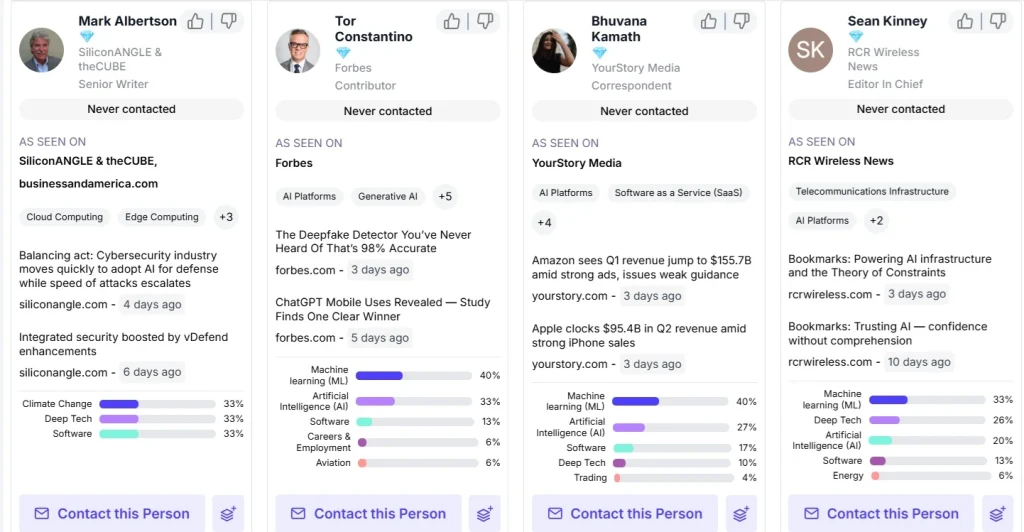
Not using a media database? Have one but don’t know if it’s the best for your needs? Check out our guide: Unlocking the Power of the PR Media Database: A Comprehensive Guide
5. Look at the Big Picture
Lastly, you may be missing out on opportunities by failing to acknowledge industry-wide trends and issues. Talking about how AI avatars are the next big thing is all very well and good, but if you don’t also acknowledge the potential challenges, the regulatory issues, and the larger societal implications, you’re missing a big part of what journalists want to cover.
If you would like to learn more about how to make the most of PR for AI companies, set up a free consultation with us. We’ll review your strategy and get you on the right track.
Why AI PR Pitches Fail
Now we’ve talked a bit about how to make your pitches more interesting, but what are some things that could still end up hurting your AI PR efforts?
One of the most prevalent issues at the moment is AI washing.
You may have heard of greenwashing, which refers to the practice of companies pretending to be more “green” and sustainable than they actually are. AI washing is similar in that it slaps the AI label on a product when AI isn’t actually central to the software or service’s functionality. For instance, companies that call themselves AI startups when they’ve merely integrated ChatGPT into their offerings are practicing a type of AI washing.
AI washing isn’t limited to PR. It shows up in marketing and every other aspect of outreach and brand positioning. However, PR pros that are representing clients or companies that call themselves AI companies should always be aware of the danger of stretching the truth. Always ask how the company is differentiating its AI from generic tools like ChatGPT. You don’t want journalists to accuse you of making claims you can’t back up.
Another common mistake in PR for AI companies is a lack of transparency. If your client runs a company that provides AI for sorting job applications, you should acknowledge that those kinds of platforms come with risks. Your client may not want to tackle the hard topics for thought leadership because of potential negative implications for the brand’s reputation, but the reality is that many journalists are going to be pursuing that angle anyway, whether you like it or not.
Instead, you should pitch topics that are related to complying with new regulations and addressing AI challenges and weaknesses, which often perform well with journalists and publications because they’re addressing real issues in the industry. They are timely, relevant, and often compelling to the intended audience. So don’t shy away from tough conversations.
Need some general tips on how to make a good pitch in 2025? Check out our thought leadership: 4 PR Pitching Tips for Pros to Land Better Media Coverage in 2025
Final Thoughts
The AI boom has created both opportunity and overload. With so many companies vying for attention, successful PR for AI companies isn’t just about getting coverage – it’s about demonstrating credibility, relevance, and awareness of the broader conversation. If your pitch doesn’t offer a clear perspective or timely insight, it won’t rise above the noise.
If you would like to learn more about how to reach AI journalists with the Preston media database, book a demo. We’ll also show you how Preston tailors pitch ideas to your needs.