
Beyond Impressions: PR Reporting That Boards and Investors Actually Want to See in 2026 [Example + Tips]
Quarterly board meeting incoming! Are you prepared? I mean, your slide deck is polished, and the leadership team is ready. So all good, right? Then comes the question every communications leader eventually faces: “So, what business impact did P...
- Home
- Intelligent Insights Blog
- Beyond Impressions: PR Reporting That Boards and Investors Actually Want to See in 2026 [Example + Tips]

Quarterly board meeting incoming! Are you prepared?
I mean, your slide deck is polished, and the leadership team is ready. So all good, right? Then comes the question every communications leader eventually faces:
“So, what business impact did PR actually have this quarter?”
But unlike many communications leaders, you’re not scrambling to defend a stack of impressions, media mentions, and coverage screenshots. Your team took a different approach — one focused on growth, efficiency, competitive positioning, and risk.
Rather than cheerleading every media win, you came armed with evidence of measurable business impact and a clear game plan for what comes next.
Because modern board-level PR reporting isn’t about documenting activity — it’s about demonstrating impact and helping leadership make better decisions.
In this guide, we’ll explore what boards and investors actually want to see, the KPIs that matter most, and how to build board-ready PR reports that connect communications performance to measurable business impact.
- Why Most PR Reporting Fails at the Board Level
- What Boards and Investors Actually Want to See
- The 3 Layers of PR Reporting
- Core Board-Level PR KPIs
- How to Structure an Executive PR Dashboard
- The Quarterly PR Reporting Model
- What to Exclude from Board Reports
- Common Reporting Mistakes
- Aligning PR Reporting with Business Objectives
Why Most PR Reporting Fails at the Board Level
The issue is almost never a lack of data — it’s a lack of relevance. Traditional reports are built to showcase activity, but boards and investors want business performance.
The result? PR teams waste hours compiling metrics that answer what they did while failing to answer whether or not it contributed to value creation.
The Legacy of Communications-Centric Reporting
For years, PR reporting has been centered around:
- How many media mentions were secured?
- How many impressions were generated?
- How many pitches were sent?
While these metrics are useful for managing campaigns and evaluating day-to-day execution, they were never meant to support executive decision-making.
They provide activity visibility without insight into real business impact.
This traditional PR reporting style often stems from an awareness and exposure evaluation era. But modern teams are increasingly expected to support broader business goals such as:
- Market Expansion
- Fundraising
- Talent Acquisition
- Revenue Growth
Reporting expectations must mature in relation to the organization.
Why Leadership Evaluates Performance Differently
Board members, investors, and operating partners bear the burdens of resource allocation resources and business performance evaluation. So naturally, they see communications through a different lens than PR teams.
They don’t look at how much activity occurred — they want to understand if PR actually impacted priority business outcomes.
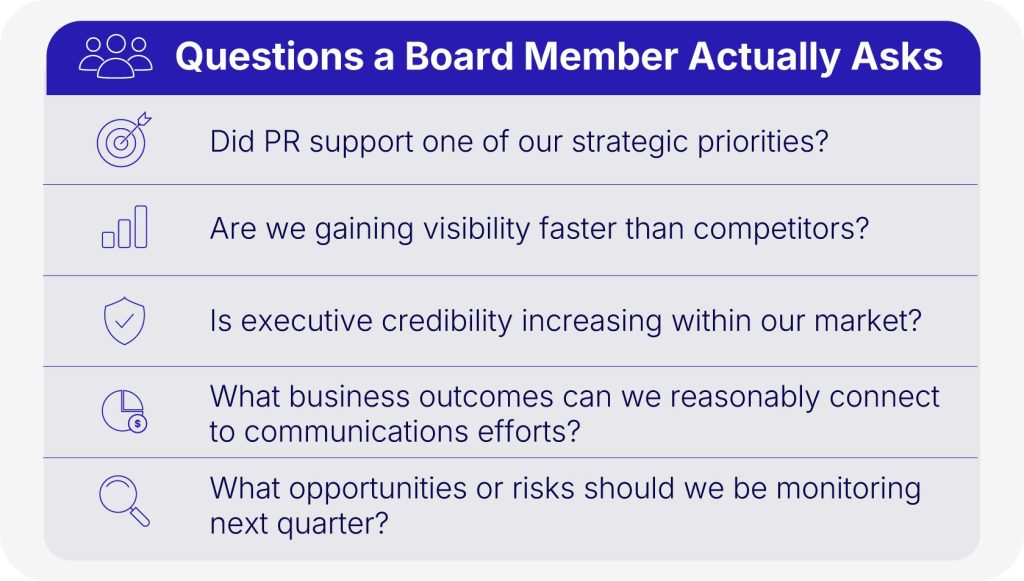
Common questions include:
- Did executive visibility increase within our target market?
- Are we gaining ground against competitors?
- Did PR support a strategic growth initiative?
- Is brand authority improving over time?
- Are communications investments becoming more efficient?
Example: Your operating partner is reviewing quarterly performance. Instead of how many media pitches were sent, they more interested in whether or not:
- Executive Visibility Increased
- SOV Improved
- PR Supported Growth
Though this distinction seems subtle, it’s important. Leadership never evaluates PR as a communications function alone — they evaluate it as a strategic investment.

The Reporting Disconnect
This different view leads to a common reporting disconnect.
- PR teams often report on activities and outputs because those metrics are easily tracked and readily available. “X number of this resulted in Y number of that.” But where’s the business impact?
- Leadership, meanwhile, is looking for actionable, decision-guiding insights about growth, investment, risk, and strategic priorities. “Did Y number of that directly influence an increase in sales? If so, keep doing X.” They want measurable business value.
The last thing you want is a report that’s all data and no context.
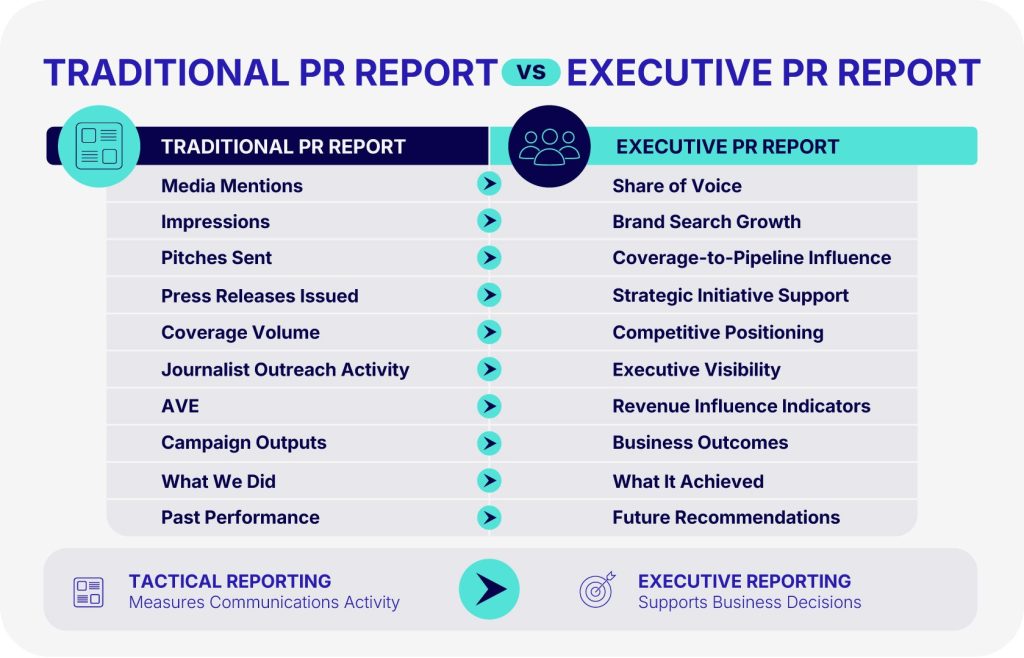
Consider two versions of the same quarterly update:
Version 1 (tactical):
- 125 media mentions
- 18 million impressions
- 4 press releases distributed
- 1,200 media pitches sent
Version 2 (executive):
- Executive SOV increased 22% quarter-over-quarter.
- Coverage supported a major product launch initiative.
- Earned media drove a measurable increase in branded search traffic.
- Tier 1 coverage outpaced key competitors.
- Recommendations identified for next quarter’s growth objectives.
While both reports contain valuable information, only Version 2 helps leadership understand what happened, why it matters, and what should happen next.
Board-level PR reporting isn’t about detailing every communications activity — It’s about converting PR performance into:
- Business Context
- Strategic Insights
- Informed Recommendations
Pro Tip: Before adding a metric to a board-level PR report, ask yourself if the information would influence a leadership decision. If the answer is no, it doesn’t belong in an executive dashboard.
For more on Earned Media ROI, read our guide: Earned Media Measurement: The Executive Playbook for PR ROI in 2026 [Examples + Tips]
What Boards and Investors Actually Want to See
A new world of metrics opens up as PR reporting moves beyond activity. Rather than a play-by-play of efforts, give boards and investors a clear understanding of how those efforts:
- Support Business Objectives
- Strengthen Market Position
- Contribute to Long-term Growth
Revenue Influence
Not many board members expect PR to operate as a direct-response channel with perfectly attributable revenue. But they do expect communications leaders to prove how earned media supports demand gen and commercial growth.
This means moving beyond media placements and considering signals such as:
- Branded Search Growth
- Referral Traffic from Earned Media
- High-intent Website Visits
- Pipeline Influence
- Sales Enablement Support
- Increased Visibility Among Target Buyers
You’re not trying to prove that one article generated a certain amount of revenue — you’re trying to show how PR adds value to a broader ecosystem that:
- Creates Demand
- Builds trust
- Accelerate Purchasing Decisions
Example: Your cybersecurity company earns coverage in several industry publications ahead of a major product launch.
Over the following quarter:
- Branded search volume increases.
- Direct traffic grows.
- Sales teams report prospects referencing recent media coverage during discovery calls.
While PR isn’t solely responsible for revenue generated, those placements indicate meaningful influence on buyer awareness and consideration.
Competitive Positioning
Leadership is majorly concerned with where their organization stands within the market.
Strong PR reporting answers key questions such as:
- Are we being included in industry conversations?
- Are competitors receiving more visibility?
- Are our key messages gaining traction?
- Is executive visibility improving over time?
Metrics that provide context around market position and category leadership include:
- SOV
- Executive Mentions
- Message Pull-through
- Tier 1 Media Coverage
For PE-backed companies and organizations pursuing aggressive growth strategies, competitive visibility is often on par with absolute visibility.
Example: A board review reveals that executive SOV increased from 18% to 27% over two quarters, while your largest competitor dropped 9 points. This signals improving category visibility and market authority — two key indicators leadership uses to evaluate competitive positioning.
Operational Efficiency
Executives don’t ask if PR is busy — they ask if it’s effective.
As budgets are scrutinized, leadership wants to be sure that resources are being allocated efficiently and producing meaningful outcomes.
Useful efficiency indicators include:
- Coverage-to-pitch Ratios
- Journalist Response Rates
- Cost per Earned Placement
- Coverage Quality Trends
- Performance Improvements Over Time
These metrics help leadership evaluate whether the communications function is becoming more predictable, scalable, and efficient.
Want to improve journalist response rates and budget more efficiently? Read our guides for more info:
Risk and Reputation Signals
A board’s responsibilities don’t end with growth. They also include protecting the organization’s reputation and reducing risk.
PR reporting plays an important role by tracking indicators such as:
- Media Sentiment Trends
- Narrative Consistency
- Executive Reputation
- Emerging Industry Issues
- Crisis Preparedness and Response Outcomes
While you won’t typically find these indicators on a revenue dashboard, they significantly influence:
- Investor Confidence
- Customer Trust
- Recruiting Efforts
- Long-term Enterprise Value
Strategic Initiative Support
One of the best ways to take PR reporting to the next level is to organize results around business priorities — not communications activities.
One of the best ways to take PR reporting to the next level is to organize results around business priorities — not communications activities.
Instead of reporting on X number of secured media placements, demonstrate how that coverage supported:
- A Product Launch
- Market Expansion Efforts
- Fundraising Initiatives
- Executive Thought Leadership Goals
- Recruitment Campaigns
- Category Creation Strategies
Example: Rather than reporting 40 earned media placements, your quarterly report shows that 75% of coverage supported a new market expansion initiative. This resulted in increased awareness among target buyers in a priority region.
This framing not only shows leadership what happened — it tells them how communications contributed to broader organizational objectives.
Ultimately, boards and investors want clarity over metrics. The most effective PR reports translate data into business context. This not only helps leadership understand where the organization stands today, it tells them what actions should come next.

The 3 Layers of PR Reporting
PR metrics serve different purposes. A major PR reporting mistake is presenting every metric to every audience.
Effective PR reporting operates in layers.
The info PR managers use to optimize outreach differs greatly from what a CMO, board member, or investor uses to evaluate business performance.
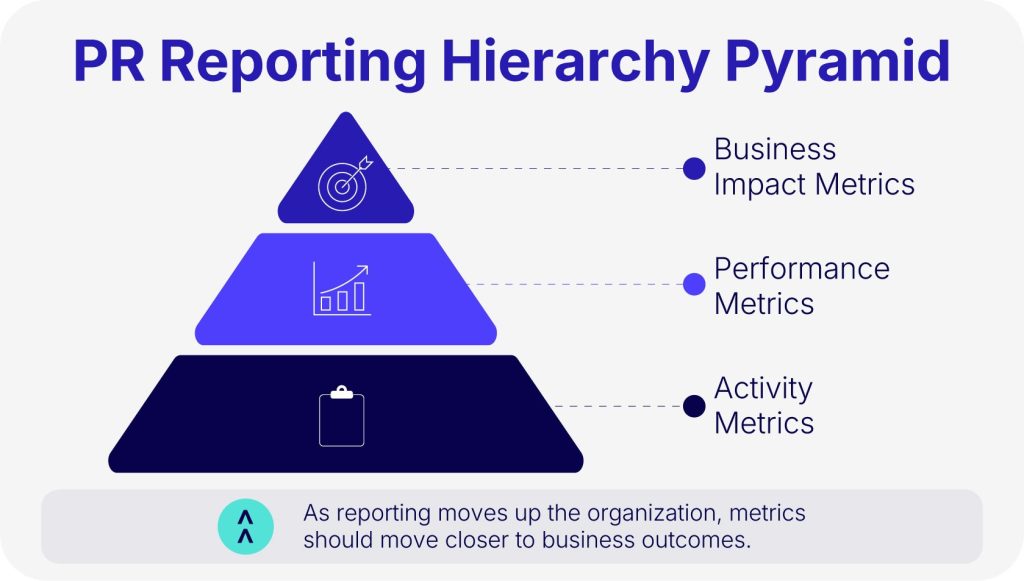
It’s easier to think about PR reporting through three distinct layers:
- Activity Metrics
- Performance Metrics
- Business Impact Metrics
Layer 1: Activity Metrics
Measuring effort is still necessary for operational management but activity metrics are rarely board material.
Common activity metrics:
- Media Pitches Sent
- Journalist Conversations
- Press Releases Distributed
- Media Lists Developed
- Follow-up Outreach Completed
- Briefings Scheduled
Their value lies in helping PR teams understand whether programs are being executed consistently and at sufficient scale. But activity metrics are limited in that they don’t measure outcomes.
Sending out thousands of pitches doesn’t mean a campaign was successful. Likewise, distributing multiple press releases doesn’t guarantee coverage or business value.
Example: If a PR manager notices that journalist response rates are declining despite consistent outreach, activity metrics help identify the operational issue.
- But they don’t explain the broader business impact.
Layer 2: Performance Metrics
Measuring outcomes generated by activity is important because it begins to answer questions about:
- Visibility
- Message Penetration
- Market Presence
Common performance metrics:
- Media Coverage Volume
- Tier 1 Placements
- SOV
- Executive Mentions
- Message Pull-through
- Media Sentiment
- Audience Engagement
Beyond effort, performance metrics show if communications activities are actually producing meaningful results.
Use these metrics to answer key questions like:
- Is messaging resonating?
- Are media relationships strengthening?
- Is competitive visibility improving?
Example: Your software company secures fewer placements than the previous quarter but significantly increases Tier 1 media coverage and executive visibility.
- Despite lower coverage volume, performance metrics reveal that quality and strategic value improved.
Layer 3: Business Impact Metrics
Measuring organizational value by connecting performance to broader business objectives is what boards, investors, executive teams, and PE operating partners care about most.
While PR should never overstate attribution, it should demonstrate its influence through several measurable business indicators.
Examples include:
- Pipeline Influence
- Brand Search Growth
- Earned Media Referral Traffic
- Sales Enablement Impact
- Competitive Market Position
- Investor Visibility
- Talent Attraction Indicators
- Reputation Strength
These metrics answer how communications is supporting business growth and strategic priorities — which is what leadership ultimately wants to know.
Instead of only reporting on media coverage, demonstrate how visibility contributes to:
- Demand Gen
- Market Authority
- Recruitment Efforts
- Fundraising Initiatives
- Expansion Goals
Example: After a major thought leadership campaign, your company experiences a rise in branded search traffic, stronger executive visibility, and a measurable increase in prospects mentioning recent media coverage during sales conversations.
- Though PR can’t claim sole ownership of revenue outcomes, it has demonstrated meaningful influence on buyer awareness and consideration.
Why the 3 Layers Matter
The most effective PR reporting programs don’t discard activity or performance metrics — they just put them in the right place.
Think of the three layers as a progression:
- Activity Metrics: What did we do?
- Performance Metrics: What happened?
- Business Impact Metrics: Why did it matter?
If you report exclusively on activity, you’ll struggle to demonstrate value. But if you report only on business outcomes, you’ll lack visibility into what’s driving results.
The best executive reporting frameworks take advantage of the PR reporting trifecta — connect all three layers while emphasizing the metrics most relevant to the audience receiving the report.
Key Takeaway:
- Activity creates performance.
- Performance creates business impact.
- Board-level reporting shows how those layers connect.
Pro Tip: Don’t remove activity metrics from your reporting — reposition them. Use activity metrics for operational management, performance metrics for communications leadership, and business impact metrics for executive and board-level discussions.
A PR efficiency audit helps determine whether your reporting aligns with executive and board-level expectations. Learn more here: The PR Audit Guide: A Step-by-Step Framework for High-Performance Teams
Core Board-Level PR KPIs
After locking in a solid reporting framework, the next step is to prioritize KPIs. You don’t want to bury leadership in a flurry of metrics. Just focus on a clear set of the most important indicators:
- Visibility
- Competitive Position
- Operational Efficiency
- Business Impact
Remember, you’re not reporting everything. Stick to what informs high-level decision-making.
Board-Level PR KPIs
| KPI | Why It Matters to Leadership | Reporting Cadence |
| SOV | Competitive position | Quarterly |
| Tier 1 Coverage | Market credibility | Monthly/Quarterly |
| Executive Visibility | Leadership authority | Quarterly |
| Brand Search Growth | Demand signal | Quarterly |
| Referral Traffic | Audience engagement | Monthly |
| Pipeline Influenced | Revenue alignment | Quarterly |
| Earned Backlinks | SEO authority | Monthly |
| Message Pull-Through | Narrative control | Quarterly |
| Sentiment Trends | Reputation health | Quarterly |
| Cost Efficiency Metrics | Resource optimization | Quarterly |
Why No Single KPI Tells the Full Story
Boards want simplicity. They also understand that there’s no magic metric that encapsulates the total value of a PR program.
Example: A surge in Tier 1 media coverage may strengthen credibility, but if there’s no measurable increase in executive visibility or branded search growth, questions about whether or not that visibility is translating into broader business value.
Likewise, referral traffic alone doesn’t reveal if coverage reached the right audience or reinforced strategic messaging.
The most effective board-ready reports balance the most relevant KPIs, all working together to paint a more comprehensive picture of communications performance.
Focus on KPI Trends, Not Snapshots
Generally speaking, leadership is more interested in long-term performance than isolated monthly numbers.
So whenever possible, report key KPIs alongside:
- Historical Trends
- Benchmarks
- Competitive Comparisons
Example: Instead of stating that executive visibility increased by 15%, provide additional context:
- Executive visibility increased by 15% quarter-over-quarter while SOV surpassed the company’s two closest competitors for the first time this year.
This additional context transforms a standalone metric into an actionable business insight.
Tie Every KPI Back to a Strategic Objective
Every KPI included in a board report should answer a business question.
For example:
- SOV: Are we strengthening our competitive position?
- Pipeline Influence: Is communications supporting demand generation?
- Executive Visibility: Are company leaders becoming trusted industry voices?
- Brand Search Growth: Is market awareness increasing?
- Media Sentiment: Are we protecting and enhancing our reputation?
If your KPIs aren’t helping to explain progress toward a strategic objective, they likely belong in an operational report — not a board presentation.

Pro Tip: Limit your board dashboard to the KPIs leadership can act on. A focused report with meaningful context is far more valuable than dozens of disconnected metrics.
For a deeper dive into selecting and tracking the metrics that matter most, check out our guide: 10 Best PR Metrics to Measure for Increased Success
How to Structure an Executive PR Dashboard
The last thing you want to do is overload leadership with data. The goal is to clearly reveal performance at a glance.
It’s all about clarity over complexity.
Only surface the insights executives need to:
- Evaluate Performance
- Identify Trends
- Make Informed Business Decisions
Your dashboard isn’t just a spreadsheet — it tells a story. Every section should answer a specific leadership question.
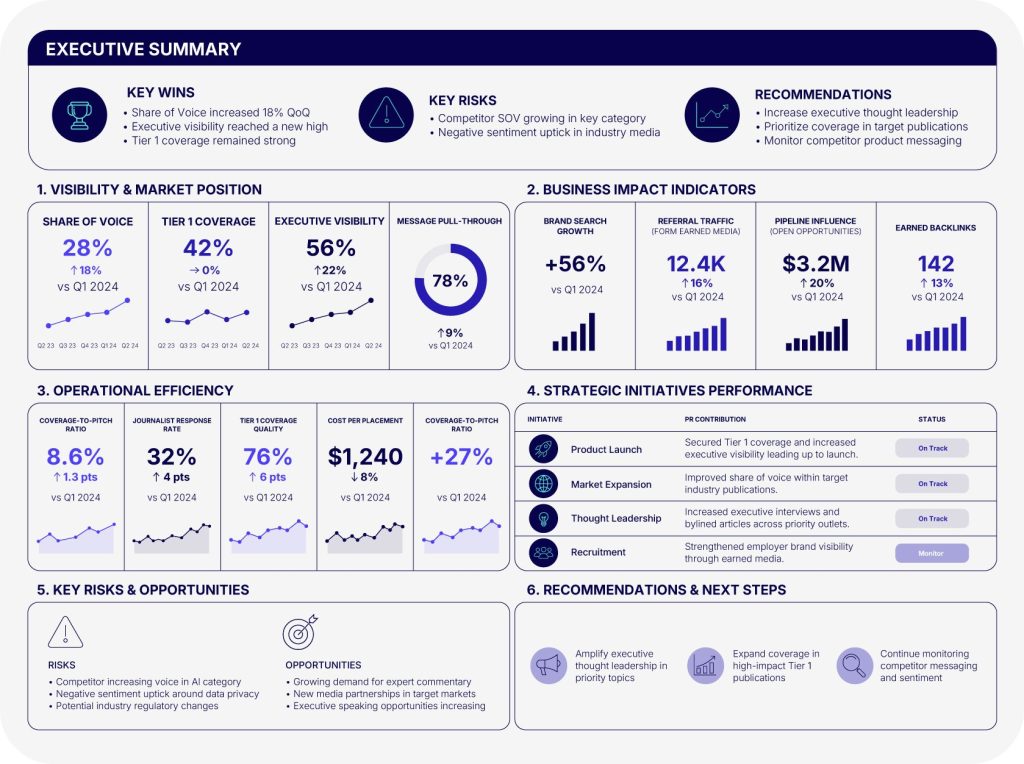
Section 1: Executive Summary
Start with a concise overview of the reporting period. Executives are most likely to read this section first, so focus on the highlights instead of every single supporting metric.
Include things like:
- Top Achievements
- Strategic Wins
- Emerging Risks
- Key Recommendations for Next Quarter
Your aim here is to answer one simple question: “What do leadership and the board need to know in the next two minutes?”
Section 2: Visibility Metrics
In this section, provide a snapshot of your organization’s presence within the market.
Focus on:
- SOV
- Tier 1 Media Coverage
- Executive Visibility
- Message Pull-through
- Competitive Comparisons
This is where leadership should clearly understand if the company’s visibility and authority are improving relative to competitors.
Example: Executive SOV increased 18% quarter-over-quarter, surpassing two primary competitors while Tier 1 coverage remained consistent.
Section 3: Business Impact Indicators
Now that visibility has been established, it’s time to connect communications performance to broader business objectives.
Relevant indicators may include:
- Brand Search Growth
- Referral Traffic from Earned Media
- Pipeline Influence
- Sales Enablement Support
- Earned Backlinks
- Investor Visibility
Don’t try to claim direct attribution. It’s often unrealistic, and most executives don’t expect it as long as you show how PR influenced:
- Awareness
- Credibility
- Commercial Outcomes
Section 4: Efficiency Metrics
Executives especially want to know that communications resources are being allocated effectively.
Consider including metrics such as:
- Coverage-to-Pitch Ratio
- Journalist Response Rates
- Coverage Quality Trends
- Cost Efficiency
- Quarter-over-Quarter Performance Improvements
Over time, these metrics show if the communications function is improving predictability, scalability, and efficiency.
Section 5: Strategic Initiatives
Finish your dashboard by organizing results around the top-priority business objectives.
Example:
| Strategic Initiative | PR Contribution |
| Product Launch | Secured Tier 1 coverage and increased executive visibility leading up to launch. |
| Market Expansion | Improved SOV within target industry publications. |
| Thought Leadership | Increased executive interviews and bylined articles across priority media outlets. |
| Recruitment | Strengthened employer brand visibility through earned media. |
This moves the conversation from activity to strategic business support.
Pro Tip: Design your dashboard for busy executives. If leadership doesn’t understand the key takeaways in fewer than five minutes, simplify the report and elevate the insights that drive decision-making.
Looking to streamline recurring reporting? Preston helps surface executive-ready insights and reduce the time spent compiling quarterly reports: Meet Preston: the 2026 AI PR agent that runs your entire campaign
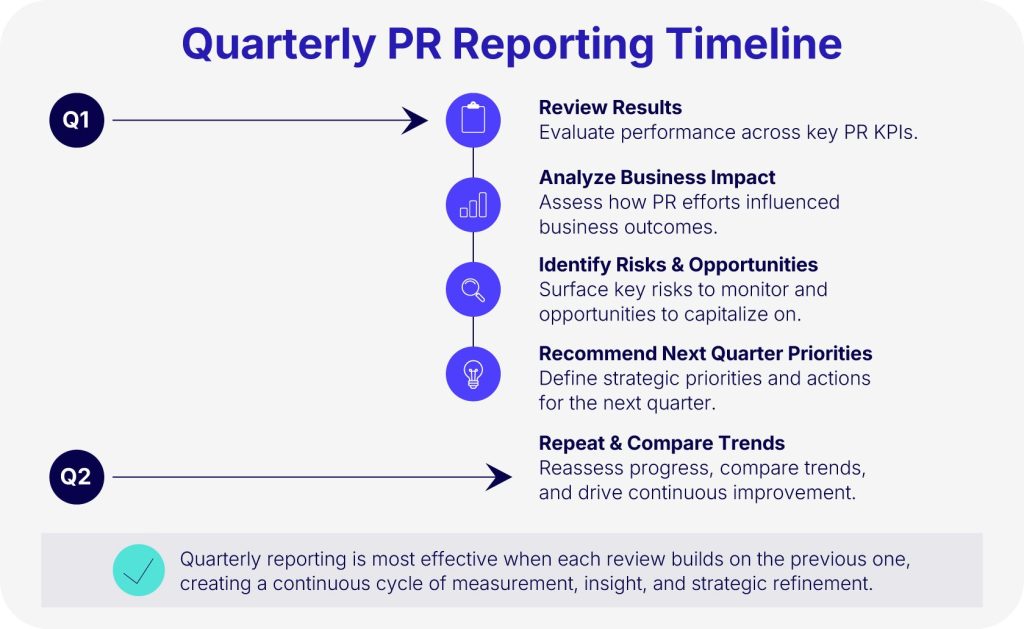
The Quarterly PR Reporting Model
Simply choosing the right metrics won’t make a board-level PR report great. You need to deliver them the right way and at the right time.
Monitoring performance weekly or monthly is fine for communications teams, but boards and investors are typically looking for:
- Meaningful Trends
- Strategic Insights
- Forward-looking Recommendations
That’s why quarterly reports are the gold standard for executive PR reporting.
Why Monthly Reporting Often Creates More Noise Thank Insight
Monthly reports are great for:
- Managing Campaigns
- Optimizing Media Outreach
- Identifying Short-term Performance Trends
But it’s really not enough time for strategic initiatives to reveal measurable business impact.
Quarterly reporting lets leadership evaluate:
- Progress Toward Strategic Objectives
- Changes in Competitive Positioning
- Trends in Executive Visibility
- Improvements in Operational Efficiency
- Emerging Opportunities and Risks
This helps them focus on more important patterns that influence decisions rather than month-to-month fluctuations.
Recommended Quarterly Reporting Cadence
Different stakeholders require different levels of reporting. Tailor the reporting cadence to each audience to ensure the right information gets to the right people — at the right time.
| Audience | Reporting Frequency | Primary Focus |
| PR Team | Weekly | Campaign execution, outreach activity, media opportunities |
| Communications Leadership | Monthly | Performance trends, campaign optimization, resource allocation |
| Executive Team | Quarterly | Business impact, competitive positioning, strategic initiatives |
| Boards and Investors | Quarterly | Growth, efficiency, risk, and long-term communications performance |
This structure equips communications teams the data needed for incremental optimization without overloading executives with operational details.
A Simple Quarterly Reporting Framework
Keep is short and actionable. Organize each quarterly review into a consistent structure so leadership can quickly identify:
- Progress
- Challenges
- Next Steps
A simple framework includes:
- Executive Summary: Key wins, significant developments, and emerging risks.
- Business Impact: Brand search growth, pipeline influence, referral traffic, and executive visibility..
- Competitive Position: SOV, tier 1 coverage, and message pull-through.
- Operational Performance: Coverage efficiency, journalist response rates, resource use.
- Recommendations: Priorities for next quarter, risks to monitor, and potential opportunities.
Focus on Trends, Not Isolated Wins
Boards want to know if communications performance is improving over time — not whether PR had a great month.
Whenever possible, compare results against:
- The Previous Quarter
- Year-over-Year Performance
- Strategic Goals
- Key Competitors
- Industry Benchmarks
Trend analysis gives leadership the context they need to determine if PR is actually building sustainable momentum or just experiencing short-term spikes.
Example: Instead of reporting that executive visibility increased by 15% in July, show that executive visibility has grown consistently over the past four quarters while SOV has continuously outpaced the company’s closest competitors.

Pro Tip: Create a standardized quarterly reporting template and use it consistently. Over time, consistent reporting makes it easier for executives to spot trends, measure progress, and evaluate PR’s contribution to long-term business goals.
Looking to build a more repeatable reporting process? Read our guide: How to Write an Effective PR Plan [Tips + Examples]
What to Exclude from Board Reports
Knowing what to leave out a board-level report is just as important as knowing what to leave in. Operational metrics are important to optimizing PR performance, but they rarely help leadership evaluate real business progress.
A board report needs to favor strategic insights over tactical details to give boards and investors a clearer picture of PR performance without unnecessary distractions.
Excessive Activity Reporting
Boards don’t want a play-by-play of every task completed during the reporting period.
Avoid emphasizing quantities of:
- Pitches Sent
- Follow-up Emails
- Press Releases Distributed
- Media Lists Created
- Journalist Outreach
- Internal Meetings
These metrics are useful for managing day-to-day execution, but they lack business outcomes and strategic impact context.
Vanity Metrics Without Context
Large numbers seem impressive, but do they always tell a meaningful story? The answer is no.
Metrics that should never stand on their own include:
- Total Impressions
- Raw Media Mentions
- AVE
- Social Shares (without business relevance)
Instead, explain what those metrics contributed to growth.
- Did increased visibility improve SOV?
- Did high-authority coverage support a product launch?
- Did earned media drive branded search growth?
Context — not scale — is what matters most to leadership.
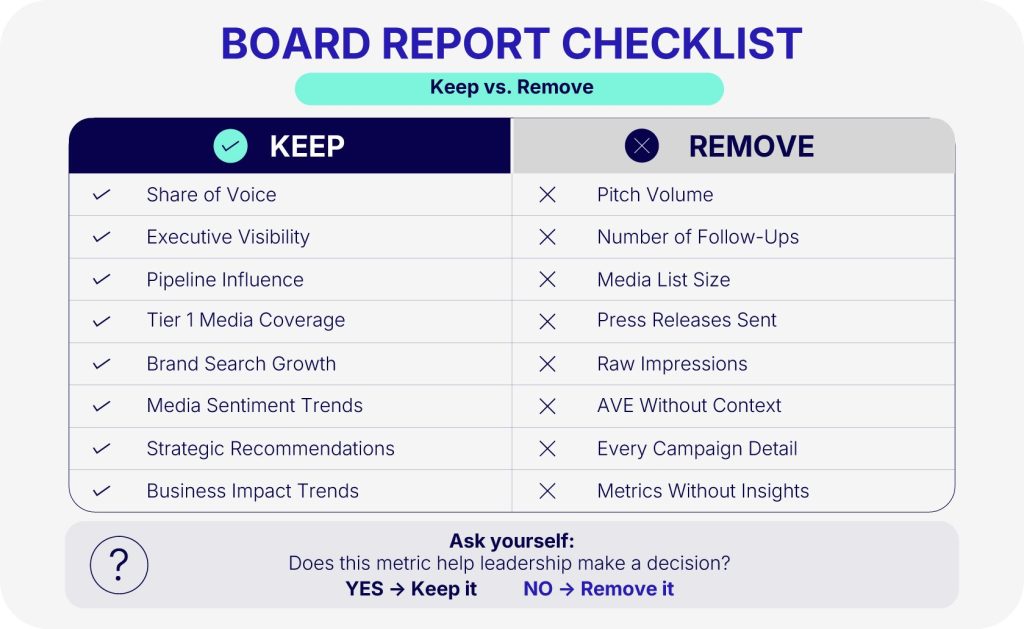
Every Campaign Detail
A board-level report isn’t a campaign recap.
Leadership doesn’t want or need an exhaustive recounting of every media placement, interview, or announcement from the quarter. Instead, sum up how communications supported broader business priorities.
If Shakespeare had been a PR pro, perhaps he would’ve penned, “Brevity is the soul of solid board-level reporting.”
Example: Rather than listing every article secured during a product launch, explain how earned media increased executive visibility, strengthened competitive positioning, or supported demand generation around the launch.
Technical PR Jargon
It’s also important to remember that not every board member has a background in communications.
Avoid filling reports with overly technical industry jargon or rattling of a series of unexplained acronyms that require additional interpretation.
Example:
- Don’t say, “Message pull-through improved while AVE increased significantly.”
- Do say, “Media coverage more consistently reflected our key messaging, while coverage quality and visibility improved compared to last quarter.”
Simple, business-focused language gets to the point and makes reporting more accessible and actionable.
Data Without Recommendations
Possibly the biggest missed opportunity in board-level reporting is wrapping up with metrics alone. Executives are looking for guidance — not just an update on performance.
Every report should end with clear recommendations, such as:
- Double down on executive thought leadership in priority publications.
- Expand media outreach to support upcoming market expansion.
- Address declining share of voice in a key industry segment.
- Monitor emerging reputation risks over the next quarter.
If a metric doesn’t help leadership understand performance, make a decision, or set priorities, it probably doesn’t belong in a board report.
Pro Tip: Before finalizing your report, remove any metric that requires lengthy explanation but doesn’t support a strategic decision. The clearest board reports are often the most concise.
For additional guidance on choosing high-impact KPIs, explore our guide: 10 Key PR Metrics You Must Measure to Gauge Success
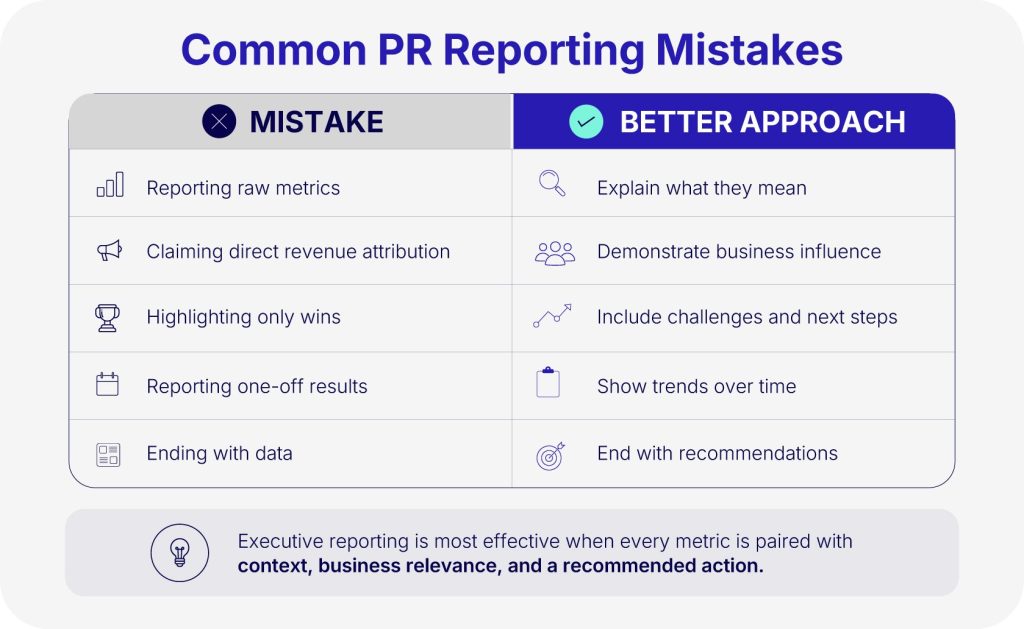
Common Reporting Mistakes
Even the most experienced teams fall into bad reporting habits that make it hard for executives to see the true strategic value of PR. Fortunately, these mistakes aren’t from weak performance — they’re from presenting the right information in the wrong way.
Avoid these common pitfalls early to build reports that:
- Inspire confidence.
- Support better decision-making.
- Demonstrate how communications supports broader business objectives.
Reporting Metrics Without Context
An out-of-context metric doesn’t provide decision-making insights.
Example: Reporting that executive visibility increased by 24% is helpful — but if you explain that it outpaced key competitors while supporting a product launch, you provide leadership with actionable business context.
Whenever possible, accompany metrics with:
- Historical Comparisons
- Competitive Benchmarks
- Business Objectives
- Key Takeaways
In a garden of numbers, watering with context makes insights bloom.
Overstating PR Attribution
Boards know that growth is influenced by many factors, including:
- Marketing
- Sales
- Product Development
- Market Conditions
Avoid claiming that a single placement directly generated revenue or closed a deal unless there is undeniable attribution to prove it.
It’s better to position PR as a key contributor to outcomes such as:
- Buyer Awareness
- Brand Credibility
- Sales Enablement
- Executive Thought Leadership
- Demand Gen
This creates a balance that builds credibility and trust with leadership.
Focusing Only on Success
Your board report also shouldn’t read like a pat on the back or victory lap.
Executives want transparency, especially when challenges are coupled with a thoughtful plan of action.
Example: If SOV dropped in a priority market, you need to answer:
- What changed?
- Why did it happen?
- What are the next steps?
Honest reporting is a pillar of strategic maturity, and it positions PR as a proactive business partner.
Ignoring Trends Over Time
Having one great quarter rarely tells the whole story.
Leadership wants sustained progress more than isolated wins. That’s why reports should stress quarter-over-quarter and year-over-year trends whenever possible.
Show consistent improvements in:
- Executive Visibility
- Message Pull-through
- Media Sentiment
This carries more weight than rallying around a single successful campaign.
Ending Without Recommendations
Ending with data only is one of the most overlooked reporting mistakes.
Strong board reports explain way more than what happened — they recommend what should happen next.
End each report with actionable guidance:
- Increase executive thought leadership around an emerging industry trend.
- Expand outreach in regions where share of voice is declining.
- Prioritize Tier 1 publications ahead of an upcoming product launch.
- Monitor a developing reputation issue before it escalates.
This takes board reporting from a myopic historical recap to a strategic decision-making tool.
Pro Tip: If your report doesn’t help executives make better business decisions, refine the insight — not just the metric.
Find more resources on PR mistakes to avoid here:
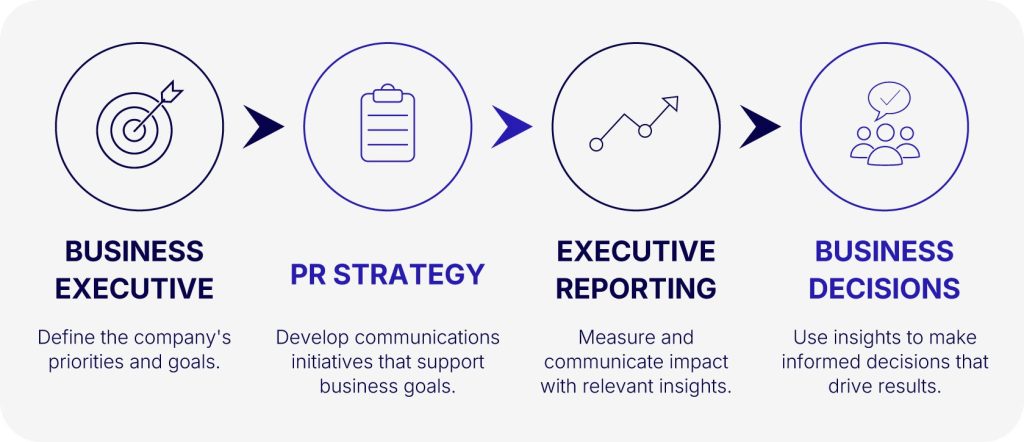
Aligning PR Reporting with Business Objectives
How do you ensure your PR reporting consistently demonstrates business value?
Start with business priorities — not metrics. When you tie every KPI to a strategic objective, leadership quickly understands how PR:
- Contributes to Growth
- Strengthens Competitive Positioning
- Supports Better Decision-making.
So you’re not asking what PR accomplished this quarter — you’re asking which business objectives it helped advance.
Start with Business Goals, Not PR Activities
Before choosing key metrics, pin down your organization’s top initiatives for the reporting period.
These may include:
- Accelerating Revenue Growth
- Launching a New Product or Service
- Expanding into New Markets
- Strengthening Executive Thought Leadership
- Increasing Competitive Market Share
- Supporting Fundraising or Investor Confidence
- Enhancing Employer Brand and Recruitment
Once these objectives are clearly defined, select KPIs that best demonstrate how PR contributed to each initiative.
Organize Reports Around Business Outcomes
Reports should be organized around objectives rather than campaigns or media activity.
| Business Objective | How PR Supported It |
| Increase market awareness | Improved Share of Voice and secured Tier 1 media coverage. |
| Support product launch | Generated executive interviews and launch-focused earned media. |
| Expand into new market | Increased visibility in regional and industry publications. |
| Strengthen investor confidence | Elevated executive thought leadership and maintained positive media sentiment. |
This format helps leadership more effectively evaluate PR through the same lens they view all other business functions.
Collaborate Across the Organization
Board-level reporting is a collaborative creation. Draw from other departments to add meaningful business context to your reports.
Example:
- Marketing provides brand search trends and website engagement data.
- Sales shares examples of earned media supporting prospect conversations.
- Investor Relations identifies messaging priorities for shareholders and analysts.
- Executive Leadership clarifies the strategic initiatives that should guide communications efforts.
This cross-functional collaboration makes your reporting more credible, actionable, and aligned with organizational priorities.
End Every Report with Actionable Recommendations
Never end a board report with charts and metrics.
Finish strong by answering the most important question:
- “Based on these results, what should we do next?”
Clear subsequent action transforms PR reporting from a retrospective briefing to a strategic planning blueprint.
Pro Tip: Before adding a KPI to your next board report, ask which business objective it supports. If you can’t answer that question clearly, reconsider whether the metric belongs in an executive presentation.
Strong reporting starts with a strong strategy. Learn how our Modern Earned Media Strategy Guide helps enterprise B2B tech brands align communications initiatives with measurable business growth.
PR Reporting Should Inform Decisions, Not Just Measure Activity
Board-level PR reporting isn’t an exercise in proving how busy communications was — it’s about providing leadership with the information they need to make the most informed decisions. When strategic objectives take precedence over vanity metrics, your PR reports connect PR activity to measurable outcomes and lay out a data-backed game plan for what’s next.
Whether you’re reporting to a board of directors, an executive team, or PE-backed leadership, your goals remain the same:
- Deliver meaningful insights that demonstrate how communications supports growth.
- Strengthen competitive positioning.
- Help manage risk.
If your current reports still lean into activity more than impact, it’s time for a new approach. Intelligent Relations helps enterprise communications teams build board-ready reporting frameworks that deliver:
- Greater Clarity
- Stronger ROI Narratives
- Actionable Insights
Schedule a Board-Level PR Reporting Consultation today to transform your communications data into executive-ready business intelligence.