Fewer Emails, Better Journalist Response Rates: Why Precision Media Outreach Outperforms Mass Pitching [Examples + Tips]
Feeling ignored? Every PR pro experiences periods of snubbery and stonewalling from journalists. But never because they’re not pitching enough. In fact, the leading cause of journalist neglect is adding to the deluge of their already-fl...
- Home
- Intelligent Insights Blog
- Fewer Emails, Better Journalist Response Rates: Why Precision Media Outreach Outperforms Mass Pitching [Examples + Tips]

Feeling ignored? Every PR pro experiences periods of snubbery and stonewalling from journalists.
But never because they’re not pitching enough.
In fact, the leading cause of journalist neglect is adding to the deluge of their already-flooded inboxes with another generic drop in the bucket. You become that annoying, repetitious kid chanting, “Mom, mom, mom.” The mother loves her kid (probably), but that incessancy is irritating — no matter the relation.
For B2B brands, improving your journalist response rate requires an overhaul of traditional outreach approaches.
The answer isn’t more pitches — it’s a more efficient and focussed communications strategy:
- Target the most relevant journalists.
- Align with active industry narratives.
- Use timing as a core tactic.
- Deliver genuinely useful story angles.
In this guide, we’ll dissect key influences of media pitch response rates, and demonstrate how to audit your current outreach performance. You’ll come away with practical optimization strategies to increase engagement without increasing outreach volume.
- What is a Journalist Response Rate?
- Why Most Media Pitches Get Ignored
- 7 Factors that Influence Journalist Response Rates
- How to Optimize Outreach with Data
- 6 Steps to Audit Your Current Response Rate
- Sample Pitch Breakdown
- 6 Ways to Improve Journalist Response Rates
- Enterprise Outreach Best Practices
- Common Outreach Mistakes
- How to Build Journalist Relationships that Last
What is a Journalist Response Rate?
This important metric measures the percentage of outreach emails that actually get noticed by media contacts. It’s one of the clearest indicators that your outreach efforts are resonating with the people you’re targeting.
You need to know if journalists are engaging with your pitches — or ignoring them. Journalist response rate answers this important question.
Here’s the formula: Journalist Response Rate = Responses ReceivedTotal Pitches Sent ×100
For example, your team sends 200 pitches and gets 24 replies. That’s a 12% journalist response rate. But not all responses carry the same value.
You need to track multiple engagement layers:
- Overall Response Rate: Any journalist reply.
- Positive Response Rate: Replies expressing interest, requests for interviews, or follow-up questions.
- Coverage Conversion Rate: Outreach that ultimately results in earned media placements.
- Follow-up Response Rate: Replies generated after secondary outreach attempts.
Why it Matters
This distinction is important because email activity alone isn’t indicative of effective earned media outreach. If your campaign is generating polite declines, you need to make immediate narrative and targeting adjustments.
PR managers and communications leaders must use journalist engagement metrics as operational performance indicators.
This helps to identify issues rooted in:
- Story Relevance
- Audience Fit
- Timing
- Segmentation
- Outreach Quality
But mainly, these metrics create a measurable framework for boosting pitch performance over time rather than crutching on guesswork.
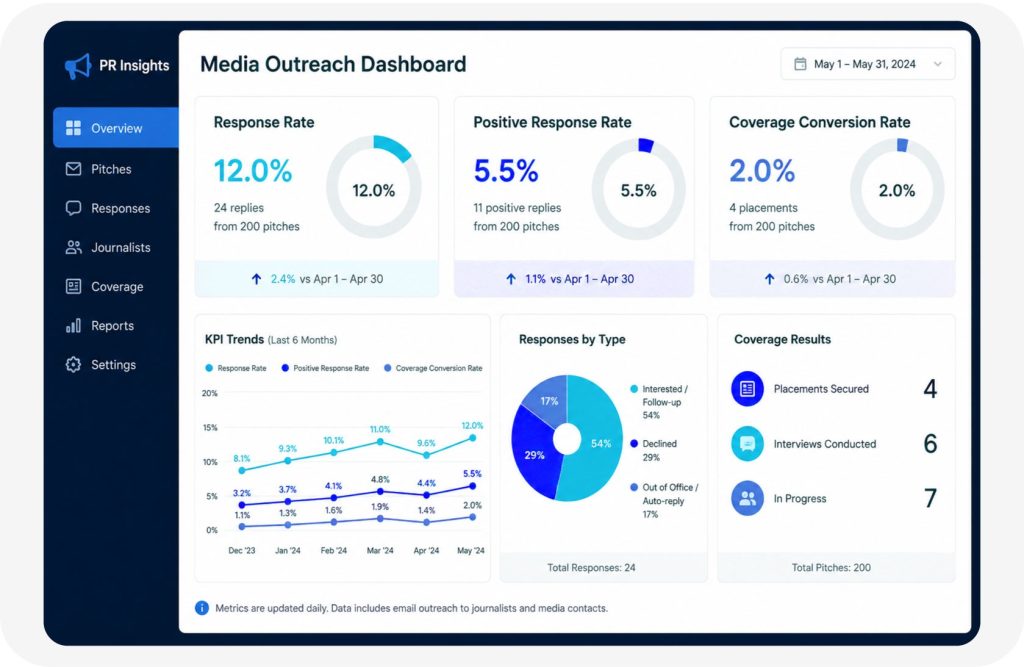
Pro Tip: Track positive responses separately from total replies. A smaller number of high-intent journalist engagements is far more valuable than a large volume of neutral or dismissive responses.
For more key metrics you need to measure, read our guide: 10 Key PR Metrics You Must Measure to Gauge Success
Why Most Media Pitches Get Ignored
Journalists are value-sensitive and time-conscious. That’s why they open less than half of the emails they receive.
They don’t want to trash your emails, but they’re averse to irrelevance and editorial misalignment.
Inbox volume only increases attention selectivity in highly competitive media environments. Reporters, editors, and producers scan a staggering amount of pitches every day with a sort of Spidey sense for stories that feel timely, credible, and directly connected to their beat.
It’s relevance and alignment over volume — every time.
Top 5 Causes of Low Engagement
Here are the top five reasons journalists ignore your pitches:
1. Weak Story-Narrative Alignment
One of the most common outreach errors is pitching based on publication name rather than actual editorial focus.
Example:
- A cybersecurity reporter receives a generic SaaS funding announcement.
- A healthcare editor gets a broad AI product launch.
- A business journalist receives a highly technical feature update with no market implications.
Even major brands get ignored when the story doesn’t align with a journalist’s active coverage themes. The best strategies place narrative fit above all else.
2. No Clear News Angle
A lot of pitch emails describe what the company is doing but not why it matters now.
Journalists are interested in:
- Emerging Trends
- Contrarian Insights
- Industry Impact
- Proprietary Data
- Market Shifts
- Audience Relevance
A basic product launch or milestone announcement without contextual significance feels more promotional than editorially useful.
Weak example: “We’re excited to announce our new platform update.”
Stronger example: “New customer data shows enterprise AI compliance concerns have overtaken automation priorities in 2026 buying decisions.”
- This stronger version immediately introduces timeliness, industry context, and broader relevance.
3. Mass-produced Outreach
Journalists smell generic, templated outreach right away.
Common warning signs include:
- Basic Introductions
- Surface-level Personalization
- Irrelevant Examples
- Overly Broad Messaging
- Obviously Automated Formatting
While mass-blasting large media lists increases send volume, it also:
- Reduces Trust
- Damages Future Engagement
- Lowers Overall Journalist Response Rates Over Time
Effective earned media outreach prioritizes precision and credibility over sheer activity levels.
4. Bad Timing
Even highly relevant stories fail if the timing is off.
To avoid bad timing:
- Don’t itch during major breaking-news cycles.
- Don’t send reactive commentary too late.
- Don’t ignore publication schedules.
- Don’t reach out after a trend has already peaked.
Strong media outreach optimization hinges heavily on timing intelligence. The most effective PR teams closely monitor industry momentum and align pitches with active narrative windows rather than static campaign calendars.
5. Chore-laden Pitches
Some PR pitches leave reporters with little more than a headache. Journalists exist in continuous time crunches. If your story requires extra time and brain power to understand, you’ll be fast-tracked to the trash can.
Common friction points include:
- Long Introductions
- Dense Jargon
- Unclear Story Framing
- Multiple Competing Angles
- Walls of Text
- No Obvious Takeaway
The best pitches reduce cognitive load by getting to the point in the first few sentences.
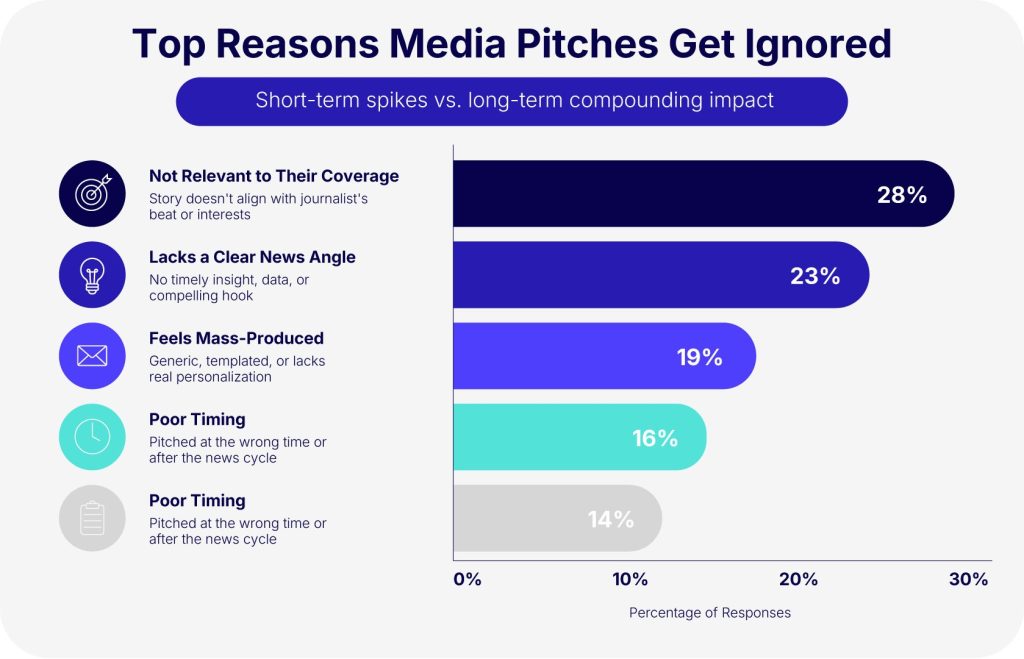
The Real Problem Isn’t Volume — It’s Precision
Never react to low engagement by increasing outreach quantity. Sending more emails doesn’t fix underlying targeting or narrative problems. Scaling ineffective outreach only makes performance worse.
Improving journalist engagement metrics requires:
- Better Segmentation
- Stronger Narrative Positioning
- More Relevant Targeting
- Smarter Timing
- Higher-quality Authority Signals
Teams that consistently earn coverage aren’t sending the most pitches — they’re sending the most relevant ones.
Pro Tip: Journalists respond to relevance density — not personalization theater. A highly relevant story with minimal personalization will usually outperform a heavily personalized pitch with weak editorial value.
Learn more about what journalists want here: What Journalists Want: What PR Pros Need to Build Relationships with Journalists
7 Factors that Influence Journalist Response Rates
Changing a single variable rarely improves your journalist response rate. Truly effective earned media outreach comes from multiple optimization layers working together:
- Stronger Targeting
- Sharper Positioning
- Smarter Timing
- More Credible Storytelling
Low-performing campaigns struggle because these factors aren’t aligned.
- A relevant story sent to the wrong journalist will fail.
- A strong narrative delivered at the wrong time may get buried.
Even good outreach underperforms if the pitch creates friction or lacks authority signals.
The trick is to treat outreach like a performance system rather than a one-time activity. Don’t focus on how many emails you send. Instead, continuously optimize the key elements that influence engagement and editorial interest.
Here are the seven biggest response rate performance drivers — and how to improve each one strategically.
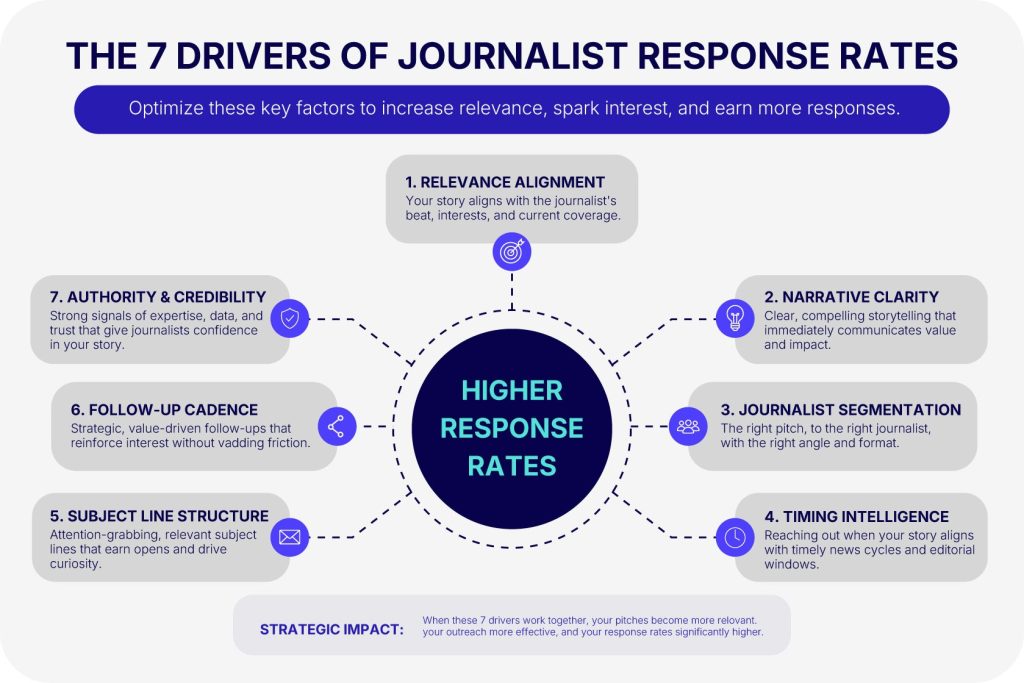
1. Relevance Alignment
When it comes to media outreach optimization, relevance is the name of the game. Journalists respond to clear story angles that align with the topics, trends, and narratives they’re currently covering.
A huge pitching mistake many B2B brands make is assuming that publication relevance automatically equals journalist relevance. But two reporters at the same outlet may cover completely different beats.
Strong outreach starts with answering these basic questions:
- What does the journalist consistently write about?
- Which angles do they prioritize?
- What types of sources do they quote?
- How does my story connect to ongoing industry conversations?
If you send out a generic AI product announcement, it may receive little engagement. But if you position the same story around emerging enterprise compliance concerns or shifting budget behavior, it creates a much stronger editorial fit.
To improve relevance alignment:
- Analyze a journalist’s last 5–10 articles before pitching.
- Group reporters by narrative interest — not just publication.
- Connect your outreach to active market trends.
- Tailor angles to audience impact rather than company updates.
Example:
- Weak: “We launched a new AI platform.”
- Strong: “New data reveals how mid-market IT teams are reallocating AI budgets in 2026.”
The best PR pitches feel like a continuation of the journalist’s existing coverage — not an interruption to it.
2. Narrative Clarity
If your story isn’t clear, it will fall flat — regardless of relevance.
Journalists are busy, and they very quickly decide whether a pitch deserves any attention. If your core narrative is confusing, too technical, or buried in company messaging, response rates will drop.
A clear narrative tells the journalist what your story is, why it matters now, who it impacts, and why their audience should care. The pitches that get ignored place focus on internal company excitement rather than external industry impact.
High-performing narratives include:
- Timeliness
- Industry Implications
- Contrarian Insight
- Proprietary Data
- Market Tension or Change
- Clear Audience Relevance
Signs your narrative needs work:
- Long Introductory Paragraphs
- Heavy Industry Jargon
- No Clear Takeaway
- Lacks an Obvious Hook
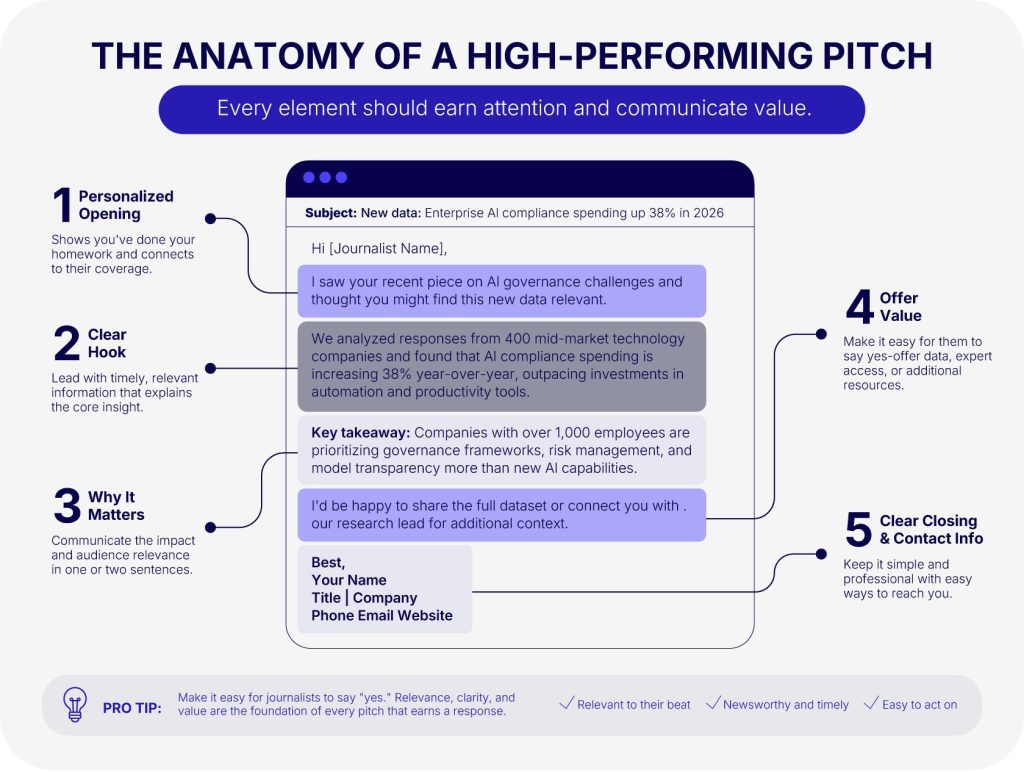
The value of your news should be clear to journalists within the first 2–3 sentences.
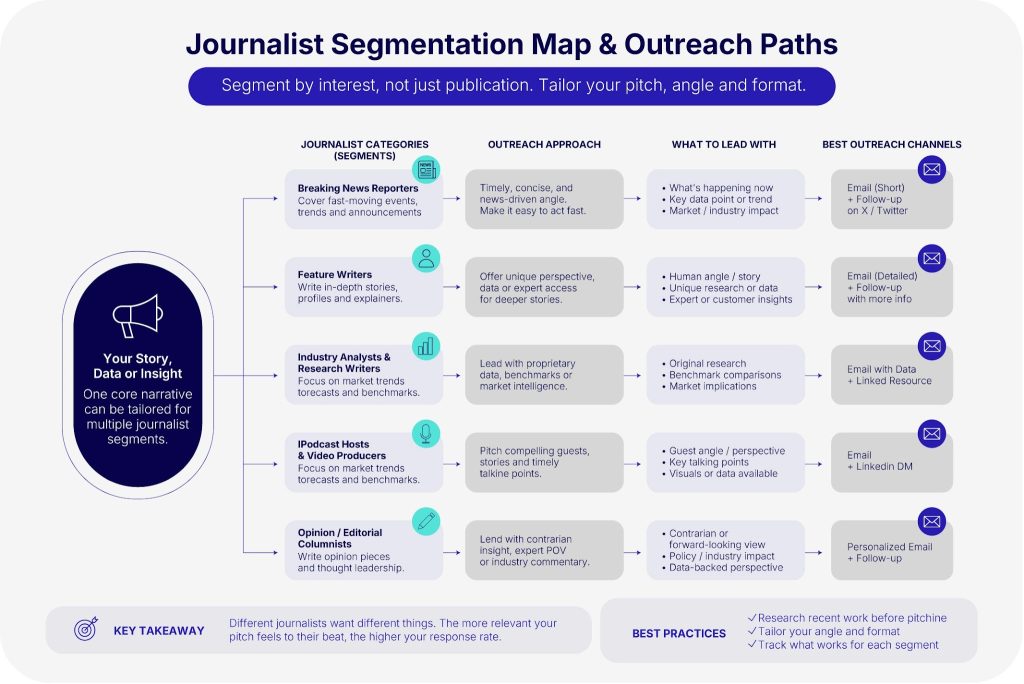
3. Journalist Segmentation
Don’t send the same pitch to every media contact. It dramatically reduces outreach effectiveness.
Instead of lumping contacts into broad categories, group media targets based on:
- Editorial Behavior
- Topic Interest
- Reporting Style
Advanced segmentation improves:
- Pitch Relevance
- Response Consistency
- Long-term Relationship Quality
- Follow-up Effectiveness
Category types include:
- Industry Vertical
- Beat Specialization
- Audience Type
- Publication Tier
- Preferred Content Format
- News vs Feature Orientation
- Podcast vs Written Media
For example, a fast-moving reporter wants quick trend commentary, while a feature writer prefers deeper research, customer stories, or proprietary data.
Segmentation matters because it helps create a more sustainable outreach strategy. Sure, mass outreach might generate a few wins here and there, but it’s not conducive to building meaningful, long-term media relationships.
Need to build a media list that gets results? Learn how here: How to Build a Media List for Successful Outreach and Impact 2026 [Examples + Tips]
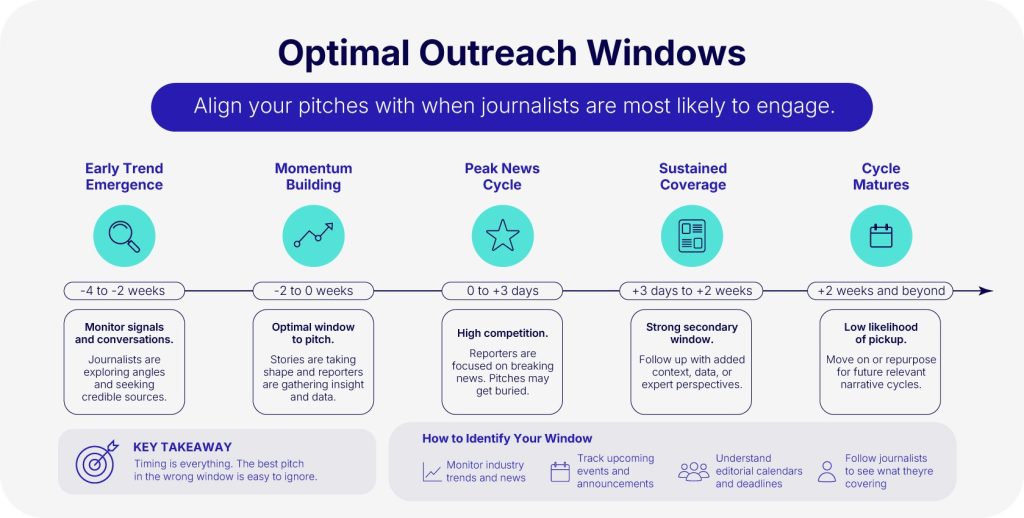
4. Timing Intelligence
To their detriment, many teams underestimate just how valuable timing is.
You might have the perfect pitch — relevant and well-written. But if you miss the right narrative window, it’ll perform worse than an average pitch sent at the perfect time.
Key factors include:
- Industry News Cycles
- Editorial Publishing Rhythms
- Seasonal Trends
- Event Timing
- Breaking News Momentum
- Reporter Workload Patterns
For example, if you pitch cybersecurity trends right after a major breach announcement, it may greatly increase relevance. But the same story sent weeks later won’t have the same legs.
Here’s what not to do:
- Don’t pitch during major breaking-news cycles.
- Don’t send reactionary commentary too late.
- Don’t ignore editorial calendars.
- Don’t launch stories without broader market momentum.
Instead, optimize for narrative windows. The best media outreach aligns with what journalists are already talking about. Well-timed and contextual pitches beat fast and mass outreach every time.
5. Subject Line Structure
Getting noticed starts with your subject line. It needs to grab the journalist’s attention immediately. If it’s weak, you’re invisible.
And while subject lines alone won’t fix flimsy pitches, strong framing significantly improves visibility and initial engagement.
Subject lines should be:
- Specific
- Relevant
- Clear
- Data-oriented
- Non-promotional
Avoid using vague phrases like:
- “Story idea”
- “Exciting announcement”
- “Quick question”
Focus on industry impact and expert insights. Where does your news fit in the conversation and how is it shaking things up?
Before vs After Examples
- Weak Subject Line: “Exciting Company Announcement”
- Improved Subject Line: “New B2B SaaS data shows CAC inflation slowing in Q3”
- Weak Subject Line: “Story Idea”
- Improved Subject Line: “Why enterprise AI procurement cycles are getting longer”
Formats for strong subject lines include:
- Trend-led
- Data-led
- Contrarian Insight
- Market Impact
- Executive Expertise
Use your subject line to convey editorial relevance — not just market excitement.
6. Follow-Up Cadence
Following up (the right way) matters. Unfortunately, most teams are doing it wrong.
“Just checking in” emails add no new value. This approach actually hurts response rates rather than improving them.
To follow up effectively, you need to:
- Introduce New Info
- Add Contextual Relevance
- Expand the Angle
- Provide Updated Data
- Tie Stories to Breaking News
The recommended followup structure is:
- Send a followup email 3–5 days after initial outreach with additional insights or context.
- No response after 14 days? Send a final close-the-loop message to maintain good working relationships — or to possibly encourage last-minute engagement.
Here’s what NOT to do:
- Don’t follow up daily.
- Don’t feign urgency.
- Don’t try to guilt-trip journalists.
- Don’t be excessively persistent.
Your follow-up cadence shouldn’t create pressure — it should reinforce credibility.
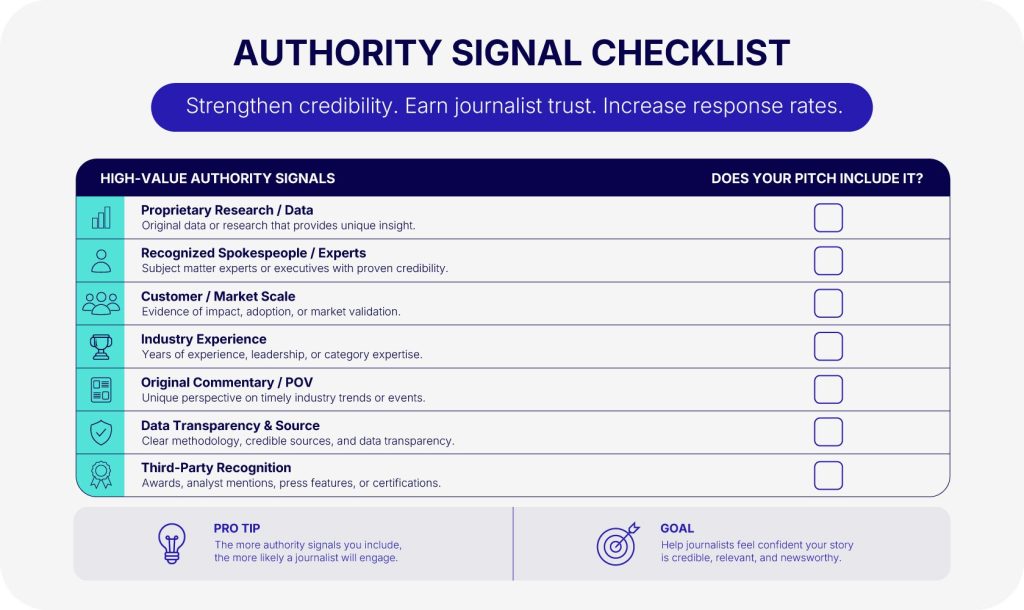
7. Authority & Credibility Signals
Journalists possess an almost supernatural ability to instantly spot source credibility. A pitch will get ignored — regardless of relevance — if the company, spokesperson, or supporting info lacks authority.
Strong credibility signals let journalists know that your news is reliable and worth their time.
High-value credibility signals include:
- Proprietary Research
- Benchmark Reports
- Recognized Executives
- Customer Scale Metrics
- Industry Expertise
- Data Transparency
- Original Commentary
- Historical Trend Analysis
For B2B brands especially, proprietary insights carry much more weight than promotional announcements because they provide journalists with exclusive market value.
To strengthen authority, you need to:
- Develop executive thought leadership.
- Publish original research.
- Create recurring industry reports.
- Build recognizable expertise within a niche.
Pro Tip: Journalists are more likely to respond when your outreach helps them explain an industry trend — not just promote the brand.
Find more pitching tips here: 4 PR Pitching Tips for Pros to Land Better Media Coverage in 2025
How to Optimize Outreach with Data
Solid media outreach is no longer purely driven by relationships — it requires measurable data.
And because PR is a measurable performance system, you need to treat it like one. Use real engagement data to analyze, optimize, and improve outreach over time.
This shift is important because improving journalist response rates is rarely achieved through raw intuition. You need numbers to pinpoint the causes of low performance:
- Weak Targeting
- Vague Subject Lines
- Bad Timing
- Confusing Narratives
- Low-authority Positioning
Data-backed outreach optimization removes the guesswork and helps you make strategic decisions based on how journalists actually behave.
Why Modern PR Requires Performance Visibility
A lot of organizations still lean on secured placements for performance evaluation. But that measurement comes with some serious lag time.
To consistently improve outreach, you need early-stage engagement visibility.
That means measuring:
- The Most Responsive Journalist Segments
- Narratives with the Strongest Engagement
- Top-performing Timing Windows
- Spokespersons with the Highest Reply Rates
- Follow-up Approaches that Improve Conversion
This kind of operational visibility helps you make outreach adjustments before a campaign underperforms.
Key Metrics to Track
Here’s a breakdown of the core outreach KPIs
| Metric | What it Measures | Why it Matters |
| Response Rate | Percentage of pitches receiving replies | Measures overall outreach relevance |
| Positive Response | Replies expressing interest or follow-up intent | Indicates true engagement quality |
| Coverage Conversion Rate | Outreach that becomes earned coverage | Connects outreach to business outcomes |
| Follow-up Response Rate | Replies generated after secondary outreach | Evaluates cadence effectiveness |
| Reply Latency | Average response time from journalists | Reveals engagement urgency |
| Segment Performance | Response rates by journalist group | Identifies strongest targeting opportunities |
Tracking these metrics over time will give you clearer insights into what journalists are actually interested in talking about.
Segment Performance Reveals Hidden Opportunities
A big benefit of data-based pitching is being able to spot which segments consistently outperform others.
For example, your analysis may reveal that:
- Trade publications outperform national business media.
- Data-led stories generate higher engagement than product announcements.
- Certain vertical reporters respond more positively to executive commentary.
- Specific timing windows outperform standard campaign launches.
These insights and patterns help optimize precision and become valuable operational intelligence over time.
Optimization Should Be Iterative
A common mistake in PR outreach is campaign isolation. Instead, operate continuous five-step optimization loops:
- Launch Outreach
- Measure Engagement
- Identify Performance Patterns
- Refine Targeting and Messaging
- Re-test and Improve
Example:
- Increase your response rate from 6% to 10%.
- Improve positive replies by 15%.
- Reduce irrelevant outreach volume.
- Increase follow-up engagement consistency.
These gains gradually improve long-term earned media efficiency.
How Data Reduces Outreach Waste
Low-performing outreach campaigns suffer from these often hidden inefficiencies:
- Over-targeted Media Lists
- Poor Journalist-fit Alignment
- Weak Timing Windows
- Repetitive Narratives
- Underperforming Subject Lines
When teams lack detailed performance analysis, they compensate by increasing outreach. This only creates more noise without solving the real problem.
Data-informed outreach optimization surgically removes wasted activity while simultaneously improving the quality of engagement.
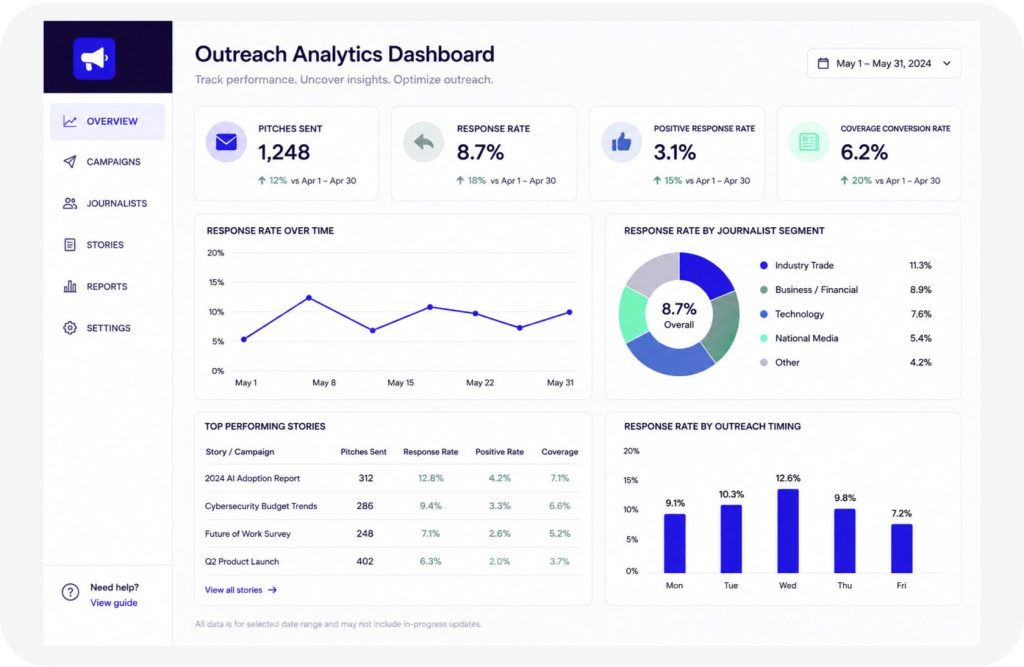
Pro Tip: The goal of outreach analytics is not simply to track activity — it’s to identify repeatable patterns that improve journalist engagement and earned media performance over time.
Read our step-by-step analytics guide for more helpful tips: 7 Step Guide to PR Analytics: Unveiling Insights for Strategy Enhancement
6 Steps to Audit Your Current Response Rate
To improve journalist response rates, you first need to identify the underperforming areas of your outreach process.
A structured efficiency audit helps find specific issues limiting engagement — whether it’s:
- Imprecise Targeting
- Terrible Timing
- Low Narrative Quality
- Lack of Segmentation
- Improper Follow-up Strategy
Sending more pitches and praying for improvement is bad practice. Instead, use outreach audits to find patterns, eliminate inefficiencies, and optimize what actually drives engagement.
The goal is really quite simple:
- Identify what’s working.
- Fix what isn’t.
- Build a more precise, data-informed outreach process over time.
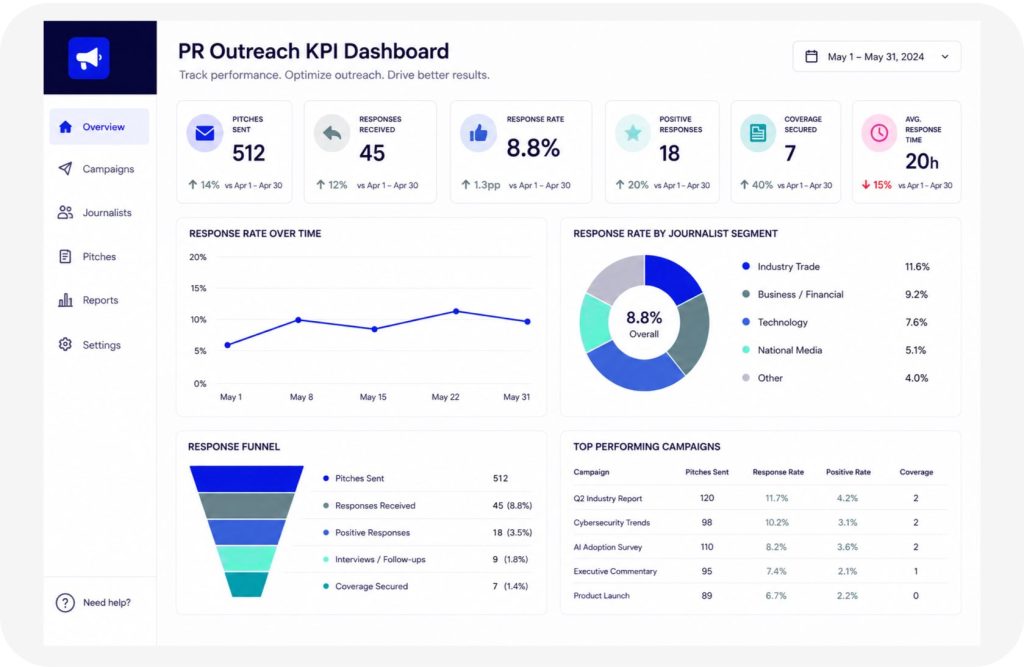
Step 1. Establish Baseline Metrics
First, measure your current performance across recent campaigns.
At minimum, track:
- Total Pitches Sent
- Total Journalist Replies
- Positive Responses
- Coverage Secured
- Follow-up Replies
- Average Response Time
This will be your baseline for evaluating future optimization efforts.
| Metric | Example |
| Pitches Sent | 320 |
| Responses Received | 28 |
| Journalist Response Rate | 8.75% |
| Positive Responses | 11 |
| Coverage Secured | 5 |
| Follow-up Reply Rate | 18% |
Without benchmark data, you can’t really tell if adjustments are actually working.
Step 2. Analyze Targeting Quality
Poor targeting often leads to lower response rates — more so than weak stories.
Review your outreach lists and ask:
- Are these journalists actively covering this topic?
- Is the angle aligned with their recent reporting?
- Are contacts outdated?
- Are segments too broad?
- Are we pitching publications instead of individual journalists?
Don’t make the common mistake of prioritizing media list size over journalist fit — it dilutes relevance.
Warning signs of weak targeting include:
- Very Low Response Rates (across all segments)
- High Bounce Rates
- Irrelevant Rejection Replies
Strong targeting includes:
- Tight Alignment (between pitch angle and journalist beat)
- Smaller, More Curated Media Lists
- Personalized Narrative Positioning (based on coverage history)
You’ll likely get more responses from a highly targeted list of 20 journalists than a generic list of 200.
Step 3. Review Narrative and Pitch Quality
Once you’ve validated targeting, it’s time to evaluate the pitch itself.
A lot of outreach struggle is due to unclear narratives, overly promotional messaging, or a total disconnect from broader industry relevance.
Audit your pitch for:
- Clear News Value
- Timeliness
- Industry Relevance
- Strong Subject Line Framing
- Concise Structure
- Sensible Takeaway
- Credibility Signals
- Data Support
The aim is to examine whether your story feels newsworthy and genuinely useful to journalists — not just internally interesting to your company.
Step 4. Compare Segment Performance
Segmented engagement analysis usually reveals valuable opportunities for optimization that would otherwise go unnoticed within campaign metrics.
Compare performance by:
- Journalist Beat
- Publication Tier
- Story Type
- Timing Window
- Subject Line Category
- Spokesperson
- Industry Vertical
For example, you may discover that:
- Trend-based pitches outperform launch announcements.
- Trade media responds more positively than national outlets.
- Data-driven stories generate higher reply rates.
- Certain subject line structures consistently increase engagement.
These insights provide a strategic approach to improving journalist response rates rather than a reactive one.
Step 5. Identify Outreach Friction
Even relevant stories perform poorly when the outreach experience feels inconvenient or time-consuming to journalists.
Remember, they operate under deadline pressure. If your pitch creates unnecessary friction, the chances of getting a response become slim-to-none.
Common points of friction include:
- Long Text Blocks
- Unclear Story Framing
- Too ManyLinks or Attachments
- Weak Opening or No Hook
- Overly Technical Language
- No Obvious Next Step
- Insincere Follow-ups
You need to answer these questions:
- Will the journalist understand the story within 10 seconds?
- Is the key takeaway immediately visible?
- Does the pitch reduce effort, or require more of it?
Easy engagement equals higher response rates.
Step 6. Look for Patterns Over Time
You don’t get the full performance story from a single campaign.
Examine patterns across multiple campaigns to find what consistently drives performance.
- Identify outreach angles that consistently perform best.
- Keep track of journalists who frequently engage.
- Note timing windows that improve response rates.
- Track campaigns that underperform repeatedly.
- Highlight authority signals that increase replies.
In time, these patterns become actionable insights that help improve earned media outreach efficiency.
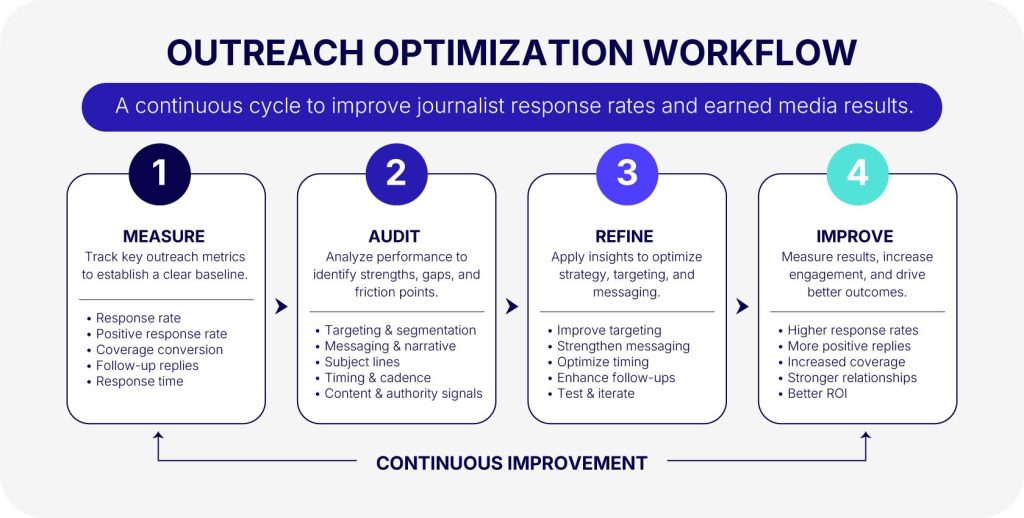
Pro Tip: The goal of a response-rate audit is not to prove outreach activity happened. It’s to identify the specific variables that improve journalist engagement so that future campaigns become more precise, relevant, and effective.
Need a total PR efficiency audit? We’ve got you covered: The PR Audit Guide: A Step-by-Step Framework for High-Performance Teams
Sample Pitch Breakdown
Comparing ineffective outreach to a strategically optimized pitch is one of the quickest ways to improve outreach and journalist response rates.
Many low-performing pitches fail because the focus is on the brand rather than the story.
They rely on:
- Vague Announcements
- Broad Claims
- Generic Outreach Language
These things don’t give journalists any real reason to engage.
Most high-performing pitches do three simple things that grab journalists’ attention:
- They immediately establish why the story matters.
- They connect to active industry conversations.
- They reduce the effort required for a journalist to grasp the angle.
Here’s a simplified before-and-after example that shows how small changes collectively improve journalist response rates.
Before: Generic Low-Performance Pitch
This example contains several common outreach problems including:
- Company-centric framing
- Weak news value
- Generic language
- No supporting data
- No clear relevance to the journalist’s audience
Exciting Update From Our Company
Hi [Name],
I wanted to reach out because our company recently launched a new AI solution that helps businesses improve efficiency.
We thought this could be interesting for your audience and would love to discuss potential coverage opportunities.
Let me know if you’re interested.
Best,
[Name]
It underperforms for five key reasons:
- The subject line lacks specificity.
- The story feels promotional rather than editorial.
- There’s no timely industry hook.
- The value to readers is unclear.
- The journalist has to do extra work to identify relevance.
This is the kind outreach used in mass-blast approaches. It’s easy to scale, but journalists don’t care for it.
After: Precision-Optimized Pitch
This example is high-performing because it focuses on relevance, timing, and narrative clarity — not brand promotion.
New data: Mid-market AI budgets are shifting from automation to compliance
Hi [Name],
I saw your recent coverage on enterprise AI spending trends and thought this new dataset might be relevant.
We analyzed purchasing behavior across 400 mid-market technology companies and found a measurable shift in AI budget allocation toward governance and compliance initiatives rather than workflow automation.
One interesting finding: compliance-focused AI spending increased 38% year-over-year among companies with over 1,000 employees.
Happy to share the full dataset or connect you with our research lead if you’re exploring broader enterprise AI adoption trends.
Best,
[Name]
This pitch will get attention for six key reasons:
- It leads with industry relevance instead of company promotion.
- It uses proprietary data to create authority.
- There’s a direct connection to the journalist’s recent coverage.
- It introduces a timely market trend.
- A clear and concise takeaway is provided.
- The story is easy to evaluate quickly.
But most importantly, this pitch positions the company as a helpful, expert source of industry insight rather than just fishing for exposure.
Key Optimization Difference
| Low-performance Pitch | Optimized Pitch |
| Company-focused | Industry focused |
| Generic messaging | Specific messaging |
| Promotional tone | Editorial relevance |
| No supporting details | Proprietary data included |
| Broad targeting | Narrative aligned outreach |
| Weak subject line | Clear trend-driven subject line |
| Creates friction | Easy to understand quickly |
Pro Tip: The best-performing pitches do not feel like marketing emails. They feel like relevant story opportunities that help journalists explain something important happening in the market.
Need to pitch in a disaster area? Here’s what to avoid: 5 PR Mistakes to Avoid When Pitching in Disaster Areas
6 Ways to Improve Journalist Response Rates Without Increasing Volume
When journalist response rates start dipping, many PR teams adopt the bad habit of sending out more emails.
Increasing pitch volume is a bad, reactionary strategy. In most cases, it exacerbates poor performance through low-quality targeting, lack of personalization, and inbox fatigue.
You improve pitch performance by increasing precision — not activity.
Focus on:
- Better Journalist-to-Story Alignment
- Stronger Narrative Positioning
- Smarter Timing
- More Credible Supporting Evidence
- Higher-quality Outreach Execution
Basically, the goal isn’t to contact more journalists — it’s to become relevant to the right ones.
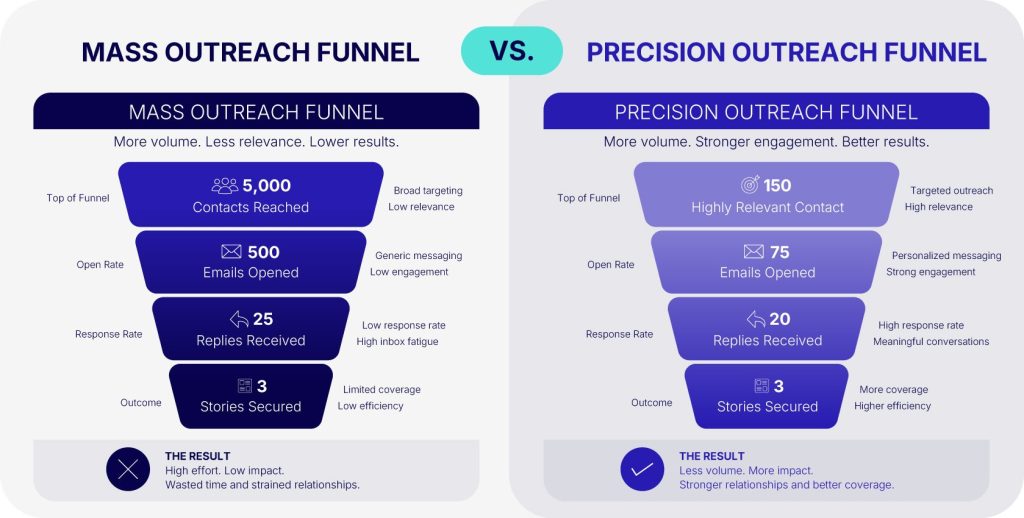
1. Prioritize Precision Over Scale
The best earned media outreach begins with a narrow focus.
You don’t need massive media lists. Just concentrate on journalists who are already covering the exact themes, trends, and market conversations around your story.
A handful of highly targeted journalists is better than a ton of loosely related contacts any day.
Shift away from:
- Publication-level Targeting
- Generic Story Angles
- Broad Announcements
- Blanketed Outreach
Shift toward:
- Narrative-based Segmentation
- Trend-aligned Pitching
- Journalist-specific Relevance
- Contextual Positioning
Applying precision outreach to your pitching process not only increases journalist response rates — it improves the quality of your media relationships.
Example: Rather than pitching a product launch to every tech reporter at a national outlet, your B2B cybersecurity company targets 12 journalists who are actively covering AI compliance risks and enterprise governance trends.
The result is fewer emails sent, but significantly higher engagement quality.
2. Improve the Story — Not Just the Pitch
Outreach campaigns often underperform because the underlying narrative has zero editorial value.
Before you optimize subject lines or follow-up, you need to evaluate whether the story itself answers these questions:
- Why does this matter now?
- What trend or market shift does this connect to?
- What insight is genuinely useful to journalists?
- Is there supporting data or evidence?
- Does this help explain something larger happening in the industry?
Strong positioning is the foundation of effective outreach. You don’t need high volume to generate engagement if your narrative is useful and timely.
Example: Your SaaS company’s original pitch “new platform capabilities” received very little attention. So you reposition the story around new research showing CFO-led AI spending shifts in mid-market businesses.
This leads to increased engagement because your new angle directly connects to a broader industry conversation.
3. Build Repeatable Outreach Systems
Consistent media performance comes from repeatable, ongoing operational systems — not one-time wins. Over time, that strategic and structured repetition will improve the quality of your outreach.
Examples of useful systems include:
- Journalist Intelligence Databases
- Narrative Angle Frameworks
- Outreach Scoring Models
- Editorial Calendar Tracking
- Performance Dashboards
- Follow-up Workflows
- Pitch Testing Processes
These systems help scale relevance rather than simply scaling pitch volume.
Example: You create an internal outreach scoring framework that ranks journalists based on:
- Beat Relevance
- Prior Engagement
- Topic Fit
Instead of rebuilding media lists manually for every campaign, your team consistently prioritizes high-probability targets.
4. Use Data to Refine Targeting
An almost instant way to boost response rates is to examine what’s already working. Analyze all areas of outreach and ask yourself:
- Which journalist segments respond most often?
- Which story types generate positive replies?
- Which subject lines improve engagement?
- Which timing windows perform best?
- Which spokespersons earn the highest interest?
Over time, the answers create operational insights that help optimize outreach across future campaigns.
Example: After reviewing recent campaign analytics, you notice that data-led pitches sent Tuesday mornings generate nearly twice the response rate of general announcements sent Friday afternoons.
Future outreach is adjusted accordingly.
Small Improvements Compound
Even moderate gains create significant long-term performance improvements:
- Higher Response Consistency
- Stronger Journalist Relationships
- Improved Coverage Conversion
- Reduced Outreach Waste
- Higher Earned Media Efficiency
5. Reduce Friction for Journalists
Journalists won’t waste time on unclear or valueless pitches.
Make a journalist’s life easier through:
- Shorter Intros
- Clearer Framing
- Faster Access to Relevant Info
- Fewer Links or Attachments
- Direct and Concise Writing
The less mental energy a journalist has to exert on your pitch, the more likely they are to engage with it.
So ask yourself:
- Will journalists understand this story in 10 seconds or less?
- Is the core insight immediately obvious?
- Does the pitch make their job easier?
If you answer no to any of these, it’s time to optimize.
Example: You shorten outreach emails from 350+ words to under 150 words, move the key statistic into the opening sentence, and get rid of unnecessary attachments.
Response rates improve because your story is clearer and easy to evaluate in seconds.
6. Build Meaningful Relationships
Aggressive outreach occasionally generates short-term visibility, but it often damages future engagement.
For lasting journalist response rate improvement, build a reputation for:
- Relevance
- Credibility
- Timeliness
- Accuracy
- Consistent Value
A journalist who recognizes your outreach as consistently useful will naturally pay more attention to future pitches.
Example: As a fintech company leader, you regularly share relevant market insights and from-the-hip expert commentary — even when not actively pitching for coverage.
After providing consistent value, journalists start reaching out proactively for thought leadership quotes and trend analysis.
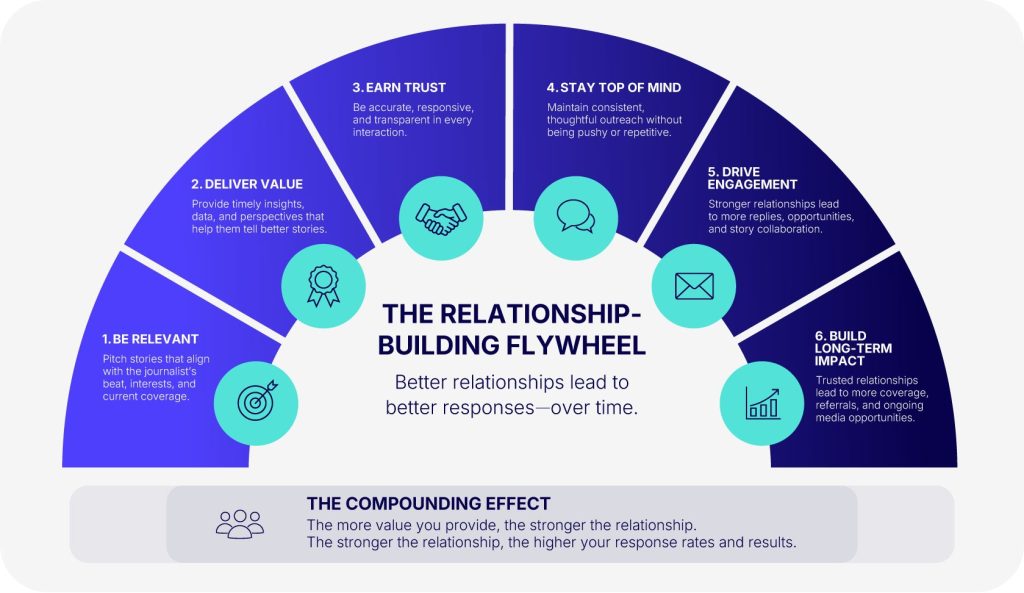
Pro Tip: The strongest PR strategies improve response rates by making outreach more targeted, useful, and trustworthy — not by increasing how many emails get sent.
Read our guide on media relations for more examples and tips: From Pitch to Publication: How Media Relations Drives PR Success [Examples + Tips]
Enterprise Outreach Best Practices
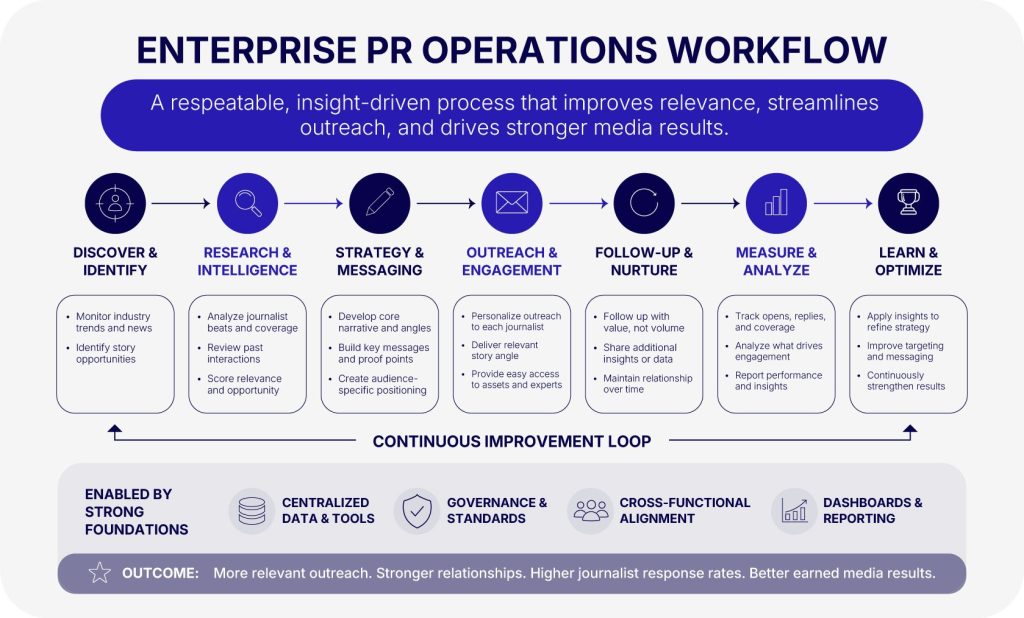
Scaling PR operations means more complex outreach. More stakeholders, more campaigns, more spokespersons, and larger media lists create more opportunities for inefficiency.
At the enterprise level, structured outreach systems — not just individual pitching tactics — are essential.
You have to start treating earned media outreach as an operational discipline built around:
- Consistency
- Segmentation
- Governance
- Continuous Optimization
Put high-volume pitching in your rearview. Now, the focus is on building scalable processes that sustain relevance and editorial quality across campaigns.
Here are six enterprise-level best practices that help improve pitch response rates while maintaining precision.
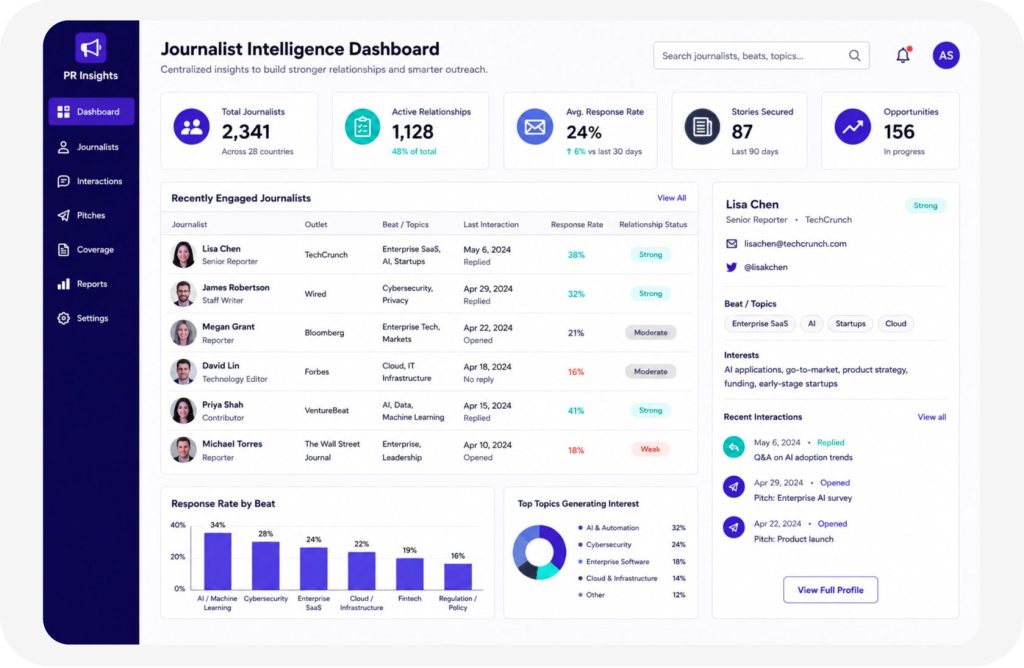
1. Centralize Journalist Intelligence
Fragmented media knowledge is a major outreach challenge enterprise brands face.
Separate teams sometimes pitch the same journalists with inconsistent messaging or outdated context. This outreach overlap creates friction and weakens long-term engagement.
It’s best practice to centralize journalist intelligence into shared systems that track:
- Reporter Beats
- Coverage History
- Prior Interactions
- Response Behavior
- Preferred Topics
- Editorial Interests
- Relationship Status
This keeps outreach coordinated, relevant, and contextual across campaigns.
Example: Your global B2B SaaS company builds a centralized media intelligence database that lets regional PR teams see previous journalist interactions before reaching out.
The result? Pitching overlap decreases, leading to more consistent journalist engagement.
2. Standardize Messaging Frameworks
Enterprise outreach starts to break down when there are messaging discrepancies across:
- Departments
- Regions
- Product Teams
A structured narrative framework helps ensure that all outreach is aligned with:
- Core Positioning
- Market Narrative
- Executive Messaging
- Industry Relevance
- Brand Credibility
But messaging alignment doesn’t mean your emails should be identical. It just means the gist of every pitch should be rooted in the same story while adapting to individual journalists and their beats.
Strong frameworks include:
- Approved Market Narratives
- Core Supporting Statistics
- Key Talking Points
- Executive Commentary Themes
- Story-angle Variations
- Audience-specific Positioning
Example: Your cybersecurity company creates standardized narrative frameworks around:
- AI Governance
- Risk Management
- Compliance Trends
Regional PR teams make messaging adjustments for local reporters while maintaining a consistent global strategy.
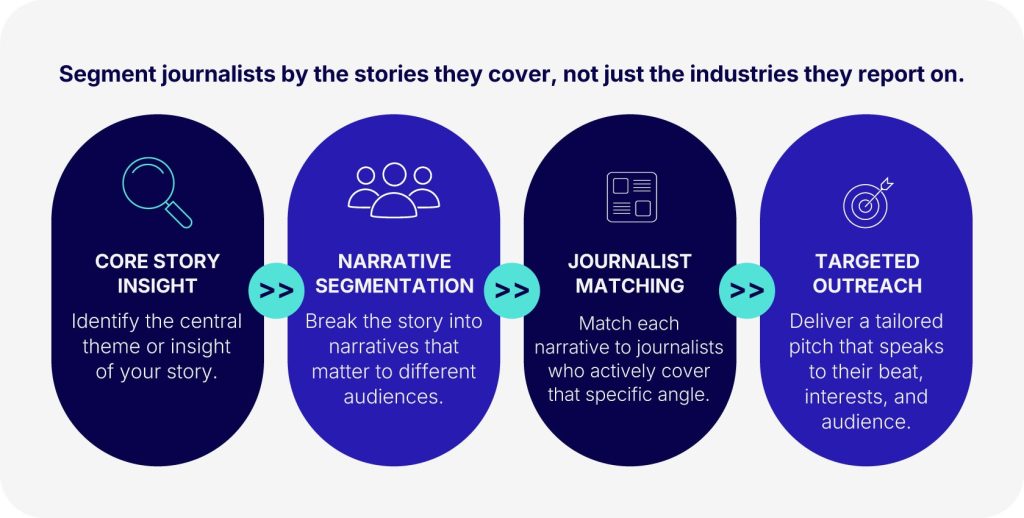
3. Segment Outreach by Narrative — Not Just Industry
Journalist segmentation for many enterprise teams is still way too broad.
For example:
- “Technology Reporters”
- “Healthcare Media”
- “Business Press”
Modern media outreach performs much better when journalist segmentation is based on narrative focus rather than publication category alone.
Highly effective segmentation looks like this:
- AI Regulation Reporters
- Enterprise Infrastructure Analysts
- Fintech Risk Journalists
- Future-of-work Feature Writers
- Climate Policy Reporters
- B2B SaaS Investment Journalists
When segmentation is narrative-driven, relevance alignment and response quality improve dramatically.
Example: Instead of pitching a generic story about cloud computing to all enterprise tech media, you separate outreach into:
- Data Privacy Reporters
- Infrastructure Modernization Journalists
- AI Operations Analysts
Then you send each segment a tailored angle tied to their coverage interests, leading to multiple media wins.
4. Create Structured Follow-Up Governance
A very common enterprise outreach issue is inconsistent follow-up behavior.
Without governance, teams will:
- Over-email Journalists
- Send Redundant Follow-ups
- Create Conflicting Outreach Timelines
- Damage Long-term Relationships
Solid enterprise PR strategies establish clear follow-up standards.
Here are some recommended governance guidelines:
- Limit Follow-up Frequency
- Define Escalation Rules
- Coordinate Outreach Ownership
- Require Value-added Follow-ups
- Track Journalist Engagement History
- Establish “Do Not Contact” Standards
These guidelines not only improve professionalism, they reduce outreach fatigue.
Example: Your enterprise team limits outreach to two follow-ups max — unless the journalist actively engages. And instead of generic check-ins, each follow-up must introduce either new data, useful commentary, or relevant industry context.
5. Align PR with Broader Marketing Intelligence
Truly effective enterprise outreach isn’t created in isolation.
You need to coordinate closely with:
- Product Marketing
- Demand Gen
- Sales Intelligence
- Executive Leadership
- Analyst Relations
- Customer Insights Teams
This alignment helps identify:
- Emerging Industry Trends
- Customer Behavior Shifts
- Competitive Positioning Gaps
- Timely Market Narratives
- Data-backed Story Opportunities
This result? Your outreach feels more strategic, timely, and relevant to journalists.
Example: After collaborating with sales and customer research teams, your fintech PR department finds growing buyer concerns around AI transparency in financial software.
You create a data-led campaign around that insight. The campaign generates significantly stronger journalist engagement.
6. Build Long-Term Editorial Credibility
Enterprise outreach should value relationship equity over short-term visibility.
Journalists engage consistently with organizations that:
- Respect Deadlines
- Provide Accurate Information
- Offer Useful Expertise
- Avoid Exaggerated Claims
- Respond Quickly to Requests
- Deliver Reliable Commentary
One of the strongest drivers of sustained earned media performance is long-term credibility.
Credibility signals include:
- Original Research
- Executive Thought Leadership
- Reliable Expert Availability
- Transparent Sourcing
- Consistent Narrative Expertise
- Historical Trend Analysis
Example: Your cloud infrastructure company is recognized among enterprise tech reporters for providing fast, data-backed commentary during major cybersecurity incidents.
Over time, journalists start reaching out for executive quotes and expert insights.
Pro Tip: Enterprise outreach scales successfully when systems improve relevance and coordination — not when teams simply increase outreach volume across larger media lists.
Are you a Series B–D startup looking to scale your PR budget? Learn more here: PR for Startups: A Scalable Budgeting Blueprint for Series B–D [Examples + Tips]
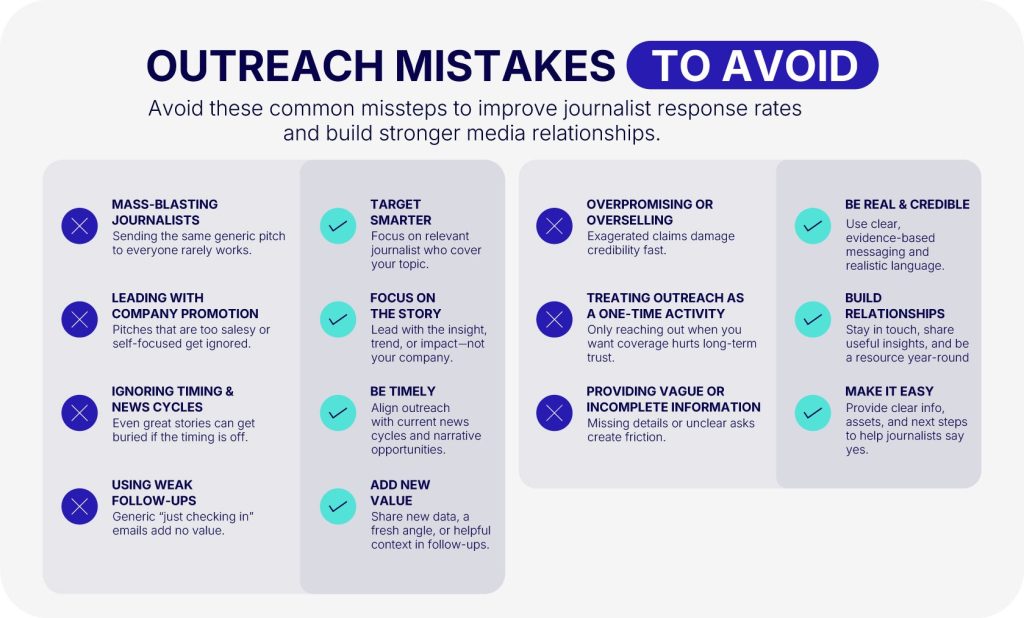
Top 6 Common Outreach Mistakes
It’s important to reiterate that even the most relevant and well-timed stories won’t land if your outreach is fundamentally flawed.
In most cases, low journalist response rates are preventable. It just requires a few simple tweaks:
- More Precise Targeting
- Stronger Positioning
- Disciplined Outreach Processes
Here are the six most common pitfalls you need to sidestep:
1. Mass-Blasting Journalists
Never send the same generic pitch to hundreds of reporters. This approach rarely produces strong engagement.
Mass outreach also signals:
- Low relevance
- Weak Targeting
- Limited Knowledge of Journalist Beats
Example: Your SaaS company sends the same product announcement to 500+ tech reporters. Response rates remain extremely low because most recipients aren’t actively covering the topic.
A better approach is to shrink media lists down to a select number of journalists (20–80 depending on coverage tier) whose interests align closely with your narratives.
2. Leading with Company Promotion
Journalists value industry impact over obvious promotional content.
Don’t send pitches with a heavy focus on things like:
- Funding Announcements
- Product Features
- Self-promotional Messaging
Unless you tie them to larger market trends, those pitches will get ignored.
Example: Don’t open with “We launched a new AI platform.” Instead, lead with a relevant, data-backed insight about changing enterprise AI adoption behavior.
It’s always better to position your company as a go-to source for industry insights and not just another brand seeking visibility.
3. Ignoring Timing and News Cycles
Bad timing often equals no response.
It seems unfair. Your pitch might be great — well-written and hyper-relevant. But the truth is, journalist attention and inbox priorities will always be influenced by:
- Major News Events
- Industry Conferences
- Earnings Cycles
- Breaking Stories
Example: If your cybersecurity company pitches trend commentary during a major global outage dominating tech coverage, it’ll get buried despite having a strong angle.
Protect strong pitches from this time bomb by aligning outreach with active narrative windows and editorial momentum.
4. Using Weak Follow-Ups
A “just checking in” follow-up doesn’t add value.
Bad follow-up habits make outreach feel like spam, especially at the enterprise level.
Example: Your team sends three identical follow-up emails within a week without adding new context, data, or relevance. The journalist deems your news unworthy and moves on to more useful email pitches.
Every follow-up should introduce something that makes the journalist’s work easier:
- Updated Data
- A New Angle
- Timely Commentary
- Industry Context
5. Overpromising or Overselling
Don’t exaggerate claims — it damages credibility quickly.
Journalists are sensitive to hyperbolic language, unrealistic promises, or pitches that feel like a used car commercial.
Example: You claim that your startup platform is “revolutionizing the future of enterprise AI” but fail to provide supporting evidence or customer adoption data. Journalists’ eyes roll as your pitch is swiftly passed over.
Instead, use clear and evidence-based positioning supported by data and realistic framing.
6. Treating Outreach as a One-Time Activity
Strong journalist relationships aren’t built overnight or during active campaigns. It takes time to establish meaningful media bonds.
If you’re only contacting reporters when you want coverage, you’ll never build long-term engagement consistency.
Example: Your company reaches out to journalists exclusively during product launches, but you never share useful insights or commentary between campaigns. Vapid, self-serving interactions feel transactional and make it hard for journalists to take you seriously.
To build ongoing credibility, consistently provide:
- Relevant Expertise
- Trend Analysis
- Reliable Commentary
Pro Tip: Most outreach problems aren’t caused by insufficient volume. They’re the result of low relevance, weak timing, unclear narratives, or poor relationship management.
Find more resources on PR mistakes to avoid here:
How to Build Journalist Relationships that Last
Optimizing individual pitches isn’t the sole factor in improving journalist response rates. The best earned media results compound over time from establishing trusted, long-term relationships with journalists who see you as a valuable and reputable source.
Trust takes time. You earn it through credibility, consistency, and usefulness — not emailing aggressively or following up incessantly.
Relationship-building is a continuous process. Focus on becoming a reliable industry resource rather than a casual coverage hunter.
Prioritize Relevance Over Frequency
A quick way to ruin media relationships is to frequently send unimportant emails. You need consistent relevance — not irrelevant bombardment.
Only send timely pitches that align with:
- Their Coverage Areas
- Their Audiences
- Current Industry Conversations
- Their Preferred Reporting Style
Example: Your fintech PR team only pitches digital wallet reporters when they have newsworthy trend data or executive commentary tied to digital banking adoption. Journalists appreciate this because:
- Your team doesn’t send emails about every little company update.
Fewer, more relevant interactions always outperform saturated outreach.
Become a Reliable Source of Insight
Journalists are always searching for credible experts, data, and new market perspectives.
If you provide a steady stream of useful information — even outside active campaigns — you will become a trusted long-term source.
Valuable relationship-building assets include:
- Proprietary Research
- Trend Analysis
- Fast Expert Commentary
- Industry Forecasts
- Executive Insights
- Relevant Customer Data
Example: As a cybersecurity company leader, you regularly supply reporters with fast commentary after major data breaches.
- Over time, journalists begin reaching out to you for expert quotes during breaking news cycles.
Respect Journalists’ Time
Strong relationships depend on professionalism and low-friction interactions.
That means you need to:
- Keep Pitches Concise
- Respond Quickly
- Avoid Unnecessary Follow-ups
- Provide Accurate Info
- Make Interviews Easy to Coordinate
Journalists note which sources are easy to work with and which require extra effort.
Example: As a PR manager, you always provide reporters with fast turnaround times, concise background materials, and direct access to executives.
- As a result, journalists are more likely to engage with your future outreach.
Engage Outside of Pitch Cycles
A huge relationship-building mistake is only reaching out when you want coverage.
Meaningful media relationships are nurtured between campaigns through thoughtful, low-pressure engagement.
To be useful, you need to:
- Share Relevant Research
- Congratulate Reporters on Strong Coverage
- Offer Useful Trend Insights
- Provide Expert Perspective on Emerging News
- Connect Journalists with Additional Sources
Example: After reading an article about AI governance trends, you share relevant industry data with a reporter without fishing for coverage.
- That interaction helps build familiarity and trust over time.
Maintain Consistency Across Teams
Inconsistent outreach weakens journalist trust quickly — especially at the enterprise level.
Journalists get frustrated with:
- Pitch Overlap
- Messaging Misalignment
- Uncoordinated Outreach
- Ignored Prior Conversations
You need to centralize journalist relationship tracking. This helps teams easily organize:
- Communication History
- Preferences
- Prior Engagement
Example: Your global B2B company uses a shared media relationship platform.
- This ensures regional PR teams are privy to previous journalist conversations before they launch new outreach.
Play the Long Game
The best journalist relationships compound over time.
Not every interaction ends with coverage. But regular relevance and credibility boost the chances of:
- Future Engagement
- Quote Requests
- Interview Opportunities
- Editorial Trust
Your aim isn’t to inch along like a caterpillar, securing single placements here and there. It’s to emerge from a cocoon of media courtship — wings resplendent with trust and newsworthiness.
Journalists will want to pin you down as their very own source of valuable insights and inspiration.
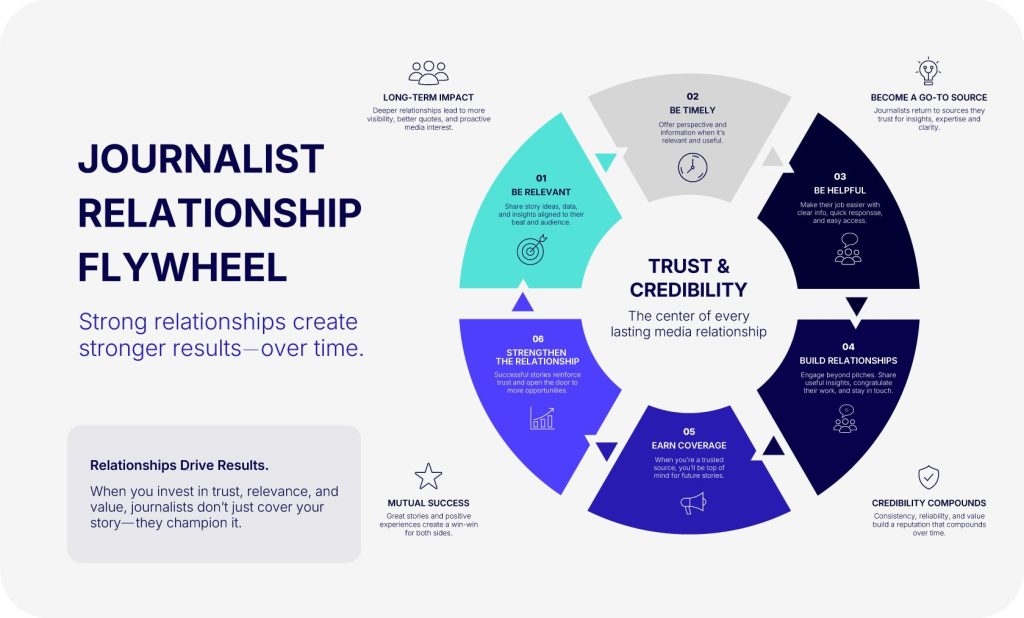
Pro Tip: The most valuable media relationships are built through consistent usefulness, credibility, and relevance — not persistent pitching.
Pitching during a holiday? Here’s what you need to know: Holiday Pitching: 5 Tips to Getting Better Results This Season
Better Response Rates Come From Better Strategy — Not More Emails
The overarching takeaway here is that better journalist response rates don’t come from blasting inboxes with generic pitches.
They come from sending smarter, more targeted ones.
Mass outreach is good for generating noise with limited results. But engagement will improve naturally if the focus is on:
- Relevance
- Timing
- Narrative Clarity
- Relationship-building
And since modern earned media outreach is a performance machine rather than a numbers game, continuous optimization is key.
Regular maintenance is required to keep the machine running efficiently and effectively. So go ahead and tighten that targeting belt, polish the positioning pistons, and grease your overall outreach execution for significantly stronger media performance over time.
When you ensure outreach is highly targeted, useful to journalists, and aligned with what they’re already talking about, the media wins start rolling in.
If you’re struggling with low engagement or inconsistent outreach results, book a free consultation with us today! An outreach efficiency audit or performance review helps reveal gaps that are holding your outreach back — and identify opportunities to improve response rates without increasing outreach volume.