The Media CRM Playbook: How to Build a PR Database That Drives Better Coverage
Many PR teams think they’re managing media relationships when in reality they’re just babysitting spreadsheets. The problem? Every journalist interaction is data. Every pitch, reply, follow-up, placement, and relationship reveals some...
- Home
- Intelligent Insights Blog
- The Media CRM Playbook: How to Build a PR Database That Drives Better Coverage

Many PR teams think they’re managing media relationships when in reality they’re just babysitting spreadsheets.
The problem? Every journalist interaction is data.
Every pitch, reply, follow-up, placement, and relationship reveals something that improves future outreach. But when that data lives in scattered spreadsheets, inboxes, or individual team members’ memories, precious insights get lost in the chaos.
A modern media CRM connects those interactions and turns them into an organized system — one that helps PR teams personalize outreach, strengthen journalist relationships, measure performance, and demonstrate real business impact.
This guide covers the best practices for building a high-performance media CRM that will transform your media database from crowded contact list to strategic growth advantage.
- What is a Media CRM?
- Why Traditional Media Lists Fail
- The Core Components of a High-Performance Media CRM
- How to Structure Journalist Segmentation
- Tracking Outreach and Response Rates
- Maintaining Data Hygiene
- Integrating Your Media CRM With PR Reporting
- Common Media CRM Mistakes
- How a Media CRM Improves Earned Media ROI
What is a Media CRM?
The problem for most PR teams is context.
While a spreadsheet tells you who a journalist is, it rarely helps you answer these key questions:
- How have I worked with them?
- What do they cover today?
- Why are they right for my next story?
A media CRM answers these questions by turning isolated data into a living system that paints a holistic picture of your media relationships. The better you organize data from every interaction, the smarter your outreach becomes.
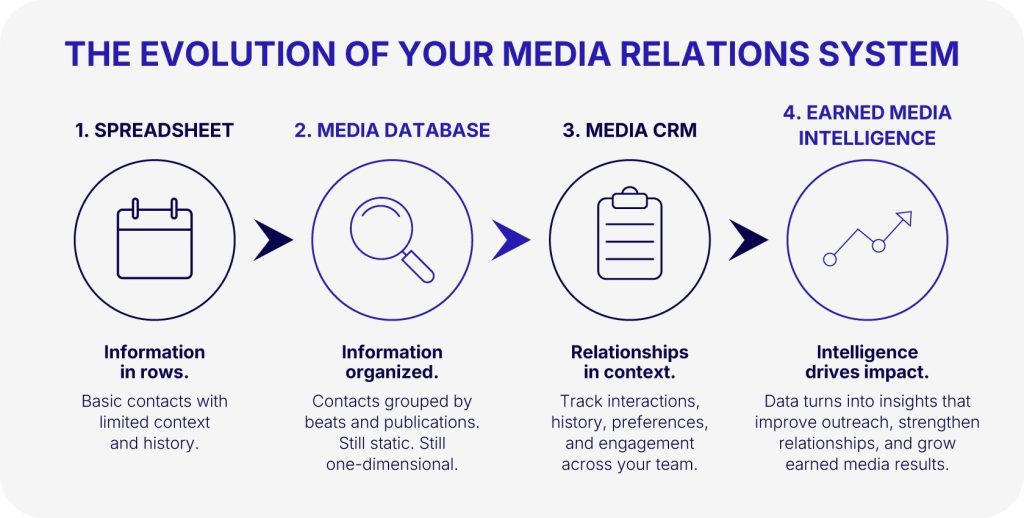
It’s also important to draw distinctions between a contact list, media database, and media CRM. These terms are often conflated or used interchangeably to the detriment of PR efforts, but the differences are clear:
| Resource | Primary Purpose | Typical Limitations |
| Contact List | Stores basic journalist contact information | Quickly becomes outdated and lacks context |
| Media Database | Organizes journalists by publication, beat, and industry | Often functions as a static reference without relationship history |
| Media CRM | Centralizes contacts, relationship history, outreach tracking, engagement metrics, and reporting | Requires ongoing maintenance to remain valuable |
More Relationship-Driven PR
Shifting from a media database to a media CRM is similar to the transformation that has already taken place in sales. For scaling organizations, spreadsheets are fossils, gone the way of rolodexes and handwritten ledgers.
High-performing sales teams now use CRM platforms to:
- Track Every Interaction
- Identify Buying Signals
- Continuously Improve Performance
Modern PR teams are following suit. Instead of treating outreach like a disconnected campaign series, they’re replacing one-off media contact lists with systems that:
- Sustain Institutional Knowledge
- Nurture Journalist Relationships
- Continuously Optimize Outreach
Relationships Should Outlast Campaigns
A modern media CRM supports an always-on approach to media relations.
This means building a centralized database that grows in value with every interaction rather than creating a brand-new media list for every milestone.
With a media CRM, you don’t have to worry about key interactions expiring when a campaign ends. This includes things like:
- Coverage History
- Response Rates
- Pitching Preferences
- Relationship Notes
These data points become long-term assets, helping you deliver more relevant outreach and build stronger, long-term media relationships.
Why Enterprise Teams Invest in Media CRMs
The best PR teams understand that journalist data is more than operational — it’s strategic.
Document every interaction, including:
- Conversations
- Responses
- Follow-ups
- Media Placements
This makes PR more scalable, measurable, and consistent across the entire organization.
When employees leave or campaigns end — instead of losing context — you’ll have a shared source of well-organized data that improves:
- Collaborations
- Reporting
- Long-term Earned Media Performance
Key Takeaways
- A media CRM isn’t just where journalist information lives — it’s where journalist relationships grow.
- Every interaction is valuable data — not just a one-time activity.
- Build a system that continuously improves outreach, reporting, and earned media performance.
Pro Tip: Treat your media CRM as a living system, not a one-time project. Every journalist interaction — from a pitch reply to a published story — adds valuable context that makes future outreach more relevant, personalized, and effective.
Every journalist interaction is data — but that data creates the most value when it informs your long-term PR strategy. Learn more here: How to Write an Effective PR Plan [Tips + Examples]
Why Traditional Media Lists Fail
A media list helps you launch a campaign, but it doesn’t help make the next one better.
Traditional media lists are usually created for a singular milestone — announcement, event, or product launch.
When the campaign ends, the list evaporates with outreach. All the relationship data that could benefit future campaigns — who responded, which angles resonated, when a journalist changed beats, or why a pitch fell flat — is rarely captured.
Static Lists Create Static Results
Spreadsheets are designed to log info, not track relationships. While they’re good for organizing contact details, they lack the context needed to inform outreach strategy.
Without a centralized system, teams struggle with:
- Outdated Contact Information
- Duplicate or Inconsistent Records
- No Outreach or Response History
- Generic, Impersonal Media Lists
- Limited Visibility (into journalist preferences or recent coverage)
- Difficulty Measuring Outreach Performance
- Inconsistent Collaboration Across Teams
Institutional Knowledge Gets Lost
Loss of institutional knowledge is a major detriment of traditional media list dependence.
Outreach history resigned to individual inboxes or someone’s memory is destined to disappear. When employees change roles or campaigns conclude, wave goodbye to that interaction info.
Example: You pitch a journalist without realizing a colleague reached out to them two weeks ago with the same story. The duplicate outreach frustrates the journalist, weakens the relationship, and reduces the likelihood of future engagement — all due to a lack of coordination.
A media CRM prevents situations like this by preserving every meaningful interaction.
You don’t have to start from scratch with each campaign. Instead, build on the preserved interaction data — previous conversations, response patterns, and coverage history — centralized in a media CRM.
This creates more relevant and personalized outreach.

Pro Tip: Make every journalist interaction part of your organization’s institutional knowledge. Capturing outreach history, relationship notes, and coverage outcomes in one place helps your team build stronger media relationships over time without starting from scratch every campaign.
If your outreach still relies on static media lists, strengthening your media relations strategy is the next step: From Pitch to Publication: How Media Relations Drives PR Success [Examples + Tips]
The 6 Core Components of a High-Performance Media CRM
A high-performing media CRM does a lot more than organize contact info — it provides the context needed to make smarter outreach decisions. It pulls from profiles, interactions, and performance metrics that contribute to a total rendering of your media relationships.
Since every journalist interaction is data, your well-structured media CRM makes sure that data is easy to:
- Capture
- Analyze
- Act On
While individual organizations customize their CRM to fit a specific workflow, the best systems have six core components in common.
1. Comprehensive Journalist Profiles
A strong media relationship starts with a complete and accurate journalist profile. Beyond basic phone numbers and email addresses, your CRM should include details that streamline personalized outreach and pitching relevance.
Include information such as:
- Name and Publication
- Job Title and Role
- Primary and Secondary Beats
- Industries Covered
- Geographic Focus
- Social Media Profiles
- Preferred Pitching Methods (when known)
- Valuable Notes (on content preferences or editorial interests)
The more robust each profile becomes, the easier it is to identify the best fit for your story.
2. Coverage History Tracking
You need to know more than just who a particular journalist is. Familiarize yourself with past and recent articles as well as how they’ve previously engaged with your organization. This provides valuable context for future outreach.
Things you should be tracking include:
- Previous Media Coverage
- Executive Interviews
- Quote Requests
- Published Articles
- Brand Mentions
- Topics Covered
- Dates of Coverage
Having a detailed historical record reduces the risk of repetitive pitching while highlighting opportunities to reengage based on past interactions.
3. Tier Segmentation
You don’t need to give every journalist equal attention. Divide them into levels based on priority. This helps teams use time and resources more efficiently.
A simple framework might include:
- Tier 1: High-authority journalists who consistently influence your target audience.
- Tier 2: Relevant industry reporters with moderate reach or specialized expertise.
- Tier 3: Niche publications, emerging writers, and regional media.
- Emerging Contacts: New journalists or recently identified opportunities worth developing.
Don’t base tier placement on publication size. A segmented list is fluid. Contacts should move between tiers, depending on engagement, as relationships change.
4. Beat Categorization
Accurately categorizing based on beat makes your media CRM way more valuable than a simple contact list. Forget broad industry labels — organize journalists by the themes and topics they actively cover.
Examples include:
- AI
- Cybersecurity
- Fintech
- Healthcare
- Enterprise Software
- Venture Capital
- Startups
- Sustainability
- Manufacturing
- Public Policy
This helps to quickly identify which journalists are most aligned with your announcement or campaign.
5. Relationship Status Tracking
Relationships evolve over time. Your media CRM should reflect that evolution. By tracking relationship status, you clearly see where each journalist stands and what the next interaction should be.
A simple status framework should include tags like:
- New Contact
- Researched
- First Pitch Sent
- Responded
- Ongoing Conversation
- Active Relationship
- Trusted Contact
- Dormant
- Do Not Pitch
This way, you’re not treating every journalist the same. The context provided by these status updates improves collaboration across the entire communications team.
6. Engagement Metrics
The best media CRMs don’t just measure activity — they measure engagement. By tracking how journalists interact with your outreach, you reveal patterns that help improve future campaigns.
Helpful metrics include:
- Emails Sent
- Response Rate
- Positive Response Rate
- Follow-up Frequency
- Interviews Secured
- Media Placements
- Last Interaction Date
- Relationship Score
Over time, these metrics show which outreach strategies are generating the most meaningful engagement.
Media CRM Structure
A well-organized media CRM brings these core components together into a single, searchable system.
| Category | Example Fields |
| Contact Info | Name, publication, title, email, LinkedIn, X profile |
| Coverage Details | Beats, industries, recent articles, geographic focus |
| Relationship Management | Status, last interaction, relationship notes |
| Outreach Activity | Pitch history, follow-ups, responses, interviews |
| Performance Metrics | Response rate, placements, engagement score |
| Administrative | Contact owner, last verified date, tags |
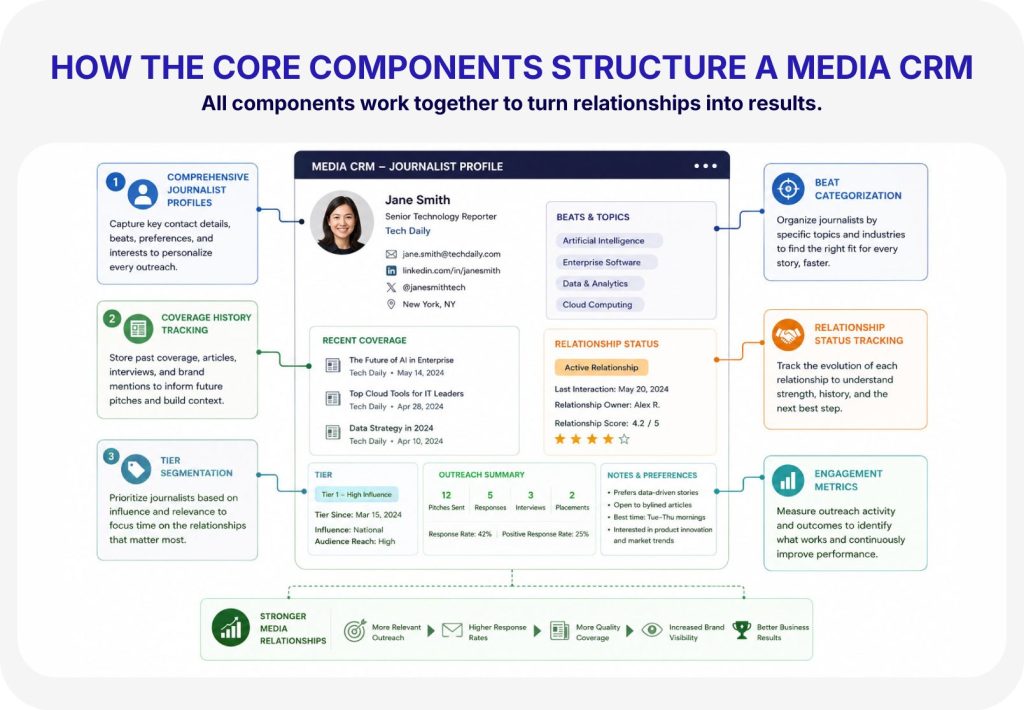
While these core components create the foundation of a truly effective media CRM, they perform best when they’re organized in a way that helps teams quickly identify the right journalists for every story.
That’s where thoughtful journalist segmentation comes in.
How to Structure Journalist Segmentation
The number of journalists a media CRM contains isn’t important — it’s how quickly it helps you identify the best fit for a story.
Instead of grouping contacts into broad categories, organize journalists across multiple dimensions that reflect:
- Relevance
- Expertise
- Influence
- Relationship Strength
Your goal isn’t to create a bunch of lists — it’s to create smarter, more efficient ones. Thoughtful segmentation pulls from all of your interaction data to inform who to contact, when to contact them, and how to personalize your pitch.
Segment by Beat
Journalist beats are the bedrock of your segmentation strategy because it’s what they’re actually writing about.
Example: If you’re announcing a new AI product, your first filters might include:
- AI
- Enterprise Software
- Data & Analytics
This way, you won’t send the same pitch to every tech reporter in your database.
Also, remember that journalists frequently change beats. It’s important to continuously track and update their coverage info. This ensures your story gets in front of journalists whose editorial focus best aligns with your news.
Segment by Industry and Audience
Two journalists who cover the same topic might have completely different audiences. Segment by industry and readership to match your messaging to the readers you most want to reach.
Consider categorizing journalists by:
- B2B vs. B2C
- Enterprise vs. SMB
- Startups vs. Public Companies
- National vs. Regional
- Trade Publications vs. Mainstream Media
- Technical vs. Executive Audiences
Example: You would tailor a funding announcement one way for venture capital reporters, another for startup publications, and a third for enterprise tech media — each highlighting the details most relevant to that audience.
Adding an extra layer of segmentation makes outreach more precise and improves the likelihood of engagement.
Segment by Relationship Strength
Data related to relationship status is as important as editorial relevance. If you’ve already had success working with a particular journalist, they may be a better option than a reporter with a wider audience but no established relationship.
Example: If you’ve interviewed with a journalist several times, send them an exclusive pitch or early embargoed briefing. If it’s a new contact, send them a personalized introduction before any formal story pitch.
Having an up-to-date framework of relationship status tags helps prioritize relationship-building rather than lumping contacts into a generic mass of equal outreach.
Prioritize Journalists with a Scoring Model
Many enterprise PR teams go even further by attributing a simple score to journalists based on multiple factors. Far from the “spray and pray” days of old, this scoring approach removes all guesswork by creating an objective way to prioritize outreach.
A basic scoring model evaluates:
- Beat Relevance: Does the journalist regularly cover your industry?
- Relationship Strength: Have they engaged with your team previously?
- Recent Activity: Have they published on your topic recently?
- Response History: Do they typically reply to your outreach?
- Influence: How closely does their publication align with your target audience?
A simple framework might look like this:
| Scoring Factor | Points |
| Covers your primary beat | +5 |
| Published on the topic within the last 30 days | +4 |
| Responded to a previous pitch | +3 |
| Existing relationship | +3 |
| Tier 1 | +2 |
How journalists are scored will vary by organization, but the aim is the same — identify journalists who are most likely to care about your news.
Example: A journalist covering AI who recently responded to your last pitch and writes for a Tier 1 publication would receive a higher priority score than someone who covers tech broadly but has no previous engagement.
Segmentation Table Example
| Journalist | Primary Beat | Audience | Relationship Status | Priority Tier |
| Jerry S. | AI | Enterprise B2B | Active Relationship | Tier 1 |
| Elaine B. | Cybersecurity | IT Leaders | Occasional Engagement | Tier 2 |
| George C. | Venture Capital | Startup Founders | New Contact | Tier 2 |
| Cosmo K. | Manufacturing | Trade Media | Trusted Contact | Tier 1 |
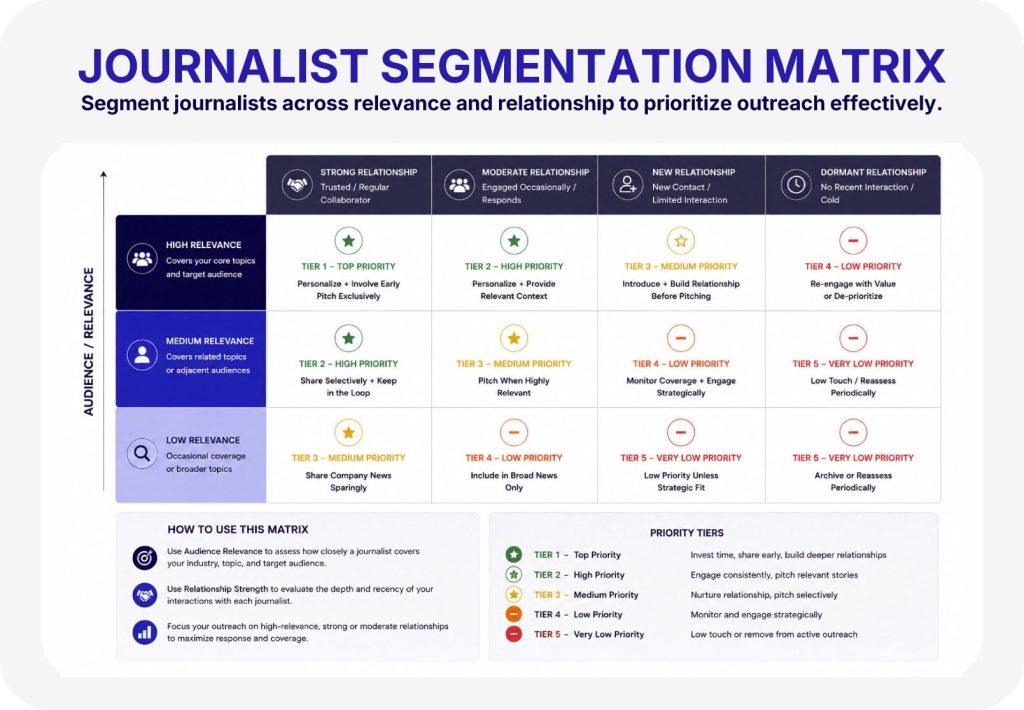
Pro Tip: Segmentation isn’t about organizing contacts — it’s about optimizing outreach. Use the data in your media CRM to determine who receives a pitch, when they receive it, and what angle is most likely to resonate.
Want to put your segmentation strategy into practice? Learn how targeted outreach improves journalist engagement and boost response rates in our guide: Fewer Emails, Better Journalist Response Rates: Why Precision Media Outreach Outperforms Mass Pitching [Examples + Tips]
Tracking Outreach and Response Rates
Now that we’ve covered how to organize data, it’s time to talk about how to use it.
Once you’ve built a well-organized media CRM, you’re only halfway there. The next phase is where you derive real value — and that comes from tracking what happens after you hit “send.”
Every interaction tells you something about your outreach strategy. Over time, that data helps teams:
- Identify patterns
- Refine Messaging
- Build Stronger Media Relationships
Track the Entire Outreach Journey
Don’t just record whether a story earned coverage — document every meaningful touchpoint throughout the entire outreach process. This means tracking the very first email, final contact, and everything in between.
To get a panoramic view of journalist engagement — and insights on areas that need improvement — capture and organize these activities:
- Initial Pitch Sent
- Email Opened (if available)
- Follow-up Emails
- Journalist Responses
- Requests for Additional Info
- Interviews Scheduled
- Declined Opportunities
- Published Coverage
- Last Interaction Date
These milestones not only show where conversations progress but also where they stall.
Measure the Metrics That Matter
More emails and more activity don’t necessarily improve results. Focus on the metrics directly linked to the overall quality and effectiveness of your outreach strategy.
Monitor KPIs such as:
- Overall Response Rate
- Positive Response Rate
- Media Placement Rate
- Repeat Engagement Rate
- Time to First Response
- Coverage by Journalist Segment
- Relationship Growth Over Time
Every organization will prioritize different KPIs. The goal is to focus on metrics that reflect engagement and relationship quality — not just email volume.
For a deeper look at the PR metrics that matter most, explore our guide: 10 Key PR Metrics You Must Measure to Gauge Success
Look for Patterns, Not Just Results
A single, high-quality placement is encouraging, but real insights come from spotting trends across a multitude of interactions.
Example: Your CRM may reveal that:
- Tier 1 journalists respond more frequently to exclusive pitches.
- Cybersecurity reporters engage most with original research.
- Funding announcements generate stronger responses on Tuesday mornings.
- Personalized follow-ups outperform generic reminders.
Instead of relying on assumptions, these patterns help you continuously refine outreach strategies.
Outreach Tracking Workflow
A simple workflow might look like this:
| Stage | Example Status |
| Pitch Sent | Initial outreach delivered |
| Follow-up | Polite reminder sent after several days |
| Response Received | Journalist replied |
| Interview Scheduled | Additional information requested |
| Coverage Published | Story successfully placed |
| Relationship Updated | Notes and engagement history recorded |
Tracking the total outreach journey guarantees that every interaction contributes to future decision-making.
In time, your media CRM becomes more than just an activity log — it becomes a key source of insights that improve:
- Targeting
- Messaging
- Relationship Management
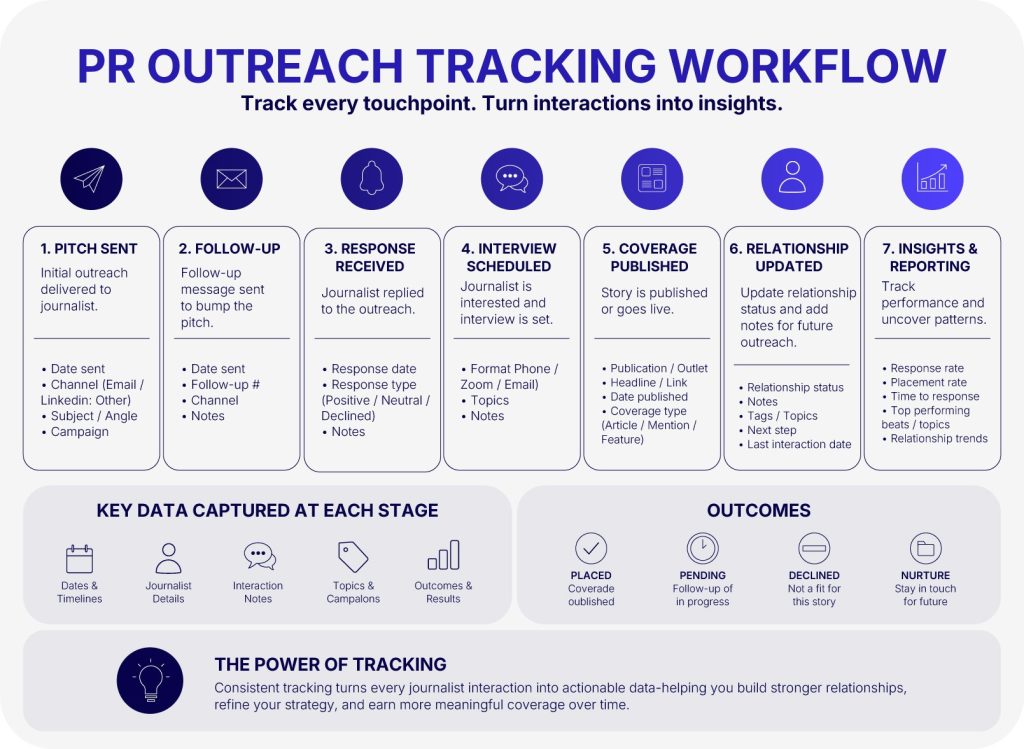
Pro Tip: Don’t measure success by how many pitches you send. Measure how journalists engage at each stage of the outreach process. Those engagement patterns are often the clearest indicators of what’s working — and where your strategy needs to tighten up.
Looking to improve outreach efficiency and uncover opportunities for better campaign performance? We’ve got you covered: The PR Audit Guide: A Step-by-Step Framework for High-Performance Teams
Maintaining Data Hygiene
Data quality is directly tied to outreach quality and your media CRM as a whole. Journalist info is constantly changing, and without regular maintenance, even the best CRMs become inefficient over time.
Practicing good data hygiene means keeping data accurate and standardized.
This leads to:
- Make Better Decisions
- Improve Collaboration
- Maximize Earned Media Performance
Regularly Verify Contact Information
Contact info isn’t etched in stone. In fact, journalist attributes change often. Habitually verify their records and update your media CRM when changes happen.
Review items such as:
- Email addresses
- Publications
- Job Titles
- Primary and Secondary Beats
- Geographic Coverage
- Social Media Profiles
Keeping profiles current is essential to relevant outreach.
Remove Duplicates and Outdated Records
Duplicate contact entries and outdated records are the main sources of outreach confusion and wasted time.
To avoid this, follow the CAR method:
- Consolidate duplicate entries.
- Archive inactive contacts when appropriate.
- Remove records that are no longer useful.
A tidy database also improves reporting accuracy by making sure engagement metrics aren’t divided across multiple profiles.
Standardize Data Entry
How organized your media CRM is also depends on how the data was entered. You want every team member to record information the same way, so establish consistency for things like:
- Naming Conventions
- Required Fields
- Tagging Standards
- Status Definitions
Example: Instead of using multiple status labels like Active, Engaged, Working With, or In Progress to describe similar relationships, stick to one standardized framework that everyone follows.
Consistency makes the entire outreach process significantly easier.
Schedule Routine CRM Audits
Data hygiene is an on-going practice — not a “something’s wrong” recovery chore. Establish a periodic review process to keep your CRM in good shape throughout the year.
A quarterly audit includes:
- Verifying Contact Information
- Updating Beats and Publications
- Removing Duplicate Records
- Reviewing Relationship Statuses
- Confirming Ownership of Contacts
- Archiving Inactive Journalists
- Checking for Incomplete Profiles
Routine audits prevent minor issues from becoming database disasters.
Example Status Tagging Framework
At a glance, you should be able to tell where each journalist relationship stands.
| Status | Purpose |
| New Contact | Recently added to the CRM |
| Active | Regular outreach and engagement |
| Recently Viewed | Contact info confirmed |
| Needs Review | Info may be outdated |
| Moved Publications | Journalist changed outlets |
| Dormant | No recent engagement |
| Do Not Pitch | No longer appropriate for outreach |
Clean and standardized data doesn’t just enhance daily workflow — it strengthens every downstream activity:
- Journalist Segmentation
- Outreach Tracking
- Executive Reporting
- Earned Media Measurement
Use our Data Hygiene Checklist to keep your data accurate, consistent, and actionable.
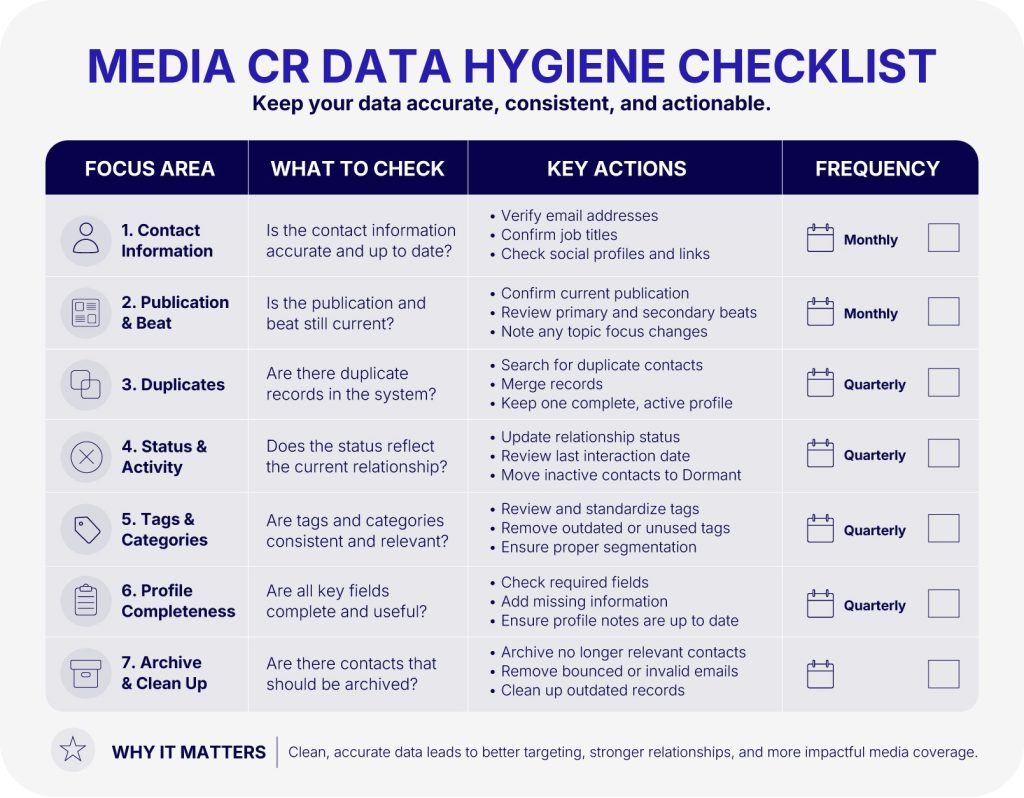
Pro Tip: Great data doesn’t maintain itself. Assign clear ownership of your media CRM so journalist profiles, relationship history, and status updates stay accurate, consistent, and ready to support better outreach decisions.
One of the easiest ways to keep your Media CRM current is by monitoring changes in journalist attributes. Learn how to build an effective monitoring strategy here: A Full Guide to Mastering Media Monitoring in 2026 [+ Examples]
Integrating Your Media CRM With PR Reporting
Your media CRM should power your PR reporting process.
When all that data from journalist interactions is organized consistently, it lays the groundwork for powerful, board-level PR reporting. Instead of simply keeping track of coverage quantity, your media CRM answers these key questions:
- How have media relationships developed?
- Which outreach strategies perform best?
- Where do future opportunities exist?
Connect Outreach Activity to Performance
Traditional PR reports are more outcome-focused — media placements or SOV. While those metrics matter, they don’t explain what led to the results.
A media CRM connects outreach activity with campaign performance. This adds valuable context, helping you not only report on what happened but also why it happened.
For example, you analyze:
- Response Rates by Journalist Segment
- Placements by Industry or Beat
- Performance by Outreach Campaign
- Follow-up Effectiveness
- Relationship Growth Over Time
- Repeat Engagement with Key Journalists
These insights help with future outreach refinement rather than simple past activity summarizations.
Build More Actionable PR Dashboards
A high-performance dashboard blends relationship data with campaign results, creating a more complete picture of earned media performance.
Consider including metrics such as:
- Active Journalist Relationships
- New Media Contacts Added
- Response and Positive Response Rates
- Media Placements
- Repeat Coverage from Existing Relationships
- Top-performing Beats or Industries
- Relationship Status Distribution
- Outreach Activity by Campaign
Tracking these metrics over time helps:
- Identify Trends
- Measure Progress
- Support Informed Decision-making
Support Executive and Board Reporting
Leadership doesn’t want to hear about the number of emails sent or stories published — they want to know how PR supported key business objectives.
A media CRM provides the data you need to answer important questions like:
- Are journalist relationships expanding over time?
- Which industries or audiences generate the strongest media engagement?
- Are response rates improving?
- Which campaigns consistently produce earned media?
- Where should future outreach efforts be prioritized?
When you connect outreach activity to measurable outcomes, you deliver board-level reporting that demonstrates both operational performance and strategic impact.
PR Reporting Dashboard Model
| Category | Example Metrics |
| Relationship Health | Active relationships, new contacts, relationship growth |
| Outreach Performance | Response rate, positive response rate, follow-up effectiveness |
| Coverage Results | Media placements, repeat coverage, top-performing publications |
| Campaign Insights | Performance by campaign, beat, or industry |
| Trends | Monthly outreach volume, engagement trends, relationship progression |
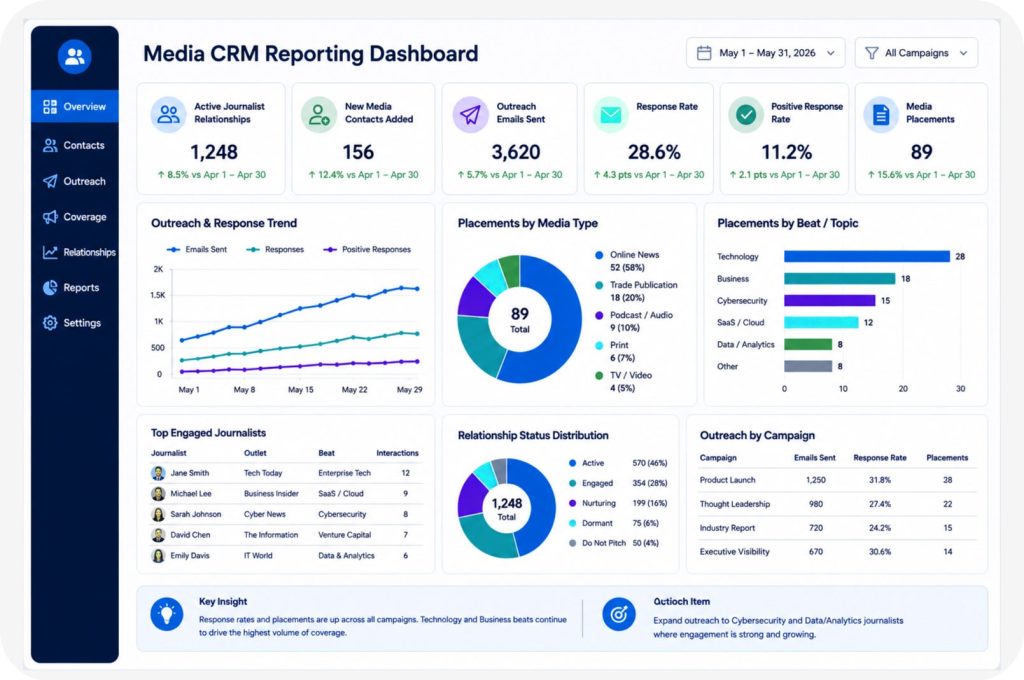
The strongest PR reports never measure activity alone — they clearly and concisely demonstrate performance. If you practice proper data hygiene, your media CRM will continuously:
- Provide the necessary context for Campaign Success.
- Reveal opportunities for refinement and improvement.
- Prove how media relationships contribute to long-term goals.
Pro Tip: Don’t wait until the end of a campaign to review your CRM data. Ongoing reporting helps you spot engagement trends, refine outreach strategies, and make informed decisions while campaigns are still in progress.
Ready to transform your CRM data into executive-ready insights? Read our guide: Beyond Impressions: PR Reporting That Boards and Investors Actually Want to See in 2026 [Example + Tips]
Then explore the 7 Step Guide to PR Analytics: Unveiling Insights for Strategy Enhancement to build dashboards that measure the metrics that matter most.
5 Common Media CRM Mistakes
Even the most experienced PR teams forget their media CRM is a living relationship management system and treat it like a static database.
Data from journalist interactions only creates value when it’s:
- Organized
- Maintained
- Used strategically
Here are five of the most common media CRM mistakes — and how to avoid them.
1. Treating Your CRM Like a Spreadsheet
Contact lists store information. Media CRMs capture relationships.
If your database only contains basic contact info, you’re missing out on the requisite contextual data necessary for outreach personalization and long-term performance improvement.
Record everything from relationship history and outreach activity to journalists preferences and engagement metrics.
2. Sending the Same Pitch to Everyone
Generic outreach only leads to lower response rates and weaker relationships.
Never blast the same message to your entire database. Always use segmentation to personalize pitches based on:
- Beats
- Industries
- Audience
- Relationship Status
- Previous Engagement
3. Letting Data Become Outdated
Journalists are constantly changing roles, publications, and editorial priorities. If you fail to update your media CRM, you’ll end up bouncing emails, sending irrelevant pitches, and missing out on valuable opportunities.
Schedule regular CRM maintenance before the next campaign to:
- Verify Contact Info
- Update Beats
- Archive Inactive Records
4. Tracking Activity Instead of Performance
More pitches and better results aren’t mutually inclusive.
Don’t measure outreach volume alone. Do focus on metrics that reflect engagement and relationship quality, such as:
- Response Rates
- Repeat Coverage
- Relationship Growth
5. Failing to Connect CRM Data With Reporting
A media CRM hates being lonely, so don’t let yours exist in isolation. Outreach data should inform campaigns and strategic decision-making. Otherwise, you’re forfeiting one of its biggest benefits.
You need to integrate media CRM insights into your PR reporting process to not only prove business impact but spot opportunities for ongoing program optimization.
Use our checklist to avoid these mistakes.
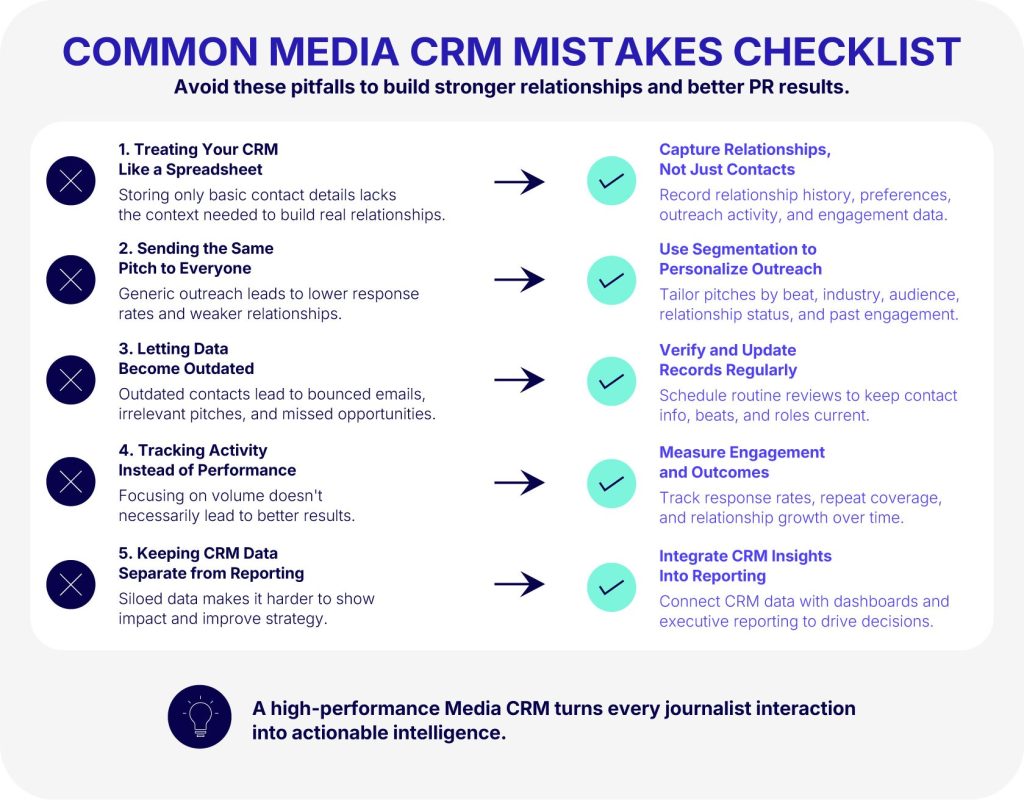
You’ll transform your media CRM from a simple contact database to a strategic asset that supports:
- Stronger Media Relationships
- Board-ready PR Reporting
- More Consistent Earned Media Results
Pro Tip: Build media CRM updates into your team’s standard workflow. When every campaign ends with a quick database review, your CRM remains accurate, your reporting stays reliable, and future outreach becomes more effective.
Find more resources on PR mistakes to avoid here:
How a Media CRM Improves Earned Media ROI
High-performance media CRMs don’t generate earned media on their own — they open the door to smarter decision-making at every stage of the outreach process.
When every interaction is captured and catalogued, that data becomes a strategic advantage for improving earned media ROI.
Increase Outreach Efficiency
You don’t need to rebuild a media list for every campaign. A solid media CRM lets teams quickly find the best journalist for a story.
Time isn’t wasted sifting through endless, irrelevant contacts — it’s spent developing meaningful relationships with reporters who actually care about and cover your news.
Improve Journalist Engagement
Relevant outreach leads to more successful engagement.
A well-maintained media CRM lets you leverage:
- Journalist Segmentation
- Relationship History
- Engagement Data
This helps teams deliver more timely, personalized pitches that align with each journalist’s interests and editorial focus. The result is:
- Stronger Relationships
- Higher Response Rates
- More Consistent Earned Media Opportunities
Make Better Strategic Decisions
A media CRM turns outreach data into actionable insights.
Rather than crutching on assumptions, PR leaders are able to answer these key questions:
- Which journalist segments respond best?
- Which campaigns generate the strongest engagement?
- Where should future outreach efforts be focused?
This helps teams continuously refine their strategy based on data-backed evidence instead of hunches.
Demonstrate the Business Value of PR
Executives want to know how PR is supporting broader business objectives.
A media CRM provides the context you need to demonstrate that support because it connects:
- Outreach Activity
- Relationship Development
- Campaign Performance
- Reporting
If you’re reporting to marketing leadership, executive teams, or board members, your media CRM data proves how stronger media relationships contributed to sustainable earned media performance.
How a Media CRM Creates ROI
| Media CRM Capability | Business Impact |
| Journalist segmentation | More relevant outreach |
| Relationship Tracking | Stronger long-term media relationships |
| Outreach tracking | Higher response and placement rates |
| Data hygiene | More accurate reporting and analysis |
| CRM reporting | Better strategic decision-making |
| Continuous optimization | Greater earned media ROI over time |
A media CRM isn’t just a better way to organize media contacts — it’s a smarter way to enhance every stage of the earned media lifecycle. If you treat journalist relationships as meaningful, long-term assets and continuously learn from each interaction, you will build a more measurable, scalable, and effective PR program.
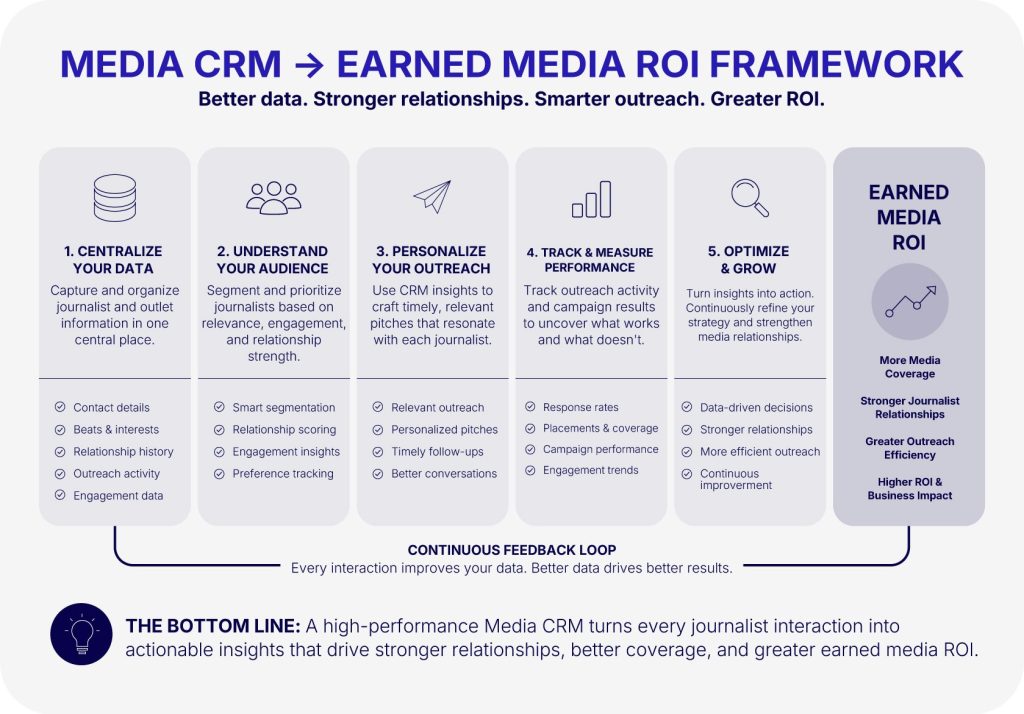
Pro Tip: Measure the success of your media CRM by the quality of your relationships and the insights it generates — not by the size of your contact database. The most valuable CRM is the one your team actively uses to make better outreach decisions.
Want to quantify the impact of those improvements? Read our guide Earned Media Measurement: The Executive Playbook for PR ROI in 2026 to learn how to measure the business value of your PR efforts using executive-ready frameworks and meaningful performance metrics.
Your Media CRM Should Be a Growth Engine, Not Just a Contact List
Media databases aren’t static spreadsheets — they’re living systems that become more valuable with every campaign. When you capture, maintain, and analyze data from every interaction you begin to see these transformations:
- Outreach becomes smarter.
- Relationships become stronger.
- Reporting becomes more meaningful.
- Earned Media ROI becomes better.
Whether managing communications for a growth-stage B2B brand or leading an enterprise PR team, a well-maintained media CRM elevates your outreach from ad-hoc pitches to a repeatable, data-driven engine that gets exponentially stronger with each campaign.
Ready to uncover opportunities that strengthen your media outreach strategy, improve journalist engagement, and maximize the value of your media CRM?
Book a free consultation with us today. We’ll help you optimize workflows, refine outreach strategy, and turn journalist data into a lasting competitive advantage.