PR for Startups: A Scalable Budgeting Blueprint for Series B–D [Examples + Tips]
In the early stages of a startup, PR is something used to get a foot in the door, generate an initial buzz, and have your mission validated. But as you grow to series B–D, your focus and intentions need to change drastically. When you reach these s...
- Home
- Intelligent Insights Blog
- PR for Startups: A Scalable Budgeting Blueprint for Series B–D [Examples + Tips]

In the early stages of a startup, PR is something used to get a foot in the door, generate an initial buzz, and have your mission validated. But as you grow to series B–D, your focus and intentions need to change drastically.
When you reach these stages, mentions and visibility are a given. Strategic growth should become an involuntary function that continuously influences the perception of buyers, investors, and the broader market.
To put it plainly, the stakes are higher. You’re dealing with aggressive revenue targets, more sophisticated competition, and investor expectations that demand consistent categorical authority.
A common mistake (and major opportunity) is that a lot of startup PR guidance is still stuck in early-stage thinking. It emphasizes tactics like press releases, cold pitches, and founder storytelling — approaches that fail to address the complexity of scaling a B2B or tech company beyond $10M in revenue.
For VC-backed startups at the growth stage, PR must be approached differently. It requires:
- Structured Budget Allocation Models
- Clear Alignment with Revenue and GTM Strategy
- Defined Frameworks for Measuring ROI and Business Impact
- A Long-term View of Earned Media as a Compounding Asset
In this guide, we’ll break down how Series B–D startups need to think about PR investment — from how startup budgets evolve and what different spend levels actually deliver, to modeling ROI and knowing when to scale.
Because at this level, PR is much more than just a marketing expense — it’s a capital allocation decision that shapes market leadership.
- What PR for Startups Really Means at the Growth Stage
- How PR Budgets Evolve from Seed to Series D
- PR Budget Allocation Models for Growth-Stage Startups
- What $5K vs $10K vs $20K/Month PR Programs Actually Look Like
- Earned vs Paid Media: Budget Tradeoffs at Scale
- How to Measure Startup PR ROI (Beyond Vanity Metrics)
- 7 Common PR Budget Mistakes Growth-Stage Startups Make
- When to Scale PR Investment
- In-House vs Agency vs Augmented PR Models
- How PR Supports Fundraising, Hiring, and Sales
What PR for Startups Really Means at the Growth Stage
Once you reach series B–D, PR goes from a coverage function to a machine that molds market perception at scale.
In earliest stages of startups, PR is driven by moments:
- Launch Announcements
- Funding Rounds
- Founder Stories
But at the growth-stage, it’s all about momentum over moments. That requires a consistent, intentional presence in the conversations that define your category.
From Awareness to Authority
The main shift at this stage is transitioning from sporadic visibility to sustained authority. You go from founder storytelling to category leadership by moving your focus beyond the narrative and positioning the company as a defining market voice.
At the early stage, you want to shout your origin story from the rooftops. But let’s say you’re now a series C cybersecurity company:
- You publish an article on ransomware trends backed by owned research.
- That piece gets cited by journalists covering enterprise risks.
Congratulations you’re now a go-to source! You’ve gone from category participant to definitive presence.
Let’s keep the momentum going. Forget announcement-based efforts — continuity is the new mindset. Sure, coverage spikes tied to product launch press releases are fine at the early stage, but if you’re a growth-stage B2B, you need to build a quarterly coverage rhythm.
- Q1: Industry Report Launch
- Q2: Executive Commentary on Market Shifts
- Q3: Customer Success Stories in Trade Media
- Q4: Next-year Predictions
This is your media metronome, generating a steady tempo of authority and visibility — beats per minute (BPM) is your new metric.
In the earliest startup stage, celebrating 10 mentions, regardless of outlet quality, was significant. At the growth stage, you’re clocking top-tier features that get used in enterprise sales decks and close $100K+ deals.
Core Functions of PR at this Stage
At this level, your startup PR integrates directly into your growth infrastructure.
1. Category Creation and Positioning
There’s a problem in your industry. Be the solution. Now, direct the conversations in your category.
Example: If you’re a Series B AI infrastructure company, reframe your positioning from “automation software” to “decision intelligence platform.”
- Publish proprietary data on AI adoption.
- Secure keynote speaking opportunities tied to that narrative.
- Get quoted in articles using coined terminology.
In six months to a year, your competitors will start parroting your tune. And that imitation isn’t just flattery — it’s proof of market dominance.
2. Sales Enablement
Provide third-party validation in enterprise deals. Equip your sales teams with credible media coverage and thought leadership materials.
Example: You’re a Series C data platform. Embed recent coverage in pitch decks, use analyst quotes in outbound sequences, and share thought leadership content during late-stage deal cycles.
The result will be a lower risk perception from prospects, and your sales cycles will shorten because that external validation supplants internal claims.
3. Investor Narrative Development
This is where you reinforce your growth story and start building momentum ahead of future funding rounds.
Example: Six months before raising a Series D, you should take the following steps:
- Secure executive commentary in high-quality pubs.
- Publish a data-backed market outlook report.
- Get on a podcast or conduct media interviews to strengthen thought leadership.
When it’s finally time to drum up some money, investors will already be familiar with who you are and what you stand for.
4. Talent Brand Amplification
With market status, you’re able to attract top talent. The best candidates will prioritize your company as an employment goal in competitive hiring markets. When you signal stability, traction, and long-term vision, you become a magnet for high-performing workers.
Example: You’re a fast-growing DevOps company, and you’ve just secured coverage highlighting your engineering culture:
- Next, push thought leadership content from your CTO.
- Then amplify those media wins across LinkedIn and hiring campaigns.
High-quality potential hires start coming in with pre-established trust, eliminating hiring friction.
Why this Shift Matters
In B2B and tech markets, perception is an investment — and it compounds just like revenue. If you regularly pop up in trusted publications, contribute meaningful insights, and shape industry narratives, you’re no longer a passenger on the category ship — you’re at the helm.
Here’s what it looks like when a Series B company invests in a year-long PR program:
| Month | Result |
| Months 1–3 | Initial placements and messaging refinement |
| Months 4–6 | Increased inbound media opportunities |
| Months 7–12 | Recognized as a trusted expert industry source |
By the end of the year, sales teams will lean on earned media, competitors will want to be you, and investors will want to be with you.
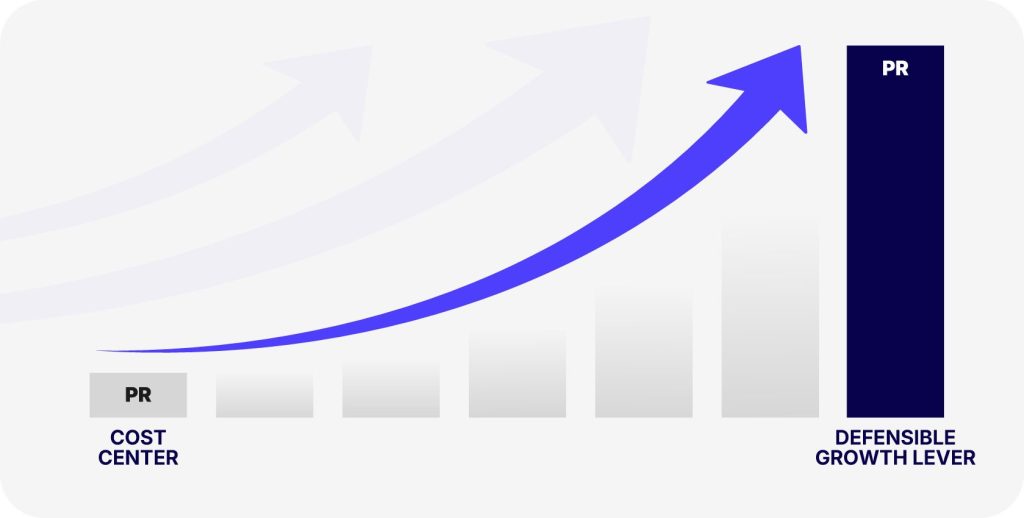
If you lack a strategic PR function, your growth-stage startup will be more likely to:
- Lose narrative control to competitors.
- Enter sales cycles with zero external validation.
- Appear less mature to investors and partners.
Key Insights
- PR shifts from awareness to growth enablement.
- Narrative ownership becomes critical.
- PR operates as an always-on function.
- Executive visibility is a strategic asset.
- PR integrates with go-to-market strategy.
Pro Tip: The most effective Series B–D startups align PR metrics with revenue outcomes — for example, tracking how a single tier-1 placement influences pipeline, accelerates deal cycles, or increases conversion rates in enterprise sales.
For more key metrics to gauge success, read our guide: 10 Best PR Metrics to Measure for Increased Success
How PR Budgets Evolve from Seed to Series D
PR spending doesn’t grow in a straight line — investment increases should track with things like:
- GTM Maturity
- Revenue Expectations
- Competition
At the seed stage, reactive PR suffices as you transition to a more tactical, annually budgeted program. But for Series B–D, your efforts should be aligned with business goals, supported by a significant budget allocation (15%–30% of revenue) as you grow a more proactive and ROI-focussed strategy.
The trick is not to underinvest at the growth stage. It’s a missed opportunity that creates narrative gaps your competitors will gladly fill.
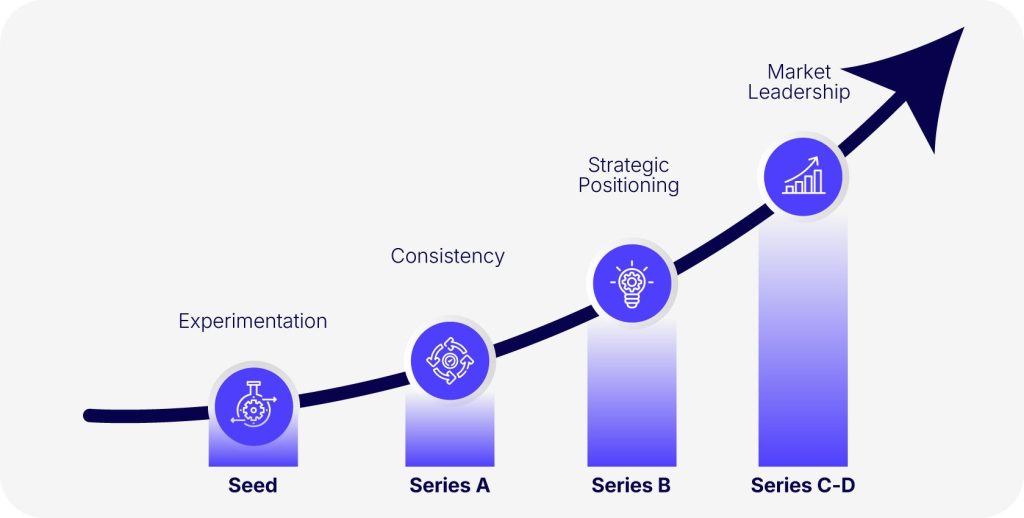
| Seed | Series A | Series B | Series C-D | |
| Budget Range | $0–$5K | $5K–$10K | $10K–$20K | $20K–$50K+ |
| PR Focus | Awareness | Traction | Positioning | Market leadership |
| KPI Model | Mentions | SOV | Tier 1 coverage | Pipeline influence |
As we continue, we’ll keep the focus on Series B–D.
Series B: PR as a Strategic Positioning Engine
At this stage, your PR comes to a fork in the road. One path is evolution. The other is a bottleneck.
So what changes?
- Your budget increases to support a proactive strategy.
- Messaging becomes more refined and category-driven.
- Leadership expects PR to contribute to market perception.
Your key outputs become tier-1 media coverage, data-driven thought leadership, and defined positioning in your category.
Example: You’re a Series B fintech startup. You commission a proprietary report on payment trends. That report becomes the foundation for media coverage, sales collateral, and investor conversations.
Now, your PR is starting to shape multiple business functions at the same time.
Series C–D: PR as Market Leadership Infrastructure
Your PR melds with your company’s growth strategy.
So, what changes?
- Your investment is more significant and sustained.
- Sales, marketing, and investors align.
- Executive visibility becomes a top priority.
Your key outputs become consistent top-tier coverage, speaking engagements, industry influence, and narrative dominance in your category.
Example: You’re a Series D enterprise software company. You not only need to maintain a steady flow of coverage in top outlets but regularly publish data-driven insights and become a go-to quote machine for journalists and analysts.
Now, your PR is a self-reinforcing cycle of visibility and authority.
Key Insights
- PR investment needs to grow with GTM complexity.
- Series B is the critical inflection point.
- Underinvestment creates competitive risk.
- Later-stage PR drives measurable business impact.
- Budget maturity reflects strategic maturity.
Pro Tip: If your company has scaled revenue, headcount, and sales complexity — but your PR budget still resembles a Series A investment — you’re likely underinvesting in one of your most important market perception levers.
Need to write a PR plan that gets results? We’ve got you covered: How to Write an Effective PR Plan [Tips + Examples]
PR Budget Allocation Models for Growth-Stage Startups
When you’re a Series B–D, you’re no longer asking if and when to invest in PR — the question becomes “How much will it take to drive measurable growth?”
Investment should be intentional, repeatable, and aligned with broader GTM strategy. If you treat budgets like random or fickle finance decisions, you’ll get stuck in a budget rut.
Instead, use structured allocations models that maintain consistency with some wiggle room for necessary adjustments.
Model 1: Percentage of Revenue Approach
This approach is ARR-based and tied directly to company performance. The typical range is between 0.5%–2% of annual revenue and is best suited for:
- Companies with Predictable Revenue Growth
- CFO-led Budgeting Environments
- Organizations Prioritizing Efficiency and Benchmarking
How it works: Your ARR is $25M — allocate 1% ($250K annually) to a $20K/month budget and scale in pace with revenue growth.
The upside to this budget model is that it’s performance-aligned, easy to justify, and proportionate to growth.
- The downside is that opportunistic moments — category creation, expansion, etc. — may be underfunded, and it doesn’t account for spikes in competition.
Model 2: Flat Monthly Investment
This is a common budget model for growth-stage startups. The typical range is $10K–$30K/month (depending on maturity and goals) and is best suited for:
- Companies Prioritizing Consistency
- Teams Working with Agencies or Strategic Partners
- Organizations Building Always-on PR Programs
How it works: You have a fixed monthly retainer that supports ongoing strategy, outreach, and content creation — expectations for output and outcomes are crystal clear.
The upside to this budget model is that it’s predictable and easy to optimize. It’s conducive to steady coverage flow and simplified vendor relationships.
- The downside is that results may become static if not regularly evaluated, and this model tends to lack flexibility for major campaigns or announcements.
Model 3: Hybrid Model
This model blends consistency with strategic flexibility — a baseline that also accounts for campaign spikes. A typical retainer range is $10K–$20K/month while an additional $15K–$50K may be required for key initiatives.
It’s best suited for:
- Companies Preparing for Major Milestones (fundraising, product launches, M&A)
- Teams Needing Always-on Visibility and High-impact Moments
How it works: You need to maintain steady, year-round PR activity. Put additional investments toward funding rounds, market expansion, and major product launches.
The upside to this budget model is that it helps balance long-term narrative building with short-term impact. It also maximizes ROI for high-leverage moments and prevents underinvestment during critical windows.
- The downside is that this model requires a lot more planning and may create inefficiencies if your campaigns aren’t integrated strategically.
How Leading Startups Actually Allocate PR Budgets
Models aside, how spending is spread really comes down to five core areas.
| Category | % Allocation | Description |
| Agency / Partner | 40–60% | Strategy + execution |
| Content Development | 10–20% | Thought leadership |
| Data / Insights | 10–15% | Surveys, reports |
| Distribution Amplification | 10–20% | Paid support |
| Measurement Tools | 5–10% | Attribution + analytics |
$20K/month Budget Example
Here’s how Series B and C companies might spend $20K monthly:
- $10K–$12K goes to a strategic partner (core PR execution).
- $3K–$4K goes to content creation (bylines, reports, messaging).
- $2K–$3K goes to data initiatives (surveys, insights).
- $2K–$3K goes to amplification (paid distribution, social).
- $1K–$2K goes to measurement tools (monitoring, attribution).
With this structure, your PR efforts aren’t just generating coverage — they’re keeping that repeatable narrative wheel spinning.
Key Insights
- There’s no one-size-fits-all PR budget model.
- Flat monthly and hybrid models dominate at Series B–D.
- Allocation matters more than total spend.
- Data and content are force multipliers.
- The best budgets are built for scalability.
Pro Tip: If the majority of your PR budget is going toward outreach alone, you’re underinvesting in the elements that actually make coverage predictable, scalable, and defensible.
For more on budgeting, read our guide: How Much of Your Marketing Budget Should You Really Spend on PR? It’s A Lot Less Than You Think
What $5K vs $10K vs $20K/Month PR Programs Actually Look Like
Your PR outcomes at the growth stage are mostly a function of investment level and resource allocation. Of course solid strategy and execution are important, but how you spend ultimately determines your programs consistency and impact.
The key difference isn’t just the amount of coverage you’re getting — it’s whether or not your PR program is acting as a reactive function or contributing to real growth.
$5K/Month (Transitional Program)
At this level, leverage is limited. Your PR strategy and execution ability are restricted.
Realistic expectations:
- Light, Opportunistic Media Outreach
- Reactive Participation in Journalist Requests
- Minimal Narrative Development
- Limited Proactive Campaign Creation
What you’re missing:
- Data-driven Storytelling
- Consistent Thought Leadership Pipeline
- Strong Tier-1 Media Access
Operational Reality
You have one core narrative that’s reused across pitches, you lack a consistent coverage cadence, and there’s very little integration with sales or marketing.
Example: You’re a Series B startup working with a low-cost agency. You secure occasional mentions in industry pubs, but you lack a structured narrative and continuous coverage. And the coverage you do get is infrequent and not really tied to business outcomes.
The bottom line is that a $5K/month PR program is really just maintenance-level. It generates some activity but doesn’t really drive meaningful growth.
$10K/Month (Structured Program)
At this level, you start to gain traction. Your PR strategy becomes more repeatable and strategy-driven.
Realistic expectations:
- Defined Messaging and Positioning
- Regular Media Outreach with Targeted Lists
- Consistent Thought Leadership Placements
- Quarterly Campaign Planning
What improves:
- More Proactive Storytelling
- Better Alignment with Company Narrative
- Increased Consistency in Coverage
Operational Reality
Pitching is a monthly or even biweekly function. You’re developing bylines and content. And you’re starting to track things like coverage quality and SOV.
Example: You’re a Series B SaaS company. You make a $10K/month investment. You start securing regular placements in trade and mid-tier pubs. Your thought leadership content gets featured in trends pieces, supporting credibility in sales conversations.
The bottom line is that a $10K/month PR program is more structured and predictable. But it still lacks the full arsenal needed to take over a category.
$20K+/Month (Growth Engine)
At this level, your efforts are strategic and scalable. Your PR is a fully integrated growth function.
Realistic expectation:
- Strong, Differentiated Category Narrative
- Consistent Tier-1 and High-value Coverage
- Data-driven Campaigns (reports, surveys, insights)
- Tight Alignment with Sales, Marketing, and Leadership
What unlocks:
- Proactive Media Opportunities (journalists come to you)
- Executive Visibility Across Top Publications and Events
- Measurable Impact on Pipeline and Deal Velocity
Operational Reality
Now, you have a strategic oversight and execution team. Outreach is continuous and combined with campaign spikes. Content is fully integrated with demand gen and RevOps.
Example: You’re a Series C fintech company. You invest $20K+/month and launch a proprietary industry report that drives:
- Tier-1 Media Coverage
- Inbound Interest (from enterprise buyers)
- Increased Close Rates (due to third-party validation)
PR becomes a key ingredient in sale decks, investor materials, and hiring campaigns.
The bottom line is that a $20K+/month PR program is not just a communications operation — it’s a scalable, perpetual growth machine.
Comparative Snapshot
| Budget Level | Program Type | Coverage Quality | Consistency | Business Impact |
| $5K | Reactive | Low-Mid tier | Inconsistent | Minimal |
| $10K | Structured | Mid-tier + selective top-tier | Consistent | Moderate |
| $20K+ | Strategic | Tier-1 + category defining | Highly consistent | High |
Monthly Breakdown
| Activity | % Effort |
|---|---|
| Media Outreach | 30% |
| Narrative + Messaging | 20% |
| Content Creation | 15% |
| Reporting & Analytics | 10% |
| Internal Alignment | 10% |
Key Insights
- Monthly PR spend directly impacts program sophistication.
- $5K/month is typically insufficient for growth-stage goals.
- $10K/month introduces structure — but not scale.
- $20K+/month unlocks full growth potential.
- Predictability increases with investment.
Pro Tip: Thought leadership isn’t a side output of PR — it’s a budget-dependent capability. Below $10K/month, content is sporadic and reactive. But at $20K+, it becomes a systematic engine that consistently fuels high-quality coverage and market authority.
Learn more about B2B thought leadership strategy here: B2B Thought Leadership Strategy Guide (+ Trends, Tips, and Examples)
Earned vs Paid Media: Budget Tradeoffs at Scale
The question at the growth stage isn’t whether to invest in earned or paid media — it’s how to balance both to get the best possible results.
Paid media at Series B–D is a well-established demand gen lever. But PR at this stage is often underused or misunderstood.
Top companies understand that earned media plays a very different role — one that builds authority and long-term influence through third-party validation. And that’s something paid placements just can’t touch.
Earned Media
For B2B and tech markets, earned media is foundational to trust.
What it delivers:
- Third-party Validation from Respected Publications
- Executive Visibility and Thought Leadership
- Long-term Brand Authority
Strategic advantages:
- Higher Trust with Buyers and Stakeholders
- Compounding Visibility Over Time
- Stronger Differentiation in Competitive Markets
Example: You’re a Series C cybersecurity company that’s consistently quoted in The Hacker News or Infosecurity Magazine. In time buyers not only recognize your brand as an authority but sales teams reference coverage in enterprise deals and journalists seek you out for expert commentary.
While this results in reduced friction at every stage of the funnel, there are some drawbacks like less control over timing and messaging, and the sustained investment required for momentum.
Paid Media
Paid media is all about speed and precision.
What it delivers:
- Immediate Reach and Visibility
- Targeted Audience Segmentation
- Predictable Scaling of Campaigns
Strategic advantages:
- Fast Pipeline Generation
- Clear Attribution Models
- Control Over Messaging and Timing
Example: You’re a Series B SaaS company that just launched a paid LinkedIn campaign targeting enterprise buyers. This could generate leads within weeks, drive demo requests, and scale quickly based on performance.
The downside of paid ads is that they just can’t match the trust and authority of earned media. Costs also increase in competitive channels, and if you’re not spending, there’s no delivery.
Trust vs Control Tradeoff
At scale, the differences are clear:
| Factor | Earned Media | Paid Media |
| Trust | High | Moderate |
| Control | Low | High |
| Speed | Slower | Immediate |
| Longevity | Compounding | Stops with spend |
| Cost Efficiency | Improves over time | Often increases over time |
If you rely too much on paid media at the growth stage, it may lead to a high-cost engine that isn’t building real, lasting authority.
How to Integrate Both
Don’t treat earned and paid as separate channels — combine them to boost overall efficiency.
- Earned media enhances paid performance by repurposing coverage into paid ads. Also, third-party validation gives a bump to click-through and conversion rates. For example, if you turn a top-tier feature into a LinkedIn ad creative, it will most likely outperform product-focused ads.
- Paid media amplifies earned reach by promoting high-value content like bylines and reports. This extends content far beyond organic reach. For example, after a proprietary industry report gains modest media traction, blow it up through paid distribution.
- Shared insights improve both channels. PR insights inform messaging in paid campaigns while paid performance data informs PR narrative. For example, your paid campaign reveals a strong engagement around a specific pain point, so your PR doubles down on that narrative in outreach.
Key Insights
- Earned and paid media serve fundamentally different roles.
- Over-reliance on paid media increases long-term costs.
- Earned media compounds over time.
- The highest-performing startups integrate both channels.
- Earned media acts as a force multiplier for paid performance.
Pro Tip: The most effective growth-stage startups don’t ask “earned vs paid” — they invest in earned media to increase the ROI of every dollar spent on paid ads.
Want more earned media strategy? Read our guide: The Modern Earned Media Strategy Guide for Enterprise B2B Tech Brands [Examples + Tips]
How to Measure Startup PR ROI (Beyond Vanity Metrics)
One of the main reasons growth-stage startups underfund PR is because they’re measuring it wrong. Traditional metrics — impressions, media mentions, reach — may indicate activity and quantity of coverage, but they don’t answer the question that matters most at Series B–D:
How does PR contribute to business outcomes?
To justify and scale PR investment, it needs to be measured like other growth functions — through its impact on:
- Pipeline
- Revenue
- Strategic Positioning
3-Layer ROI Framework
There are three distinct layers across which PR measurement operates:
1. Input Metrics
These track activity and investment — what you’re putting into the system.
- Budget Allocation
- Number of Campaigns or Initiatives
- Volume of Media Outreach
- Content Production (bylines, reports, commentary)
Why does this matter? Inputs help pin down effort and efficiency — but they don’t measure success alone.
2. Output Metrics
These measure visibility and quality — what PR produces.
- Tier-1 vs Tier-2 Media Placements
- SOV vs Competitors
- Message Pull-through (are key narratives showing up?)
- Executive Visibility (quotes, bylines, interviews)
Why does this matter? Outputs show whether your narrative is actually breaking through — but they still don’t fully encapsulate business impact.
3. Business Impact Metrics
These measure business impact — where PR proves its value.
- Pipeline Influence (deals touched by PR assets)
- Sales Velocity (shorter deal cycles due to increased trust)
- Win Rates (improved close rates with third-party validation)
- Investor Inbound (increased interest from VCs or analysts)
- Talent Conversion (higher-quality candidates entering pipeline)
Why does this matter? At this level, PR goes from marketing function to revenue driver.
How Do You Connect PR to Revenue?
Let’s say you’re a Series C B2B tech startup. You secure a feature in TechCrunch. Here’s how that translates into ROI:
- The article is added to enterprise sales decks.
- Sales reps use it in late-stage conversations.
- Prospects reference it during calls.
- Close rates increase by 10%–15% for influenced deals.
The result? That one feature went beyond awareness to directly impact revenue outcomes.
Attribution Methods
- CRM Integration: Tag deals influenced by PR coverage, and track which assets are used in sales cycles.
- Assisted Conversion Tracking: Measure how PR contributes alongside other channels, and identify where it accelerates decision-making.
- Brand Search and Direct Traffic Lift: Monitor increases in branded search volume after major coverage, and track spikes in direct website visits.
- Content Engagement Signals: Measure how earned media is consumed and shared, and identify which narratives resonate most
4-Step ROI Modeling Framework
Here are four explicit ROI modeling steps to justify growth-stage PR investment.
Step 1: Define PR Inputs
- Monthly Budget (e.g., $20K)
- Campaign Outputs (e.g., 10–15 meaningful placements/quarter)
Step 2: Map to Sales Influence
- % of Pipeline Exposed to PR Coverage
- Frequency of PR Asset Usage in Deals
Step 3: Estimate Impact
- Increase in Conversion Rate or Deal Velocity
- Revenue Influenced by PR-supported Deals
Step 4: Calculate ROI
- Compare influenced revenue vs total PR investment.
Sample ROI Scenario
- Monthly PR Investment: $20K
- Quarterly Influenced Pipeline: $5M
- Conversion Lift: 10%
- Additional Revenue Driven: $500K
When measured properly, even low-end expectations prove that PR delivers on ROI.
Key Insights
- Vanity metrics don’t reflect real PR impact.
- PR ROI must be measured across three layers.
- Business impact is the ultimate KPI.
- Attribution is essential for proving value.
- PR ROI is often underestimated.
Pro Tip: If your PR reporting doesn’t connect coverage to pipeline or revenue, you don’t have an ROI problem — you have a measurement problem.
Find out more about PR reporting here: PR Reporting – Displaying Metrics for Success [+3 Examples]
7 Common PR Budget Mistakes Growth-Stage Startups Make
As you reach Series B–D, PR only gets more important — and more expensive. It can’t function on flawed assumptions. But many growth-stage startups keep making budget miscalculations that:
- Limit Impact
- Reduce Efficiency
- Stall Momentum
1. Underfunding PR Relative to Growth Goals
You’re not going to get category leadership on a Series A-level budget, so don’t expect it.
What does this look like?
- Expecting Consistent Tier-1 Coverage on < $10K/month
- Limited Resources for Content, Data, and Strategy
- Overreliance on Reactive Outreach
Why is this a problem?
- Low spend with high expectations makes PR inconsistent and unpredictable. You can’t build and sustain authority that way.
Example: If you’re a Series C company with a $50M+ revenue target, and you only invest $6K/month in PR, you’re going to have a hard time maintaining visibility against well-funded competitors.
2. Treating PR as Campaign-Based Instead of Always-On
PR needs to be prioritized — not turned on only for announcements.
What does this look like?
- Spikes in Activity Around Funding or Launches
- Long Gaps with Little to No Media Presence
- No Ongoing Narrative Development
Why is this a problem?
- Your visibility tanks, and momentum starts from scratch after each campaign.
Example: You generate strong coverage during a funding round only to vanish from conversations for 6–9 months. Now, your category relevance is nearly nonexistent.
3. Over-Investing in Outreach, Under-Investing in Story
It’s good to invest in pitching, but if you don’t have a compelling story, what’s the point?
What does this look like?
- Heavy Focus on Media Lists and Outreach Volume
- Limited Thought Leadership or Data-backed Insights
- Recycled Messaging Across Pitches
Why is this a problem?
- Journalists don’t respond to volume. They want interesting and unique narratives that add value.
Example: Your startup sends tons of pitches monthly, but they’re generic. You get no responses. Some journalists even get annoyed and delete all future emails at a glance.
4. Hiring Too Junior, Too Early
Some PR teams fill up with junior staffers before there’s a clearly defined strategy.
What does this look like?
- Hiring a PR Manager Without Senior Oversight
- Expecting Execution Without Clear Positioning
- Lack of Strategic Direction or Media Relationships
Why is this a problem?
- Aimless execution only leads to low-impact activity.
Example: Your Series B company hires an in-house PR generalist who only focuses on press releases and reactive outreach. They struggle to secure meaningful coverage and shape narrative.
5. Failing to Align PR with GTM and Revenue Teams
PR is often siloed within marketing or comms.
What does this look like?
- No Coordination with Sales or Demand Gen
- PR Outputs Not Used in Sales Processes
- Lack of Shared KPIs Across Teams
Why is this a problem?
- You’re not capturing or amplifying PR value across the organization.
Example: You secure strong media coverage, but your sales teams don’t use it in pitches. This results in missed opportunities to influence deals.
6. Not Investing in Measurement and Attribution
If your PR is not clearly measured, it will be undervalued and underoptimized.
What does this look like?
- Reporting Limited to Impressions or Placements
- No Tracking of PR-influenced Pipeline
- Lack of ROI Visibility
Why is this a problem?
- If PR looks less effective than it actually is, investment will drop off.
Example: You generate coverage that influences enterprise deals, but there’s no attribution. Leadership fails to see PR’s true impact and budgets are reduced.
7. Delaying PR Investment Until It’s “Needed”
Major milestones aren’t the only reasons to invest seriously in PR, but many startups wait for fundraising, expansion, or increased competition before they dole out the dough.
What does this look like?
- Ramping up PR Right Before a Funding Round
- Reacting to Competitor Visibility
- Trying to Accelerate Results on Short Timelines
Why is this a problem?
- As a compounding function, PR needs time to demonstrate what it really brings to the table.
Example: You begin PR efforts three months before a Series D raise but lack the established narrative and long-standing media relationships needed for real impact.
Key Insights
- Most PR failures are allocation issues — not budget issues.
- Underfunding and misaligned expectations go hand in hand.
- Always-on PR outperforms campaign-based efforts.
- Narrative and data matter more than outreach volume.
- Integration and measurement are critical for ROI.
Pro Tip: The most costly PR mistake isn’t overspending — it’s investing in activity that doesn’t compound. Focus your budget on narrative, data, and consistency to build long-term market advantage.
Find more resources on PR mistakes to avoid here:
When to Scale PR Investment
What you definitely shouldn’t do at the growth-stage is scale reactively — increasing investment only after a major milestone is underway. PR needs to be scaled ahead of key inflection points.
To come out on top, invest early enough to build narrative momentum before it’s needed.
5 Key Signals It’s Time to Scale
Scaling PR isn’t a discretionary spend — it’s a strategic decision tied directly to milestones.
Here are five key indicators that tell you it’s time to bump up PR investment:
1. Entering a New Market or Category
As you move into new segments, solid PR is your perception shaper.
Example: You’re a Series B SaaS company moving upmarket into enterprise. It’s time to stop calling yourself a “startup tool” and reposition as an “enterprise-grade platform.”
A beefed up PR budget will help:
- Support new messaging.
- Secure coverage aligned with enterprise audiences.
- Build credibility with larger buyers.
Now, your narrative and positioning are aligned with new outcomes and long-term business goals.
2. Preparing for a Funding Round
The strength of your narrative and visibility in the marketplace have great influence on investor perception.
Example: Your company is planning a Series D raise. Invest in PR 6–12 months in advance to:
- Establish executive presence in top-tier publications.
- Publish data-driven insights about its category.
- Build familiarity with investors before outreach begins.
This results in stronger inbound interest and improved valuation leverage.
3. Scaling the Sales Organization
The need for external validation grows with sales teams.
Example: You’re doubling your sales headcount. Here’s what to do:
- Make sure reps are equipped with recent media coverage.
- Use thought leadership in inbound campaigns.
- Reduce friction in enterprise deal cycles.
A bigger PR budget isn’t just for awareness — it’s for complete pipeline efficiency.
4. Facing Stronger Competition
It becomes harder to stand out (and more important) as categories mature.
Example: If you’re a Series C startup watching competitors get consistent media coverage, you need to:
- Reclaim SOV through a bigger PR spend.
- Separate yourself with data-driven campaigns.
- Pitch your execs as expert industry voices.
If you don’t scale PR, say goodbye to narrative control.
5. Launching a New Product or Platform
For a major product expansion, a single announcement doesn’t cut it anymore.
Example: Instead of a one-time launch, you should:
- Build a multi-month PR campaign.
- Secure pre-briefings with journalists.
- Follow up with thought leadership and customer stories.
Increasing PR investment makes your launch an ongoing conversation rather than a solitary event.
A Simple Scaling Framework
Follow a consistent pattern when scaling PR investment:
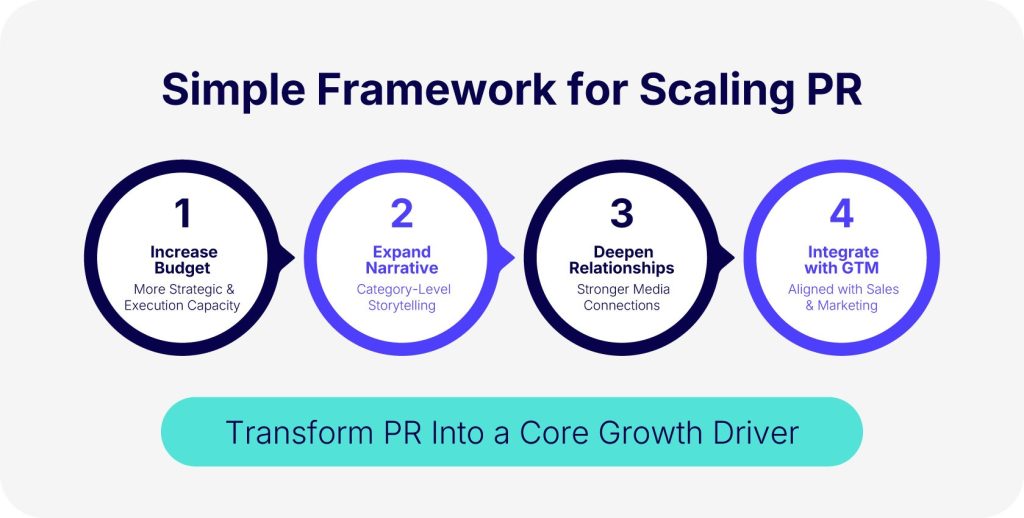
- Increase your budget to unlock a greater capacity for strategy and execution.
- Expand the narrative to move from product-focused to category-level storytelling.
- Deepen media relationships to build stronger, ongoing connections and coverage.
- Integrate with GTM to align PR with sales, marketing, and leadership.
Timing Over Spend
PR’s impact depends heavily on timing.
Scaling too late leads to missed opportunities and reactive positioning, whereas increasing investment early compounds visibility and stronger market perception
Example: You and another Series C company enter the same category. You invest in PR 12 months early. You build authority and recognition. Your Competitor waits until launch. They struggle to gain traction.
By the time your competitor invests, you already own the narrative.
Key Insights
- PR should be scaled proactively, not reactively.
- Growth inflection points signal the need for more PR.
- Early investment creates a competitive advantage.
- PR directly supports revenue and valuation outcomes.
- Timing has a greater impact than total spend.
Pro Tip: The best time to scale PR investment is before you feel ready — because by the time PR impact is urgently needed, it’s often too late to build it from scratch.
Having trouble doing PR for your software startup? Read our guide for expert tips: Why Is Software PR So Hard? 8 Game Changing Tips for Making It Work
In-House vs Agency vs Augmented PR Models
At the growth stage and enterprise levels, how you resource PR is as important as what you spend on it. For Series B–D companies, PR requires a combination of:
- Strategy
- Execution
- Media Access
- Business Alignment
Unfortunately, there isn’t a single model that perfectly delivers all four. The decision ultimately comes down to choosing the right structure based on your growth goals, internal capabilities, and the level of sophistication required.
Model 1: In-House
If control and alignment are your top priorities, in-house is a good option. However, there are always tradeoffs.
Strengths
- Deep Understanding of Product, Market, and Messaging
- Strong Alignment with Internal Teams (sales, marketing, leadership)
- Faster Feedback Loops and Iteration
Limitations
- Limited Media Relationships (compared to external partners)
- High Fixed Cost (salary, benefits, overhead)
- Often Lacks Senior Strategic Depth (without multiple hires)
Operational Reality
In-house PR works best when it’s paired with external support, but it still requires time to build up media credibility and momentum.
Example: You’re a Series C company. You hire a Head of Communications to align PR with GTM strategy — but you still rely on external partners for media access and campaign execution.
Model 2: Traditional Agency
If execution bandwidth and media access are your top priorities, going with an agency is a good option. However, quality and strategic depth may vary.
Strengths
- Established Media Relationships
- Scalable Execution Capacity
- Experience Across Multiple Clients and Industries
Limitations
- Overly Execution-focused (pitching vs strategy)
- Retainer-driven Models May Lack Flexibility
- Less Embedded in Internal Business Context
Operational Reality
While agencies are effective for consistent outreach and coverage, there may be a struggle to really drive home the narrative without deeper client alignment.
Example: You’re a Series B startup. You hire an agency to increase coverage volume and secure regular placements, but you hit a wall trying to stand out or tie PR to business outcomes because teams aren’t totally aligned.
Model 3: Augmented / Strategic Partner (Position IR here)
An augmented model positions PR more as a growth function than a service by combining strategic oversight with data-driven insights and execution support.
Strengths
- Blends Strategy with Execution
- Integrates PR with Revenue, Marketing, and Leadership Goals
- Leverages Data and Insights to Drive Narrative
Limitations
- Requires Internal Alignment (to fully realize value)
- Typically Higher Investment (than basic agency support)
Operational Reality
Strategic PR partnerships act as an extension of internal teams. The focus is on building repeatable, scalable PR systems.
Example: Your Series C SaaS company partners with a strategic PR firm to:
- Develop a category-defining narrative.
- Launch data-driven campaigns.
- Integrate PR into sales and investor communications.

Comparative Overview
| Model | Best for | Strength | Limitation |
| In-house | Alignment and control | Deep internal knowledge | Limited reach and scalability |
| Agency | Execution and coverage | Media access and bandwidth | Often lacks strategy |
| Augmented Partner | Growth-stage scaling | Strategy + execution + integration | Higher investment |
How Series B–D Companies Actually Structure PR
It’s best not to rely on a single model and instead use a hybrid approach:
- In-house Lead: Owns Strategy and Internal Alignment
- Strategic Partner: Drives Narrative, Campaigns, and Integration
- Execution Support: Scales Outreach and Media Engagement
This structure allows companies to balance internal context with external expertise and scalable execution.
Key Insights
- PR resourcing is a strategic decision — not just an operational one.
- No single model fully meets growth-stage needs.
- Agencies provide execution, but not always strategic depth.
- Augmented models are best suited for Series B–D companies.
- Hybrid structures deliver the strongest results.
Pro Tip: If your PR partner is only measured on output (placements, mentions), you’re likely optimizing for activity — not for market influence and revenue impact.
Let Preston help manage your next PR campaign. Learn more here: Meet Preston: the 2026 AI PR agent that runs your entire campaign
How PR Supports Fundraising, Hiring, and Sales
PR is one of the few functions at the growth stage that directly affects multiple core outcomes at the same time. While awareness is great, real PR value lies in its ability to reduce friction across three critical growth levers:
- Fundraising
- Hiring
- Sales
This cross-functionality makes PR for Series B–D startups a high-leverage, multi-purpose investment rather than a limited-use marketing channel.
PR and Fundraising: Shaping Investor Perception (before the pitch)
Typically, investors have already formed an opinion about your company by the time fundraising starts. So, invest appropriately in PR to shape that perception in advance of funding rounds.
How does PR support fundraising?
- It establishes executive credibility through visibility.
- It reinforces market opportunity through category narratives.
- It creates momentum with consistent coverage and thought leadership.
Example: Your company is planning a Series D raise. You invest in PR 6–12 months ahead of time to:
- Secure executive features and commentary in top-tier business publications.
- Publish a data-driven report that highlights category growth.
- Build a steady cadence of visibility around your leadership team.
What’s the impact? Investors are already familiar with your company, inbound interest increases, and fundraising conversations start with context and credibility — not introductions.
PR and Hiring: Attracting Top Talent (at scale)
As you grow, hiring becomes more competitive (and more important). Top candidates aren’t just looking at the role, they’re evaluating where you’re headed and how credible you are.
How does PR support hiring?
- It signals momentum, stability, and market leadership.
- It elevates leadership visibility and vision.
- It reinforces company culture through external validation.
Example: As a fast-scaling B2B startup, you:
- Place your CTO in technical publications discussing engineering challenges.
- Secure coverage highlighting company growth and innovation.
- Amplify these placements across LinkedIn and other recruiting channels.
What’s the impact? Candidates enter the funnel with pre-established trust, recruiting conversations move faster, and higher-quality talent is more likely to engage.
PR and Sales: Reducing Friction (in enterprise deals)
Buyers at the enterprise-level, particularly in B2B and tech, are more averse to risk — seeking signals of credibility, stability, and wide recognition. PR provides the third-party validation needed to prove you’re the real deal.
How does PR support sales?
- It builds trust before the first sales conversation.
- It reinforces credibility during evaluation and procurement.
- It differentiates the company in competitive deal cycles.
Example: As a Series C SaaS company, you:
- Integrate recent media coverage into sales decks.
- Use thought leadership content in outbound campaigns.
- Share relevant articles during late-stage negotiations.
What’s the impact? Prospects perceive lower risk, sales cycles shorten, and close rates improve due to external validation.
The Compounding Effect Across All Three
Rather than operating in isolation, the benefits of PR reinforce each other. That’s what makes PR so valuable for Series B–D companies.
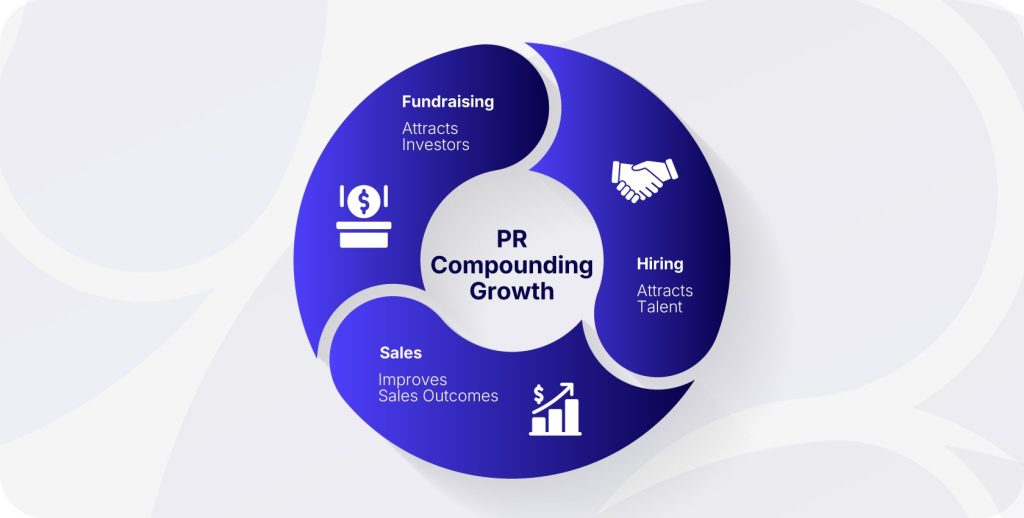
Example: As a company with consistent top-tier coverage, you:
- Gain more recognition from investors.
- Attract top senior hires who want to join a market leader.
- Enter sales conversations with pre-established credibility.
Key Insights
- PR is a multi-functional growth driver.
- Investor perception is shaped before outreach begins.
- Strong PR enhances talent acquisition.
- Earned media accelerates enterprise sales.
- PR creates a compounding growth flywheel.
Pro Tip: If PR isn’t actively supporting fundraising, hiring, and sales, it’s being underutilized — because its highest ROI comes from reducing friction at every stage of growth.
Interested in the latest PR trends? We’ve got you covered: 5 Top PR Trends in 2026: GEO, AI-Native Tools, and the New Rules of Influence
PR Is a Capital Allocation Decision, Not a Marketing Expense
PR is no longer a discretionary line item at the Series B–D stage. View it as a strategic investment that shapes your company’s perception, value, and market trust.
To be a top contender in your category, the question isn’t, “Can we afford PR?” — it’s “Can we afford not to control our narrative?”
Because at this stage:
- Markets are More Competitive
- Buyers are More Averse to Risk
- Investors are Pattern-matching
- Top Talent is More Selective
And strategic PR investment is at the crux of all four. When structured and executed with precision, you’ll have a force multiplier across your entire growth engine.
Let your PR strategy reflect the scale of your ambition. That means ditching the one-off campaigns, investing in narrative and data, and aligning PR with revenue, hiring, and fundraising goals.
If you’re looking to evaluate or optimize your approach, book a free consultation with us today. We’ll help you benchmark your current investment, identify missed opportunities, and build a clear, data-driven roadmap that turns PR into a defensible, scalable growth machine.