
Earned Media in the Digital-First World: The Ultimate Guide to No-Cost Coverage [Examples + Tips]
Do you want unpaid promotion and praise? How about no-cost coverage when you’re on a budget? The brand recognition of which I speak and you seek to garner gratis is called earned media — it’s free publicity that puts pushy paid ads in the backs...
- Home
- Intelligent Insights Blog
- Earned Media in the Digital-First World: The Ultimate Guide to No-Cost Coverage [Examples + Tips]

Do you want unpaid promotion and praise? How about no-cost coverage when you’re on a budget? The brand recognition of which I speak and you seek to garner gratis is called earned media — it’s free publicity that puts pushy paid ads in the backseat.
Consumers are inundated with commercials, pop-ups, and sponsored posts all day, and they’re sick of it. That’s the beauty of earned media — it’s powerful, organic attention that brands can’t simply buy. And people actually want real stories told through third-party voices.
When others do the talking for you, credibility and influence follow.
When done right, earned media elevates your brand, strengthens your reputation, and drives meaningful growth. In this guide, we’ll break down exactly what earned media is, why it matters, and how to make it work for you.
- What is Earned Media?
- Why Earned Media is So Powerful
- The Strategic Foundation of Earned Media
- Earned Media at Scale: Growth-Stage Momentum vs. Enterprise Authority
- 4 Types of Content that Drive Earned Media Coverage
- Digital Earned Media and Modern Channels
- How to Measure Earned Media Success
- Crisis Management and Earned Media
- Integrating Earned Media with Paid and Owned Strategies
- The Future of Earned Media
What is Earned Media?
Before diving into strategy and tactics, it’s important to clearly understand what earned media actually is — and what it isn’t.
Earned media is any organic publicity and exposure your brand receives through third-party coverage rather than paid advertising. In the simplest terms, it’s the recognition you earn, not buy.
This includes:
- Guest Contributions in Industry Publications
- Social Media Mentions from Customers
- News Articles Featuring Your Company
- Interviews on TV, Radio, or Podcasts
- Unsponsored Influencer Shoutouts
- Product Reviews
What makes earned media so powerful is that it comes from independent sources. A journalist, editor, industry expert, or customer decides your story is worth sharing.
That kind of validation carries significantly more influence than a paid ad ever could.
The PESO Model™: Where Earned Media Fits
Earned media is often discussed within the Paid, Earned, Shared, Owned or the PESO Model — a framework that organizes marketing channels into four categories:
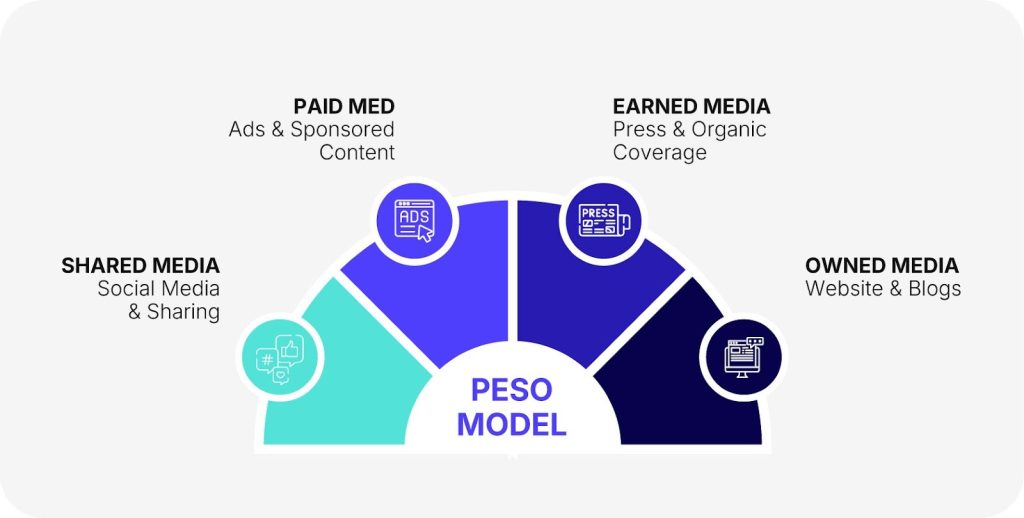
- Paid Media: Advertising, sponsored posts, PPC campaigns
- Earned Media: Press coverage, mentions, reviews, and organic publicity
- Shared Media: Social media platforms and community engagement
- Owned Media: Your website, blog, email list, and branded content
While earned media stands on its own, it works best when integrated with the other three.
For example, a news feature (earned) can be shared across social platforms (shared), highlighted on your website (owned), and even amplified through advertising (paid).
Examples of Earned Media
Earned media takes many forms across both traditional and digital channels. Some of the most common examples include:
- News Articles (in national, regional, or Industry publications)
- Media Interviews (featuring company leaders or experts)
- Radio Segments (discussing your brand or industry insights)
- Podcast Guest Appearances (where your expertise is highlighted)
- Guest Columns or Op-eds (published in reputable outlets)
- Product Reviews (written by journalists or independent reviewers)
- Unpaid Influencer Mentions
- Customer Testimonials or User-generated Content (shared organically)
- Industry Awards and Recognitions
- Inclusion in “Best of” or Expert Roundup Articles
For example, if a journalist covers your new product launch in a major publication because it’s innovative and timely, that’s earned media. If a satisfied customer posts about your product without incentive, that’s also earned media. If your industry expertise leads to a podcast tour, well, you get the picture.
What Earned Media Is Not
To fully grasp earned media, it helps to clarify what it’s not:
- It’s not advertising space you purchase.
- It’s not content you publish on your own channels.
- It’s not sponsored influencer posts.
- It’s not paid advertorial placements.
If any compensation is involved in securing coverage, it falls under paid media — not earned.
Why the “Earned” Part Matters
“Earned” indicates effort, credibility, and trust. You earn coverage by offering something that’s genuinely:
- Newsworthy
- Insightful
- Impactful
From original data and compelling stories to expert commentary and timely responses to industry trends, you’re bringing value to your industry and the public.
The Earned Media Value Pyramid
Not all coverage delivers equal value. At the enterprise level teams should prioritize impact using this hierarchy:
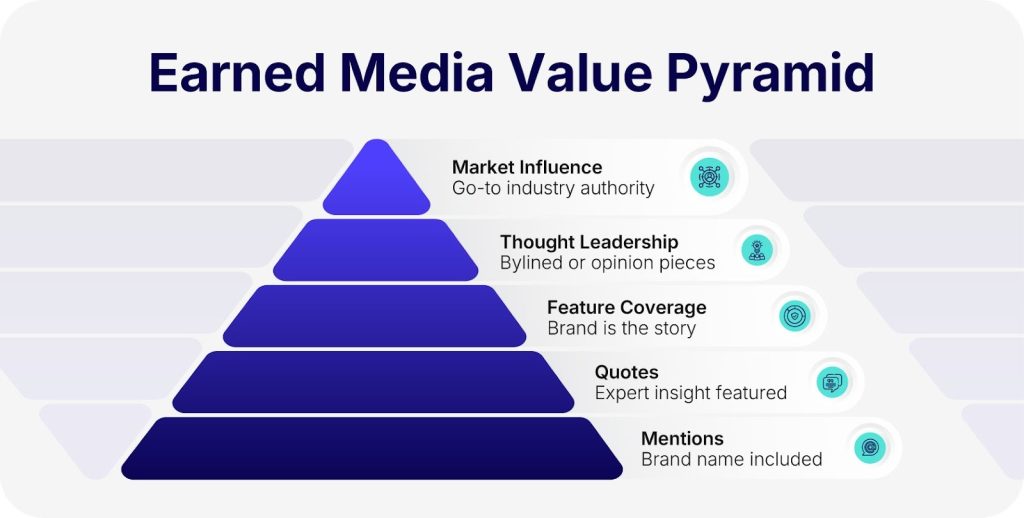
This shifts the focus from volume to strategic impact. Prioritize depth over breadth — one feature story outperforms dozens of low-impact mentions.
Pro Tip: Don’t chase coverage just for the sake of visibility — focus on stories that align with your brand’s core message and long-term goals. Strategic relevance will always outperform random mentions.
Need help pitching? Read our guide for expert insights on getting noticed: 4 PR Pitching Tips for Pros to Land Better Media Coverage in 2025
Why Earned Media is So Powerful
Earned media is more than just getting your name in the headlines — it’s building influence that money alone can’t buy. When someone else tells your story, your message is at peak impact.
That’s what makes earned media such a strong driver of authority, visibility, and long-term brand growth.
Trust and Credibility
Consumers have become increasingly skeptical, and understandably so. Their attitude is keeping pace with ad bombardment, and people know when they’re being marketed to.
That’s why third-party validation is so crucial. When a journalist, industry publication, or respected creator features your brand, it signals legitimacy.
Cary Grant never had to tell people he was handsome.
You’re not claiming you’re the best — someone else is highlighting your value.
And that subtle difference dramatically increases perceived trust and authenticity.
- Research consistently shows that consumers trust editorial coverage and peer recommendations more than traditional advertising. Earned media acts as social proof at scale.
Authority and Thought Leadership
Earned media positions your company and its leaders as industry experts. Authority is reinforced every time a company leader:
- Is Quoted in Industry Articles
- Contributes Guest Columns
- Appears on Podcasts
Recognition and trust within your niche compound over time. And instead of competing purely on price or features, earned media throws prowess into the mix.
Thought leadership through earned media creates opportunities — journalists frequent reliable sources, event organizers book keynote speakers, and partnerships become easier to secure.
Learn more about establishing executive thought leadership here: Executive Thought Leadership: A Comprehensive Guide
SEO and Benefits
Earned media delivers significant search engine benefits:
- High-quality backlinks from reputable publications strengthen your website’s domain authority.
- Brand mentions — even without links — signal relevance.
- Referral traffic from any media coverage drives engaged visitors directly to your site.
Plus, earned media coverage often ranks in AI search results for branded queries, giving you greater control over your online reputation.
Want to learn more about how PR and SEO work together? We’ve got you covered: PR SEO: Synergy for Success [Tips, Tactics, and Best Practices]
Long-Term Brand Equity
Earned media has staying power unlike paid campaigns that stop yielding results once the money runs out.
A well-placed feature article continues driving traffic, credibility, and awareness for years. It becomes an asset to showcase:
- In Sales Materials
- On Your Website
- Across Social Channels
Consistent earned media builds brand equity — the intangible trifecta of reputation, recognition, and trust. That equity grows exponentially, making future coverage easier to secure and strengthening your market position.
The Earned Media Flywheel
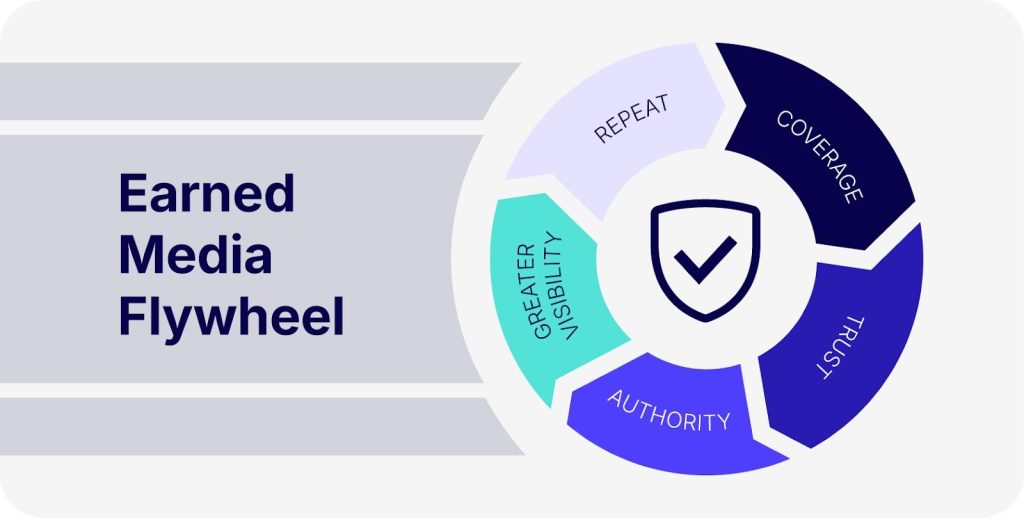
Earned media works best when it compounds over time. Instead of treating every media placement as a one-off win, modern PR teams build systems that generate ongoing coverage and authority.
How the earned media flywheel works:
- Create an Insight or Narrative: Data studies, industry commentary, and founder perspectives.
- Pitch Relevant Journalists: Identify reporters covering the topic and tailor the angle to their audience.
- Secure Coverage: Articles, quotes, interviews, expert commentary.
- Amplify the Coverage: Share on social channels, include coverage in newsletters, repurpose for paid and owned content.
- Build Authority Signals: Backlinks boost visibility and credibility.
- Generate Additional Coverage: Journalists reference previous stories and executives become go-to sources for quotes and commentary.
Over time, this process builds a self-reinforcing cycle of visibility and credibility.
Pro Tip: Don’t think of earned media in terms of singular wins. Focus on building sustained visibility through consistent thought leadership and relationship-building — momentum creates real power.
For more on thought leadership strategy read our guide: Thought Leadership Strategy: 14 Steps to Balancing Authority and Authenticity (+ Examples)
The Strategic Foundation of Earned Media
Truly valuable earned media isn’t a happy accident. While a compelling story is helpful, sustainable coverage is built on strategy.
Before you draft a pitch or send a press release, you need a clear foundation that aligns media efforts with business goals.
Here’s how to do it:
Set Clear Objectives
Earned media should support measurable outcomes — not just vanity metrics. Start by identifying what you want to accomplish:
- Brand Awareness: Do you want to increase visibility in new or competitive markets?
- Lead Generation: Do you want to drive qualified traffic to landing pages?
- Reputation Building: Do you want to establish authority and credibility?
- Product Launches: Do you want to create buzz around new offerings?
- Crisis Management: Do you want to protect and restore public perception?
Without clearly defined objectives, you can’t evaluate success. A national feature might look impressive, but if it fails to reach your target audience or support larger goals, it won’t deliver meaningful results.
Tie your media strategy directly to broader marketing and business KPIs. Learn more here: 10 Key PR Metrics You Must Measure to Gauge Success
Identify Your Target Audience
Not all coverage is created equal. The right exposure means reaching the right people, so you need to answer the following questions:
- Who are your ideal customers?
- What industries or roles do they represent?
- What media outlets do they read, watch, or listen to?
- Who influences their decisions?
For example, B2B brands might target trade publications and niche podcasts, whereas consumer brands may find lifestyle media and regional news more effective.
Understanding the media habits of your audience eliminates randomness and ensures your efforts are focused and strategic.
Craft Your Core Messaging
Be clear on your message. Before pitching the media, you need to define:
- Your Primary Value Proposition
- The Problem You Solve
- Why You’re Different from Competitors
- Key Supporting Proof Points (data, results, testimonials)
Consistency is key. While story angles may vary, your core message should remain locked in across interviews, articles, and commentary. This will reinforce brand recognition and authority.
Consider Relevance
Journalists aren’t going to cover you for simply existing. You need a compelling angle. Common newsworthy elements include:
- Timeliness: Is your news tied to current events or trends?
- Impact: Does your news affect a large group or industry?
- Innovation: Are you presenting new, disruptive, or unique solutions?
- Human Interest: Is your story emotional or relatable?
- Data and Insights: Are you offering original research or compelling statistics?
If you can’t answer why your news matters to your audience now, refine the angle before pitching.
Align Earned Media with Business Strategy
Earned media shouldn’t operate in a silo. It should complement your marketing calendar, product roadmap, and sales initiatives.
For example:
- Time expert commentary around seasonal trends.
- Coordinate media outreach with product launches.
- Support fundraising announcements with strategic press coverage.
- Use earned placements to strengthen sales conversations.
When aligned with broader business goals, earned media goes from being just a publicity tactic to a real growth driver.
Earned Media Preparedness Framework
| Foundational Elements | What You Need |
| Audience Clarity | Defined personas + media habits |
| Message Discipline | 3-5 consistent core messages |
| Proof Assets | Data, case studies, spokespeople |
| News Hooks | Pre-developed story angles |
| Internal Alignment | PR, marketing, and leadership synced |
The goal is to build a pitch-ready system that doesn’t leave you scrambling when opportunities arise.
Pro Tip: Before pitching any story, write a one-sentence goal that ties the coverage to a specific business outcome. If there isn’t a clear, definitive purpose, pause and adjust your strategy.
Pitching a disaster area? Here’s what not to do: 5 PR Mistakes to Avoid When Pitching in Disaster Areas
Earned Media at Scale: Growth-Stage Momentum vs. Enterprise Authority
Earned media strategy evolves dramatically as companies move from scrappy growth-stage execution to enterprise-level market leadership.
While the core objective remains the same — authority and credibility through third-party validation — the way you operationalize earned media, measure success, and integrate it into broader business strategy changes in meaningful ways.
For growth-stage companies, earned media is about gaining visibility and traction. The focus is on:
- Rapid Brand Awareness (in competitive or emerging categories)
- Establishing Early Credibility (with customers, investors, and talent)
- Securing High-impact Wins (e.g., feature stories, founder profiles, product launches)
At this stage, success hinges on speed, creativity, and narrative clarity. PR teams are typically lean, budgets are tight, and storytelling does most of the heavy lifting. A well-placed feature or timely trend hook meaningfully accelerates pipeline, partnerships, and funding opportunities.
Earned media here is more opportunistic — but should still be guided by a repeatable system.
Enterprise-level Strategy
If you’re an enterprise-level B2B tech brand for example, earned media becomes less about attention spikes and more about sustained market influence.
Your priorities shift toward:
- Owning strategic narratives across key industry verticals
- Reinforcing category leadership and long-term brand authority
- Supporting complex sales cycles with trust-building content
- Aligning PR efforts with executive visibility and corporate reputation
Execution at this doesn’t just rely on outreach — you need a fleshed-out strategy infrastructure.
What It Looks Like in Practice
Here’s how a system that consistently generates cover will look:
- Narrative Ownership Programs: If you’re a cloud infrastructure company, identify 3–5 strategic narratives (e.g., AI scalability, data sovereignty) and assign internal owners across product marketing, PR, and executive leadership. Build quarterly media plans around these narratives to ensure consistent coverage in top-tier and trade publications.
- Executive Visibility Engines: Instead of ad hoc interviews, operationalize executive presence by mapping spokespersons to specific topics and tiers of media. For instance, your CTO may be aligned to technical deep dives in trade outlets, while your CEO focuses on business strategy in top-tier publications — supported by a steady stream of bylines, keynote opportunities, and commentary.
- Always-on Newsjacking: Enterprise teams often run structured “rapid response” workflows — monitoring industry news in real time and deploying pre-approved POVs within hours. This includes Slack-based alert systems, pre-drafted commentary, and media lists segmented by topic to speed up outreach.
- Data-led Storytelling Pipelines: Instead of relying solely on product announcements, invest in proprietary data (e.g., usage trends, benchmarks, or surveys) to generate recurring media hooks. These reports are usually planned 6–12 months in advance and integrated into both PR and demand generation campaigns.
- Integrated Campaign Launches: If you have a major announcement (e.g., product launches, acquisitions), send it as part of a cross-functional campaign — where earned media is coordinated with paid, owned, and sales enablement efforts. To get the most out of a press release, time coverage with analyst briefings, customer marketing, and outbound sales motions.
- Performance Modeling and Attribution: Your enterprise team should go beyond impressions and SOV, tying earned media to pipeline influence. This includes tracking how media coverage impacts branded search, website conversion rates, or deal acceleration within target accounts.
The key distinction is this:
- Growth-stage companies use earned media to break into the conversation while enterprise brands use it to shape and control the conversation
Pro Tip: Understanding where your organization sits on this spectrum is critical. Without that context, teams risk applying the wrong tactics — either over-engineering efforts that need agility or underinvesting in systems required for scale.
For more detailed information on enterprise earned media strategy, read our guide: The Modern Earned Media Strategy Guide for B2B Tech Brands [Examples + Tips]
5 Steps to Developing an Earned Media Strategy
Once your foundation is in place, it’s time to move from theory to execution. A strong earned media strategy is:
- Intentional
- Research-driven
- Relationship-focused
Forget mass blasting emails — your aim is to deliver the right story to the right person at the right time.
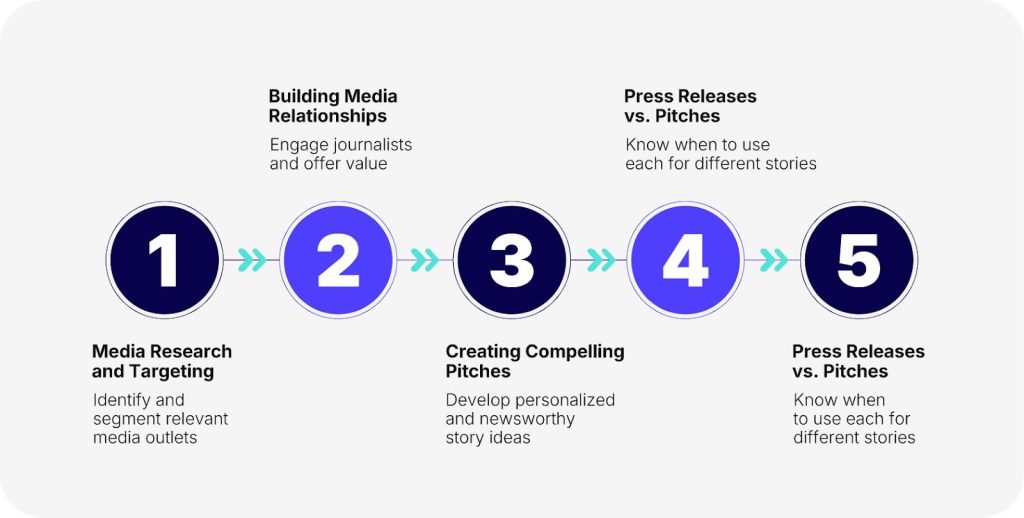
Step 1. Media Research and Targeting
Set clear objectives early. Successful earned media starts with precision targeting of journalists and outlets relevant to your news.
Begin by identifying:
- Publications Your Audience Consumes
- Journalists Who Cover Your Industry or Niche
- Editors Responsible for Relevant Sections
- Podcast Hosts and Content Creators (in your area of expertise)
Familiarize yourself with their work. Read recent articles. Learn the angles they favor, their tone, and who they quote.
Building a targeted media contact list ensures your outreach feels intentional rather than random. When it comes to earned media, quality beats quantity every time.
Step 2. Building Media Relationships
Earned media is built on trust — and trust takes time. Instead of reaching out only when you want coverage, engage consistently by:
- Following Journalists on Social Media
- Sharing and Commenting (thoughtfully) on Their Articles
- Offering Insights, Not Immediate Pitches
- Becoming a Reliable and Responsive Source
When reporters see you as credible and easy to work with, you’re more likely to become their regular source of commentary and future stories.
Step 3. Creating Compelling Pitches
Your pitch is your first impression — a glimpse into what you offer. Don’t be annoying, generic, or forgettable.
A strong pitch should include:
- A Concise, Attention-grabbing Subject Line: Don’t just say, “New App Launch.” That’s way too vague and boring. Say something like, “Why Our New App Gained 10,000 Users in 24 Hours.”
- A Clear, Newsworthy Hook: You want to grab their attention in the first sentence while answering the who, what, when, where, and why of your news. For example, “Since the launch of our new app last week, we’ve hit 15,000 users and a 51% daily retention rate — signaling a solid market fit.”
- Relevant Data, Insights, or Angles: Journalists love stats, expert insights, and interesting takes. Offer something they’ll really grab on to. It not only makes their job easier, it brands you as a top industry source.
- A Brief Explanation of Relevance: Let them know why your news matters to their audience now. Emphasize what problems existed before your product, and how it solves that problem in an innovative way.
- Easy Access to a Spokesperson: Offer help with any further inquiries or materials journalists may need, and provide them with the appropriate contact info for followups or requests.
Keep in mind that journalists receive tons of pitches daily. Keep yours brief but compelling. Show them that you respect their time while demonstrating value.
Step 4. Press Releases vs. Pitches
Press releases and pitches are often mentioned in the same breath, but they serve very different purposes — and it’s important to understand the distinction.
- Press releases formally announce news — product launches, partnerships, funding — or address crises.
- Pitches are emails with story angles tailored to specific journalists or outlets in hopes of gaining coverage.
Sending a press release alone is often a shot in the dark. To maximize your chances, pair it with targeted pitching.
Need to craft a press release that gets noticed? Here’s how: How to Write a Press Release for Great Results [Examples + Tips]
Step 5. Timing and Follow-Ups
Timing is a key consideration that has a significant impact on your pitch success rate. Here’s what to do:
- Avoid pitching on Friday afternoons — everyone’s mentally clocked out for the weekend. Likewise, Monday mornings are a no-go. Inboxes are full, and you’re more likely to go unnoticed. Shoot for mid-morning or after lunch Tuesday, Wednesday, or Thursday.
- Pay attention to major news cycles. Don’t pitch during a massive news event that completely overshadows your story.
- Don’t be pushy. It’s important to follow up, but remember, journalists are very busy. If you don’t receive a response, check in politely after a day or two.
Persistence plus respect equals professionalism — and that leads to meaningful media relationships and earned coverage.
Pro Tip: Personalization increases response rates. Reference a journalist’s recent article and explain why your story complements their coverage — it shows you’ve done your homework.
For more on what journalists want, read our guide: What Journalists Want: What PR Pros Need to Build Relationships with Journalists
4 Types of Content that Drive Earned Media Coverage
When it comes to strategic earned media success, compelling content is non-negotiable. Journalists and creators want stories that will excite, educate, inspire, and motivate their audiences.
If you consistently produce content that is valuable and newsworthy, your chances of coverage are nearly guaranteed.
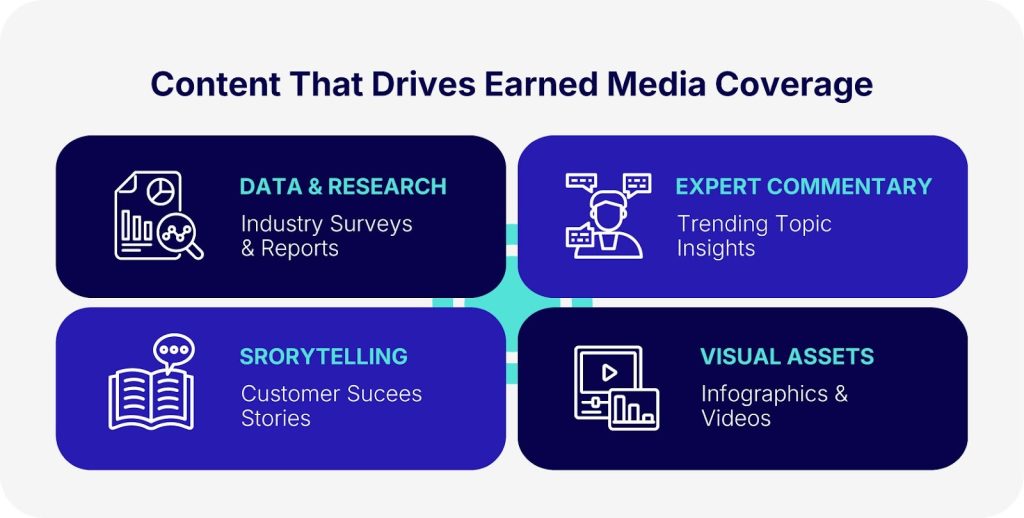
Data and Original Research
One of the most powerful drivers of any media coverage is original data. Through inhouse research, consider developing:
- Trend Reports
- Industry Surveys
- Benchmark Studies
- Proprietary Platform Data Insights
- Case Studies (with measurable outcomes)
Stats help strengthen journalists’ stories, so including your own data and research is a great way to earn instant brownie points with journalists.
Expert Commentary
Journalists want expert opinions — and they want them at the speed of news. Position yourself or company leaders as go-to sources by:
- Responding Promptly to Trending Topics
- Offering Hot Takes on Industry Changes
- Providing Clear and Quotable Soundbites
- Monitoring News Relevant to Your Niche
Stay proactive to anticipate trends and pitch insights before stories fully hit their stride.
Storytelling Techniques
Facts are great, but they don’t mean anything if you fail to make a connection. That’s where strong storytelling comes in. This includes:
- Narrative Structure: Your story should have a clear beginning, middle, and end.
- Real People or Customer Stories: To make a genuine connection, your story needs to be relatable.
- Emotional Stakes or Challenges: To resonate with audiences, your story needs to strike an emotional chord.
- Transformation or Results: What change occurred? Why is the outcome meaningful?
For example, Instead of saying, “Our company grew 200%,” explain how that growth came about. What obstacles did you face? What lessons were learned? Human-centered narratives always outshine corporate claims.
Visual Assets
You want to make it easy for journalists to say yes. Provide them with visual assets like:
- High-resolution Images
- Short Explainer Videos
- Infographics
- Executive Headshots
- A Concise Media Kit
Visuals not only add to your story, they drastically increase your chances of getting covered. The more you simplify the entire process, the more eye-catching your pitch becomes.

Pro Tip: Before reaching out, ask yourself if your content will genuinely help a journalist tell a better story. If it adds depth, clarity, and insight, your chances of coverage are pretty high.
Pitching during a holiday season? Here are five tips for better results: Holiday Pitching: 5 Tips to Getting Better Results This Season
Digital Earned Media and Modern Channels
Traditional newsrooms are no longer the only arena for earned media. Newspapers, TV segments, and trade pubs are still important, but the majority of earned coverage lives online and spreads like wildfire.
It’s necessary for modern brands to understand exactly how earned media is shaped by digital channels.
Online Publications and Blogs
A lot of influential platforms these days are digital-only. Things like industry blogs, niche media sites, and online magazines often:
- Publish Faster than Traditional Outlets
- Focus on Specific Verticles
- Reach Highly Targeted Audiences
- Offer Strong SEO Value Through Backlinks
For B2B businesses and specialized industries, securing coverage in digital-first pubs typically delivers more qualified traffic than broad national media.
Podcasts and Webinars
The rise of podcasts has been a powerful driver of earned media coverage. Securing a guest spot as a featured expert in your industry allows you to:
- Share In-depth Insights
- Build Personal Credibility
- Reach Engaged Niche Audiences
- Repurpose Content Across Shared and Owned Channels
Unlike blurbs or short quotes in the news, the long storytelling format of podcasts helps audiences connect with your message on a much deeper level.
Looking for great interview podcasts? Learn more here: 15 Best Interview Podcasts in 2024
Social Media Amplification
All earned media now lives online. Published coverage is:
- Shared Across Social Platforms
- Amplified by Journalists
- Reposted by Readers and Followers
- Discussed in Online Communities and Forums
Think of ripples, concentric circles of influence expanding outwardly from the original publication drop.
Need a social media PR plan? We’ve got you covered: Social Media PR – 6 Easy Ways to Connect with Your Target Audience
Influencer and Creator Mentions (Non-Paid)
Not all influencer marketing is paid.
Some creators mention your brand because they genuinely like it and actually use your product or service. That’s valuable earned media. These authentic endorsements carry more influence with niche audiences.
The key difference? There’s no sponsorship behind the publicity — it’s completely voluntary.
User-Generated Content (UGC)
Satisfied customers are very influential sources of earned media. Examples of UGC include:
- Social Media Posts
- Product Reviews
- Testimonials
- Unboxing Videos
- Community Discussions
All contribute to earned visibility.
In many industries, particularly involving low-risk or everyday purchases, peer recommendations are more influential than professional reviews. Happy customers sharing experiences without incentive has the potential to greatly strengthen your earned media presence.

Pro Tip: Invest in consistent media monitoring so you never miss an opportunity to engage, amplify, or respond. Tracking brand mentions in real time allows you to measure impact, spot trends, and proactively build stronger media relationships.
For more on mastering media monitoring, read our guide: A Full Guide to Mastering Media Monitoring in 2025 [+ Examples]
How to Measure Earned Media Success
You can’t refine what you can’t measure. Earned media is often associated with awareness and credibility — both somewhat intangible outcomes. It needs to be evaluated through more meaningful metrics.
The key is to align what you measure with your original goals.
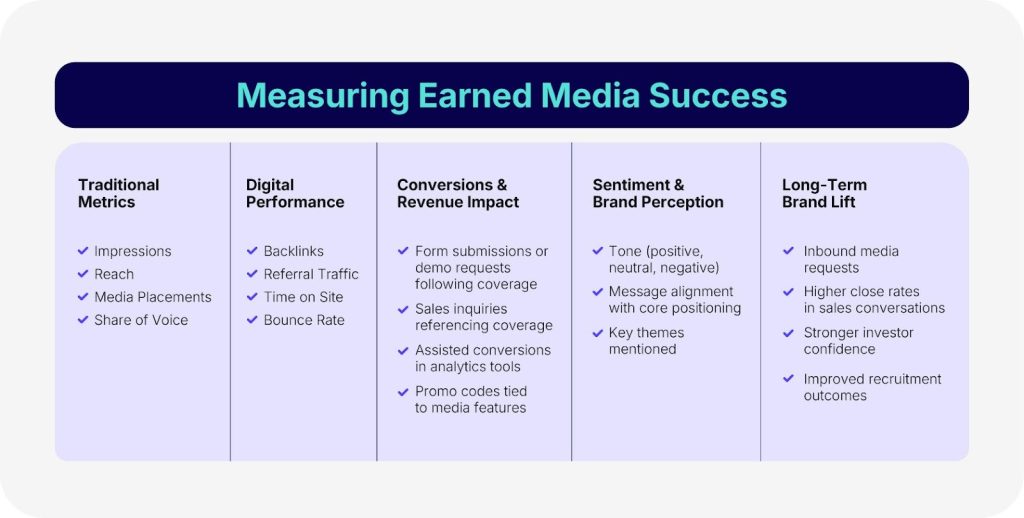
Traditional Metrics
Earned media was traditionally measured using broad visibility indicators like:
- Impressions: The estimated number of people who could have seen the coverage.
- Reach: The size of the audience per publication or channel.
- Media Placement: The total number of secured features.
- Share of voice (SOV): Your brand’s visibility compared to competitors.
These metrics provide a detailed snapshot of exposure, but they don’t fully capture impact. Think of traditional metrics as useful but incomplete.
Digital Performance Metrics
Modern digital tools offer more precise insights into performance than ever. Some key indicators include:
- Backlinks From Reputable Websites
- Referral Traffic From Media Placement
- Time on Site From Earned Visitors
- Bounce Rate of Referral Traffic
- Engagement Metrics (social shares, comments, saves)
Tracking these metrics should prove that high-quality earned media improves search rankings, increases domain authority, and drives traffic that converts at higher rates.
Conversions and Revenue Impact
For many businesses, the underlying question is whether or not coverage actually generated results. To answer this, you need to track things like:
- Form Submissions or Demo Requests After Coverage
- Sales Inquiries Referencing Media Placements
- Assisted Conversions in Analytics Tools
- Promotional Codes Tied to Media Features
Attribution is sometimes difficult, especially when earned media influences long-term perception over immediate purchases. On the other hand, if you connect placements to measurable outcomes, you strengthen strategic decision-making.
Sentiment Analysis
Coverage comes in all shapes and sizes. To truly take the public’s temperature, you need to measure:
- Tone (positive, negative, or neutral)
- Message Alignment with Core Positioning
- Key Themes Mentioned
- Reporting Accuracy
Sentiment analysis helps ensure you’re strengthening your narrative rather than diluting it.
Long-term Brand Lift
Not all results are instantaneous. Some of the most valuable earned media benefits take time to appear. Things like:
- Increased Inbound Media Requests
- Higher Close Rates in Sales Conversions
- Stronger Investor Confidence
- Improved Recruitment Outcomes
Long-term indicators often signal that brand authority is snowballing.

Pro Tip: Build a simple monthly earned media dashboard that tracks visibility, traffic, backlinks, sentiment, and conversions in one place. Consistent reporting reveals patterns that one-off metrics can’t.
Need to measure thought leadership? Here’s how: How to Measure Thought Leadership: Metrics, Strategies, and KPIs
Crisis Management and Earned Media
Earned media elevates your brand — but it also tests it.
During crises, media attention surges. Journalists seek accountability, clarity, and leadership. How your organization responds in these high-pressure situations either protects or damages your reputation.
Crisis management and earned media are deeply connected — and preparation is everything.
The Role of Earned Media in Reputation Protection
When something goes wrong — a product issue, leadership controversy, data breach, etc. — the media becomes a key channel for public information.
Reporters expect:
- Verified Facts
- Executive Statements
- Timelines and Corrective Actions
- Impact on Customers or Stakeholders
Silence fuels speculation and makes the situation worse, but thoughtful engagement helps you shape the narrative rather than react to it.
Proactive Crisis Planning
Mid-crisis is the worst time to plan for one. They’re going to happen, so you need to be prepared.
Here’s how to do it:
- Develop a Crisis Communication Plan
- Assign a Designated Spokesperson
- Create Holding Statements for Potential Scenarios
- Establish Internal Approval Workflows
Having a plan in place enables faster, clearer, and more confident responses when negative attention escalates.
Transparency and Accountability
Transparency isn’t just an expectation — it’s a demand. Media and consumers will hold organizations to account.
Effective crisis preparedness includes:
- Acknowledging the Issue Directly
- Accepting Responsibility when Appropriate
- Explaining Corrective Actions
- Providing Updates as Situations Evolve
Deflecting blame or minimizing impact only prolong coverage and erode trust. Maintaining or recovering credibility during a crisis often depends less on the mistake itself and more on how it’s handled.
Speed vs. Accuracy
There’s a lot of pressure to respond immediately after a crisis. But if a speedy response lacks accuracy, it will only worsen the situation.
The goal is balanced responsiveness:
- Issue an Initial Acknowledgment Promptly
- Commit to Updates
- Only Share Verified Information
A short, clear statement is better than a rushed explanation that you have to walk back later.
Rebuilding Through Earned Media
As the initial crisis shock wanes, earned media plays a major role in rebuilding reputation.
Recovery strategies may include:
- Sharing Progress Updates
- Highlighting Corrective Measures
- Demonstrating Cultural or Operational Improvements
- Featuring Leadership Interviews (focused on lessons learned)
Consistent and transparent communication gradually restore public confidence.
For more on crisis management, read our guide: Guide to PR Crisis Management 2025 [+ Examples and Tips]
5 Common Earned Media Mistakes to Avoid
When it comes to earned media, all brands occasionally fumble the ball. The difference between a frustrating PR effort and a successful one often comes down to sidestepping a few common pitfalls.
Let’s break them down.
1. Pitching Without a Real Story
Don’t confuse announcements with news.
Everything isn’t inherently interesting. Minor updates and product tweaks might matter to your team, but that doesn’t mean journalists will automatically care.
How to avoid it:
- Tie your announcements to larger industry trends.
- Provide data, research, or unique insights.
- Show real-world impact on customers or communities.
If it doesn’t affect a broader audience, it likely won’t earn coverage.
2. Massive Generic Outreach
Blasting generic pitches to every journalist rarely works — and will likely damage your credibility.
Keep in mind that reporters receive a mountain of emails daily. If your outreach feels templated or outside of their beat, it will most likely be banished to the trash bin.
How to avoid it:
- Research each journalist’s recent coverage.
- Reference specific articles they’ve written.
- Personalize your pitch with relevance.
Targeted outreach consistently outperforms volume-based tactics.
3. Ignoring Relationship Building
Earned media isn’t transactional — it’s relational.
If you limit outreach to only when you want coverage, you’ll miss out on long-game advantages. Strong media relationships are built through consistency and mutual benefit.
How to avoid it:
- Offer expert commentary even when it doesn’t benefit you directly.
- Share relevant resources or data.
- Engage with journalists’ work on social platforms.
Establishing strong media relationships creates repeat coverage opportunities.
4. Failing to Prepare Spokespeople
Half of the battle is securing a media interview — the other is making sure your spokesperson is on point.
Strong opportunities are often derailed by unprepared representatives. Rambling answers, off-message comments, and unclear explanations weaken authority.
How to avoid it:
- Conduct media training sessions.
- Prepare key message points in advance.
- Practice bridging techniques for tough questions.
Confidence and clarity are key.
Think you bombed an interview? Here’s what to do (and not do) next: What to Do (and Not to Do) When a Media Interview Bombs [+3 Tips]
5. Neglecting Measurement and Followup
Some teams start dancing as soon as coverage goes live — but the real party hasn’t started yet. Earned media has a lifecycle.
Without amplification and proper analysis, you’re putting value in a corner.
How to avoid it:
- Share coverage across owned and social channels.
- Repurpose mentions into sales enablement materials.
- Track performance metrics tied to business goals.
Maximizing earned media requires action beyond publication.
Pro Tip: Create a pre-pitch checklist that includes newsworthiness validation, journalist research, spokesperson prep, and measurement planning. A five-minute review helps prevent months of missed opportunities.
Using AI in your PR efforts? Here’s what to avoid: 7 Top Pitfalls to Avoid When Using AI in PR
Integrating Earned Media with Paid and Owned Strategies
To maximize the potential impact of earned media, integrate it with paid and owned media channels. A coordinated approach will:
- Boost Coverage
- Extend Reach
- Strengthen the Overall Marketing Ecosystem
Amplifying Earned Media Through Paid Channels
Once you secure earned coverage, incorporate paid media to increase its visibility:
- Social Media Ads: Promote earned articles, interviews, or features to target audiences.
- Native Advertising: Extend the reach of earned stories on relevant sites.
- Search Engine Promotion: Boost placement visibility for high-value keywords.
Amplifying earned media strategically ensures it reaches the audiences most likely to engage or convert.
Repurposing Coverage on Owned Channels
Your website, blog, email, or newsletters offer a perfect platform to showcase earned media:
- Feature press mentions on a “Media & Press” page.
- Include earned coverage in email newsletters or campaigns.
- Highlight quotes or stories in blog posts or landing pages.
- Repurpose coverage into downloadable content like case studies or reports.
Owned channels extend the lifespan of earned media while reinforcing credibility with your existing audience.
Using Earned Media for Social Sharing
Earned media also feeds shared media:
- Share news articles or interviews on LinkedIn, Twitter, and Facebook.
- Encourage employees and partners to promote content.
- Use earned coverage to spark community conversations.
This ripple effect significantly expands reach and generates impressions far beyond the original placement.
Supporting Sales and Marketing Initiatives
Earned media also enhances other business functions:
- Use press mentions to strengthen sales conversations and proposals.
- Feature awards or recognitions in product collateral.
- Include earned media in investor presentations or fundraising decks.
- Highlight thought leadership pieces during webinars or events.
This kind of strategic alignment ensures that media coverage not only builds awareness but also drives measurable business results.
Tracking the Impact of Integration
To get the most value out of integrated campaigns:
- Monitor traffic from paid amplification of earned stories.
- Measure engagement on owned channels where coverage is repurposed.
- Track social sharing and audience interaction.
- Attribute leads, conversions, or inquiries to combined efforts.
Understanding these connections helps justify investment in earned media and guide future strategy.
Pro Tip: Treat earned media as the “trust anchor” of your marketing mix. Amplify it with paid campaigns and showcase it on owned platforms to maximize credibility, reach, and conversion potential.
Want to learn more about PR reporting? Read our guide for more info: PR Reporting — How to Use Data to Get Better Results [+ 3 Examples]
Earned Media Predictions
So what’s in store for earned media as it continues to evolve?
Technology is constantly reshaping how information is created, distributed, and consumed. Third-party validation is still at the core of earned media, but how it’s earned will be unrecognizable if you fail to keep up with the latest industry trends.
Brands must adapt their strategies to stay relevant.
The Rise of Niche Media Outlets
Traditional media outlets no longer take center stage the way they once did. Independent creators, podcasts, and digital-first platforms command ultra-niche and highly engaged audiences.
Benefits of smaller outlets include:
- A More Targeted Readership
- Higher Engagement Rates
- Deeper Subject-matter Coverage
For a lot of brands, securing a feature in a small but well-respected publication drives more qualified leads than a broad national mention.
The Creator-Influencer Crossover
We’re in an era where YouTube and LinkedIn creators are trusted as much as traditional news outlets. In certain industries, influencer recommendations sway audiences more than mainstream reporters.
Forward-thinking earned media strategies must include:
- Podcast Appearances
- Industry Newsletter Placements
- Expert Commentary Collabs
- Influencer-driven Thought Leadership
Credibility is still central to success — it’s the definition of “media” that’s changing.
AI and Journalism
Newsrooms continue to transform thanks to AI impacting everything from research and data collection to reporting and content distribution. High-speed news cycles mean journalists are under increasing pressure to churn out more content faster.
For brands, this creates both opportunity and responsibility.
Opportunity because:
- Data-driven insights and original research are more valuable than ever.
- Clear, concise pitches stand out in crowded inboxes.
Responsibility because:
- Misinformation spreads quickly.
- Accuracy and transparency are critical.
If you consistently provide journalists with verified data, access to company experts, and timely commentary, you’ll position your brand as a trusted, go-to source in this AI-supercharged media environment.
Real-time Reputation Management
News cycles aren’t just shorter thanks to social media and digital platforms — they’re instantaneous. Stories gain traction within hours, and public perception shifts almost as quickly.
Now, earned media strategies need:
- Active Media Monitoring
- Rapid Response Frameworks
- Proactive Crisis Planning
Whether the attention is positive or negative, when it spikes, preparation is key to improving, maintaining, or recovering brand reputation.
Integration Across the PESO Model
The future of earned media is integration. Earned placements increasingly fuel:
- Paid Amplification
- Repurposed Owned Content
- Shared Social Engagement
When applied strategically, the E works with the P, S, and O to power a more holistic and connected communications structure.
Pro Tip: Stay up to date on the latest trends in earned media and refine your strategy accordingly. Remember, integration is the name of the game — let earned media out of the silo to enhance all areas of your PR strategy.
Find more on the latest PR trends here: 5 Top PR Trends in 2026: GEO, AI-Native Tools, and the New Rules of Influence
Earn It, Amplify It, Own It
Earned media isn’t just chasing headlines. You want to build trust. Paid ads can’t compare to expert commentary, features in credible outlets, or word-of-mouth recommendations.
But the real success lies in strategy.
- Research the journalists who cover your news.
- Build a curated media contact list.
- Craft compelling pitches.
- Respect journalists’ time and follow up politely.
Your aim should be to create mutually beneficial media relationships. Present newsworthy content that journalists actually want to cover and audiences want to read.
When you secure coverage, amplify it across paid and owned channels.
It’s part art with a dash of science — and entirely driven by relationships. If you stay curious, relevant, and responsive to trends, earned media will do a lot more than boost visibility. You’ll build authority, fuel growth, and strengthen brand reputation without having to tell anybody how great you are.
Just put in the work, tell interesting stories, and let others do the talking for you. Need help getting started? Book a free consultation with us for expert insights on how to get people talking about your brand!