The PR Audit Guide: A Step-by-Step Framework for High-Performance Teams
You have a good handle on PR budget allocation — investing $5K–$10K, maybe even $50K+ monthly (depending on growth stage, of course). You’ve got coverage rolling in. You’re sending out reports. And you’re tracking the appropriat...
- Home
- Intelligent Insights Blog
- The PR Audit Guide: A Step-by-Step Framework for High-Performance Teams

You have a good handle on PR budget allocation — investing $5K–$10K, maybe even $50K+ monthly (depending on growth stage, of course). You’ve got coverage rolling in. You’re sending out reports. And you’re tracking the appropriate metrics.
Smooth sailing, right? Well, maybe. But also, maybe not.
Do you actually know what’s working, and more importantly, what’s underperforming?
PR often operates in a sort of ambiguous, gray area for many growth-stage B2B companies. It’s there, and it’s visible enough to justify investment. But the view is too cloudy to get a true sense of performance.
This is where a PR audit comes in.
Not as a reaction to poor performance, but as a proactive measure to spot inefficiencies, strengthen execution, and boost ROI. Because the reality is that most PR programs don’t fall flat all at once — they tiptoe towards underperformance until results hit a wall.
In this guide, we provide a step-by-step PR efficiency audit framework designed for high-performance teams, a practical scoring model, and a checklist for immediate application.
By the end, you won’t just have a clearer picture of your PR program — you’ll have a structured path to improve it.
- What is a PR Audit?
- When Should You Run a PR Audit?
- 6-Step PR Efficiency Audit Framework
- PR Audit Scoring Model
- PR Audit Checklist
- How to Improve PR Performance (Without a Budget Increase)
- When to Bring in External Optimization Support
What is a PR Audit?
A PR audit is a well-structured, comprehensive evaluation of how efficiently your PR program turns paid, earned, shared, and owned coverage (PESO) into real business outcomes. It’s not just kicking the tires and peeking at the undercarriage — it’s an inspection with a full diagnostic test to make sure your PR machine is running as smoothly as possible.
Top-level teams use PR audits to fully examine the system behind results. It should answer questions like:
- Is the narrative clearly defined?
- Are the right journalists being targeted?
- Is outreach translating to engagement, coverage, and ROI?
The idea is to go beyond what is happening to understand why it’s happening.
Where Most Teams Fall Short
Reporting tends to focus on quantifying outputs while ignoring the underlying drivers of PR performance.
A real PR assessment flips that model. It looks at the inputs, quality of execution, and points of conversion that prove whether or not your PR program is performing as it should.
A Closer Look
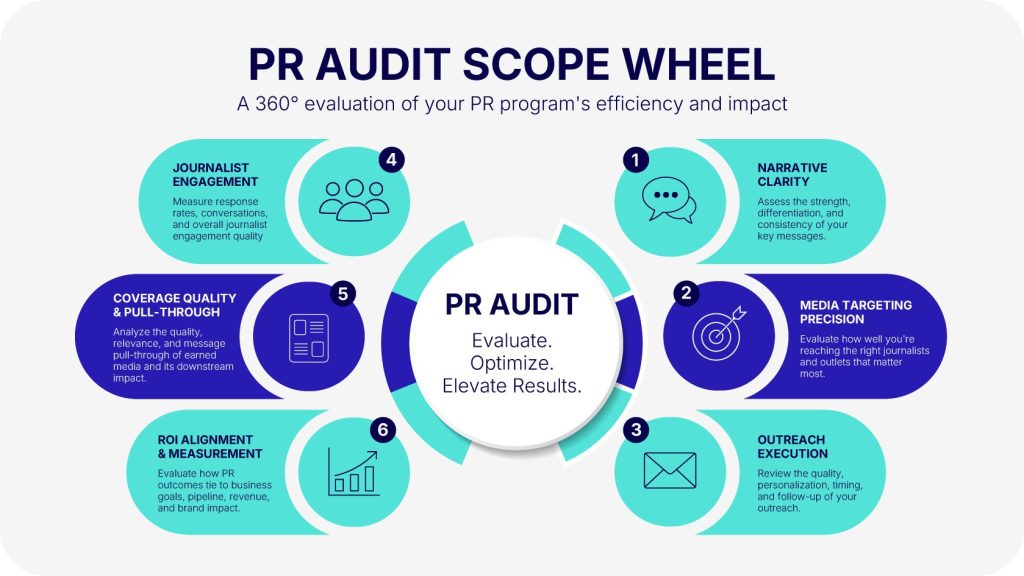
A comprehensive PR audit should evaluate:
- Narrative Clarity: Does your positioning stand out? Is it relevant and consistently communicated?
- Media Targeting Precision: Are you reaching out to the right journalists — or just recognizable outlets?
- Outreach Execution: Are your pitches interesting, personalized, and well-timed?
- Journalist Engagement: Are you generating meaningful responses — or just inbox noise?
- Coverage Quality: Does earned media reinforce your strategic narrative and authority?
- ROI Alignment: Is your PR program tied to pipeline, brand lift, or revenue signals?
In other words, a true PR audit measures effectiveness at every stage of the PR funnel. This distinction matters. Because without a deeper probe into activity, it’s easy for PR to look busy while yielding little impact in the areas that actually matter.

Pro Tip: If your PR reporting can’t influence a board-level conversation, your audit should start with measurement — not media coverage.
For more on PR reporting, read our guide: PR Reporting – Displaying Metrics for Success [+3 Examples]
When Should You Run a PR Audit?
Most companies don’t choose to run a PR audit until things are noticeably declining:
- Coverage quality and consistency plateau.
- Journalist response rates drop.
- Leadership starts asking harder questions about ROI.
Momentum slows to a crawl, and by that point, multiple parts of your program are already plagued with inefficiencies. Top teams approach PR audits differently. They don’t wait for their efforts to underdeliver — they audit proactively.
So rather than fixing issues as they arise, this PR maintenance protects performance from needing major repairs in the first place.
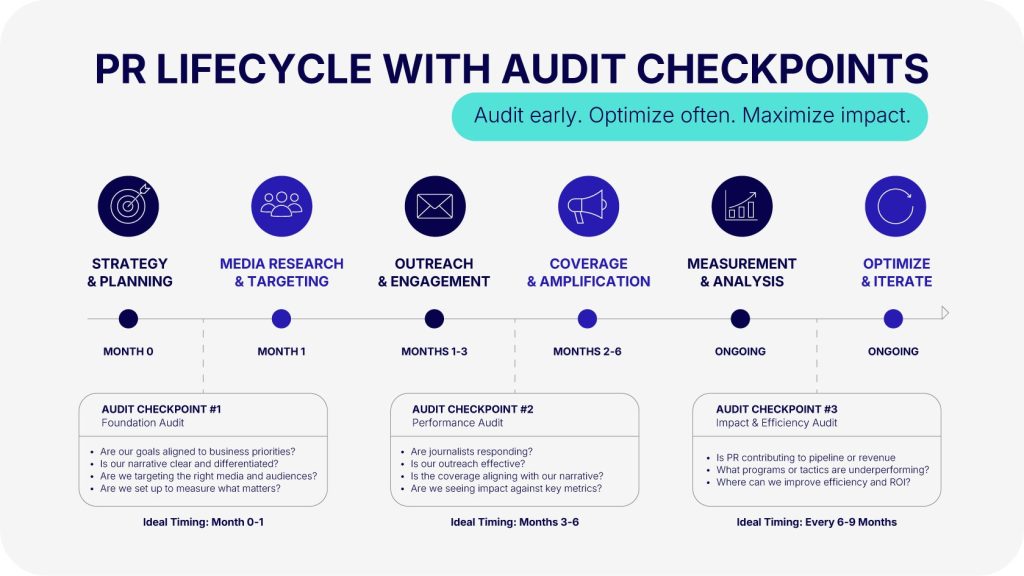
6 Examples When a PR Audit is Critical
Here are six high-signal scenarios that require a PR audit:
- You’re still landing placements, but they’re less impactful, less aligned, or less frequent.
- Outreach volume may be high, but engagement isn’t translating into conversations.
- You’re being asked by leadership to justify spend in terms of pipeline, revenue, or strategic impact.
- Fundraising, product launches, or market expansion require tighter narrative and execution.
- You’ve been working with the same agency for 6–9+ months and enough time has passed to evaluate performance trends, not just early wins.
- You’re moving from founder-led or reactive PR into a scalable, repeatable program.
Context is important here. These situations don’t necessarily mean your PR program is failing. In many cases, they just signal that it’s been a minute since your system’s last pressure test.
A well-timed PR performance audit is that pressure test.
It shows where momentum is slowing — messaging, targeting, outreach, measurement, etc. — and reveals a clear path to program optimization without the need for a complete overhaul.

Pro Tip: Schedule PR audits quarterly or biannually, even when performance is strong — this is how you continuously refine performance, catch inefficiencies early, and stay aligned with evolving business goals.
Need help writing a PR plan? We’ve got you covered: How to Write an Effective PR Plan [Tips + Examples]
6-Step PR Efficiency Audit Framework
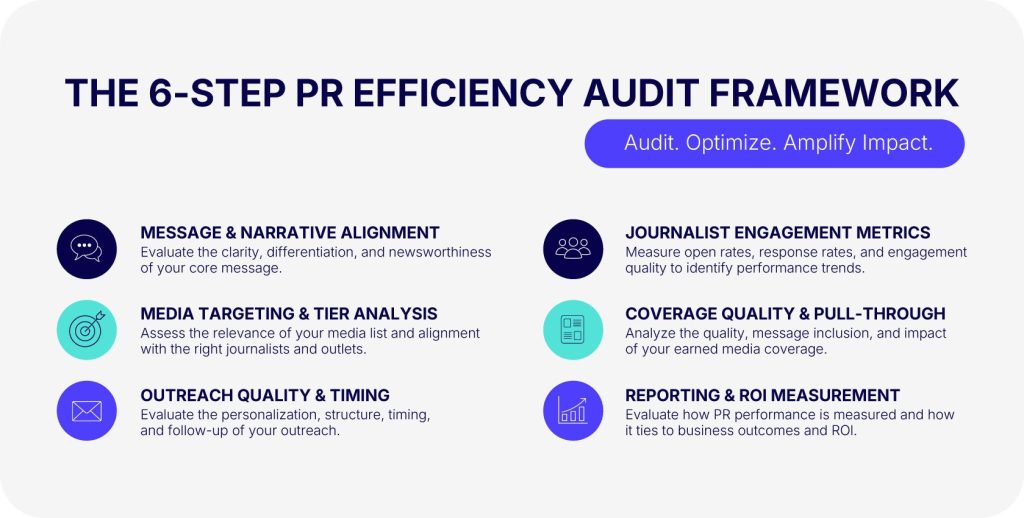
This PR audit framework is designed for end-to-end system evaluation. Each step is a crucial conversion point where performance wins or quietly loses.
As you go through each stage, identify where efficiency breaks down across your PR funnel — from narrative to ROI.
Step 1. Message & Narrative Alignment
Think of this as your PR starting line. If your narrative is unclear, too similar to competitors, and irrelevant, you’ll be off to a false start.
What to Evaluate:
- Clarity and Strength of Positioning
- Newsworthiness of Story Angles
- Consistency Across Pitches, Interviews, and Coverage
Diagnostic Questions:
- Is your narrative easily articulated in a single compelling sentence?
- Does it reflect a strong point of view, or just describe your product?
- Are you pitching newsworthy stories, or just making announcements?
Common Inefficiencies:
- Unoriginal Messaging
- Storytelling that’s Overly Product-led
- Lack of Data, Insight, or Contrarian Perspective
Example:
- Weak Narrative: “We launched a new feature”
- Strong Narrative: “New data reveals X trend reshaping [industry]”
Pro Tip: If a journalist can’t immediately see why your story matters to their audience, your narrative isn’t ready — refine it before scaling outreach.
Learn more about what journalists want here: What Journalists Want: What PR Pros Need to Build Relationships with Journalists
Step 2. Media Targeting & Tier Analysis
If delivered to the wrong audience, even the strongest narratives are prone to underperformance.
What to Evaluate:
- Relevance of Media List (not just prestige)
- Journalist Beat Alignment
- Tiering Strategy (Tier 1, 2, 3)
Diagnostic Questions:
- Are you targeting journalists who actively cover your category?
- What percentage of your outreach is relevant vs aspirational?
- Are you regularly updating and refining your media contact list?
Common Inefficiencies:
- Impersonal, High-volume Outreach
- Over-indexing on Top-tier Outlets
- Outdated or Misaligned Media Contacts
Example:
- Inefficient: You pitch a broad “top 50 tech” media list regardless of beat.
- High-performing: You target 10–15 journalists who consistently cover your exact category (e.g., fintech infrastructure, not general tech)
Pro Tip: Cut your media list in half and improve relevance — you’ll often see better results with fewer, strategically selected targets.
Want to land better media coverage? Here’s how: 4 PR Pitching Tips for Pros to Land Better Media Coverage in 2025
Step 3. Outreach Quality & Timing
This is where execution is put to the test — and where many PR programs lose efficiency.
What to Evaluate:
- Level of Personalization
- Clarity and Structure of Pitches
- Timing Relative to News Cycles
- Follow-up Cadence
Diagnostic Questions:
- Are your pitches tailored to each journalist?
- Do your emails clearly communicate value in the first few lines?
- Are you following up strategically (and politely) — or excessively?
Common Inefficiencies:
- Mass-blasting Emails
- Weak Subject Lines
- Poorly Timed Pitches
Example:
- Inefficient: You send the same impersonal pitch to 100+ journalists, and then follow up aggressively when they don’t respond.
- High-performing: You reference a journalist’s recent article and tie it to their coverage angle. Then you follow up politely with additional info after a day or two.
Pro Tip: Improving subject lines and the first two sentences of your pitch will have a disproportionate impact on engagement.
Need to craft the perfect pitch? We’ve got you covered: A Comprehensive Guide to Crafting an Effective PR Pitch [Examples + Templates]
Step 4. Journalist Engagement Metrics
This is one of the clearest indicators of whether or not your PR program is actually working.
What to Evaluate:
- Open Rates
- Response Rates
- Positive Reply Rates (interest vs polite decline)
Diagnostic Questions:
- Are you consistently tracking engagement metrics?
- What percentage of responses lead to actual conversations?
- Are engagement rates improving over time?
Common Inefficiencies:
- Tracking Sends (not outcomes)
- No Insight into Response Quality
- Ignoring Engagement Trends
Example:
- Inefficient: You report “200+ emails sent” with zero engagement data.
- High-performing: You track that 15% of outreach yielded responses, with 8% converting to real conversations.
Pro Tip: Response rate — not coverage volume — is the most reliable early indicator of PR performance.
For more on key metrics to measure for success, read our guide: 10 Key PR Metrics You Must Measure to Gauge Success
Step 5. Coverage Quality & Pull-Through
Keep in mind that not all coverage is equal, and volume alone rarely indicates performance.
What to Evaluate:
- Message Inclusion and Accuracy
- Brand Positioning Within the Story
- Presence of Backlinks or SEO Value
- Depth of Coverage (feature vs mention)
Coverage Quality Tiers:
- Tier 1: Feature or Thought Leadership
- Tier 2: Strong Quote Inclusion
- Tier 3: Passive Mention
Diagnostic Questions:
- Is coverage reinforcing your strategic narrative?
- Are you positioned as an industry expert — or just included?
- Is coverage driving downstream value (traffic, authority, etc.)?
Common Inefficiencies:
- High Volume of Low-impact Mentions
- Weak Message Pull-through
- Misaligned Positioning in Articles
Example:
- Inefficient: Your brand is mentioned once in a roundup without context.
- High-performing: An executive is quoted multiple times in a feature article aligned with your core narrative.
Pro Tip: Shoot for a few top-tier placements rather than a ton of low-quality coverage — strong narrative pull-through drives far more value than volume.
Need to measure your thought leadership efforts? Learn how here: How to Measure Thought Leadership: Metrics, Strategies, and KPIs
Step 6. Reporting & ROI Measurement
This last step is where PR either proves its value or loses credibility.
What to Evaluate:
- Metrics Being Tracked
- Alignment to Business Goals
- Clarity and Usability of Reporting
Diagnostic Questions:
- Are you tying PR performance to pipeline or revenue signals?
- Are you measuring outputs (coverage) or outcomes (impact)?
- Are reports actionable — or just informational?
Common Inefficiencies:
- Overreliance on Impressions and Reach
- Lack of Attribution or Business Alignment
- Reports that Don’t Inform Decision-making
Example:
- Inefficient: You report “10M impressions generated.”
- High-performing: You show that earned media drove a 33% lift in branded search and influenced X number of inbound leads.
Pro Tip: Build your earned media strategy backward from business outcomes—start with the audiences and actions that drive pipeline, then prioritize outlets, narratives, and coverage types that influence those decisions.
Are you an enterprise level B2B tech brand? Need help with earned media strategy? Read our guide for more info: The Modern Earned Media Strategy Guide for Enterprise B2B Tech Brands [Examples + Tips]
PR Audit Scoring Model
A framework’s value depends on how effectively you use it. This is where most PR audits fall short. Sure, they identify issues — but they often fail to quantify them and organize adjustments in order of importance.
This scoring model turns your evaluation into a clear, decision-ready diagnostic tool that allows you to:
- Benchmark Overall PR Performance
- Identify High-impact Gaps
- Prioritize Optimizations (based on ROI potential)
Step 1. Categorical Scoring (1–5 Scale)
Score based on current performance in these six areas:
| Category | Score (1–5) | Notes | Priority |
| Narrative | |||
| Targeting | |||
| Outreach | |||
| Engagement | |||
| Coverage | |||
| ROI |
Scoring by category:
- 1 = Significant gaps (unclear, inconsistent, or ineffective)
- 2 = Some gaps (clearer but still inconsistent)
- 3 = Moderate performance (functional but inefficient)
- 4 = Adequate performance (efficient with room for optimization)
- 5 = High-performing (clear, consistent, and optimized)
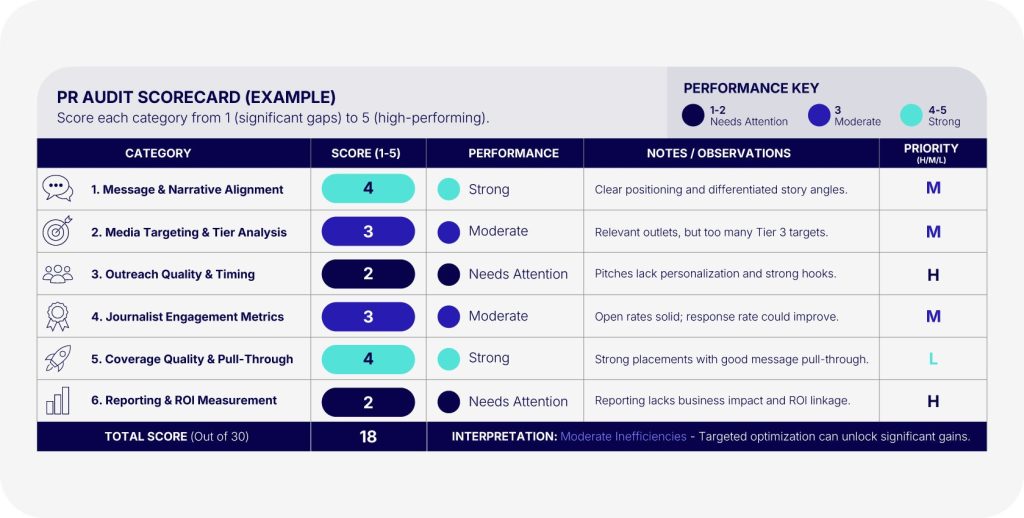
Here’s an example of a completed PR audit scoring table (color-coded for performance):
Step 2. Calculate Your Total Score
Here’s how to interpret your total:
- 24–30 = High-performing System: Your program is strategically aligned and operationally efficient. Focus on incremental gains and scaling what works.
- 18–23 = Moderate Inefficiencies: Your foundation is solid, but there are clear gaps limiting performance. Targeted optimization will unlock significant gains.
- <18 = Significant Performance Gaps: Inefficiencies exist across multiple stages of the PR funnel. A structured optimization plan is required to improve results.
Step 3. Apply Priority Weighting
Here’s how to see what’s actually driving ROI. Because not all categories contribute equally to performance, you should focus on the highest-leverage drivers of PR effectiveness first.
Use this priority weighting model:
| Category | Weight | Why it Matters |
| Message & Narrative Alignment | 25% | Drives relevance, differentiation, and journalist interest |
| Media Targeting & Tier Analysis | 20% | Determines whether your message reaches the right audience |
| Outreach Quality & Timing | 20% | Impacts whether your message gets opened and considered |
| Journalist Engagement Metrics | 15% | Early indicator of performance and message-market fit |
| Coverage Quality & Pull-Through | 10% | Reflects how well your narrative translates into media |
| Reporting & ROI Measurement | 10% | Enables optimization and executive alignment |
Step 4. Calculate a Weighted Score
Multiply each category score by its weight for more accurate performance results.
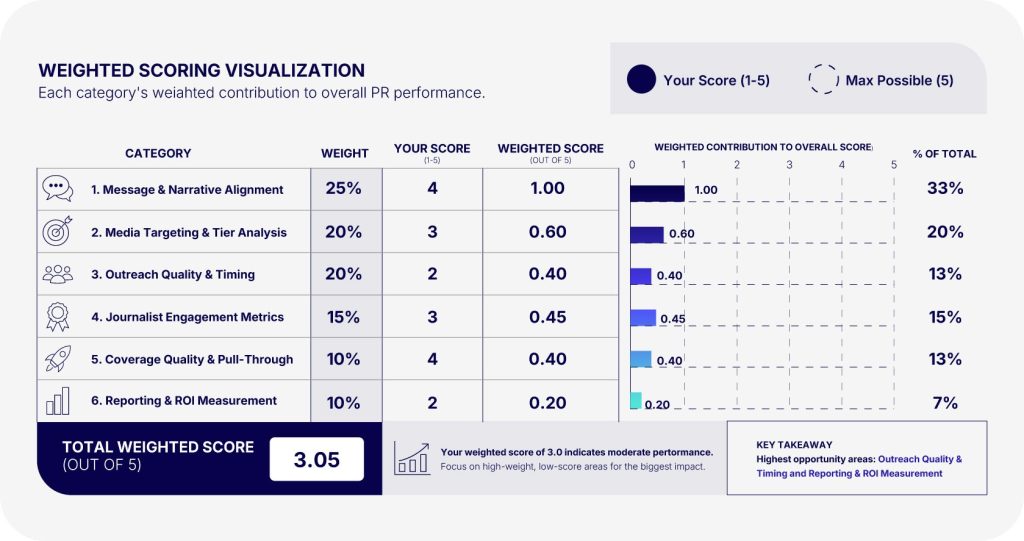
Total Weighted Score = 3.05 / 5
The weighted model provides you with a performance score that expresses both execution and strategic importance.
Step 5. Identify High-Impact Gaps
Once you have your scores, don’t just look at totals — try to spot patterns:
- High narrative + low engagement = Messaging may not be translating in outreach.
- Strong engagement + weak coverage = Targeting or positioning issues
- Good coverage + weak ROI = Measurement and alignment gaps
This is where the PR audit becomes actionable.
How to Prioritize PR Program Repair
Use this simple ranking lens:
- High Weight + Low Score = Immediate Focus
- High Weight + High Score = Scale & double down
- Low Weight + Low Score = Secondary optimization
This helps teams focus on high-impact improvements rather than wasting time on weak performance drivers.
Pro Tip: Don’t try to fix everything at once. The biggest PR performance gains come from improving one high-impact bottleneck at a time — usually narrative, targeting, or outreach.
Need help running an entire campaign? Meet Preston: the 2026 AI PR agent that runs your entire campaign
PR Audit Checklist
The scoring model shows you where your PR performance stands. This checklist shows you precisely what to evaluate and fix.
This repeatable PR audit checklist is an asset for teams to use quarterly to gauge, benchmark, and optimize performance across your entire PR program. It should act as your live audit worksheet, team alignment tool, and pre-read for leadership or board discussions.
Review each section and mark accordingly:
- Mark ✅ if the area is strong and complete.
- Mark 🚧 if the area needs improvement.
- Mark ❌ if the area is missing or not tracked.
You should also add notes where gaps exist and map finding back to your scoring model and priorities.
Section 1. Narrative and Messaging
- Clear, differentiated positioning (not interchangeable with competitors)
- Core narrative can be articulated in one compelling sentence
- Defined story angles (data, trends, POV — not just announcements)
- Messaging is consistent across pitches, interviews, and coverage
- Narrative aligns with current business priorities (growth, funding, category positioning)
Diagnostic Prompt: “Would a journalist immediately understand why this story matters to their audience?”
Section 2. Media Targeting and List Quality
- Media list is segmented by tier (Tier 1, 2, 3)
- Journalists are aligned to relevant beats (not just outlets)
- Contact list is current and actively maintained
- Outreach prioritizes relevance over reach
- Clear rationale exists for why each journalist is targeted
Diagnostic Prompt: “Are we targeting journalists who consistently cover our exact category — or just recognizable names?”
Section 3. Outreach Execution
- Pitches are personalized (not templated mass emails)
- Subject lines are clear, compelling, and specific
- First 2–3 sentences communicate immediate value
- Outreach timing aligns with news cycles and editorial calendars
- Follow-up cadence is strategic (not excessive or absent)
Diagnostic Prompt: “Would this pitch stand out in a journalist’s inbox — or virtually indistinguishable from others?”
Section 4. Journalist Engagement
- Open rates are tracked consistently
- Response rates are tracked and benchmarked
- Positive responses (interest vs decline) are measured
- Journalist conversations are documented and followed up
- Engagement trends are reviewed over time (not just per campaign)
Diagnostic Prompt: “Are we measuring actual engagement — or just activity?
Section 5. Coverage Quality and Impact
- Our coverage includes key messages and positioning
- Our brand is represented accurately and strategically
- Our overage is tiered (feature, quote, mention)
- Our backlinks or SEO value are captured where possible
- Our coverage aligns with target audience and business goals
Diagnostic Prompt: “Does our coverage reinforce our narrative—or just mention our brand?
Section 6. Reporting and ROI Alignment
- PR metrics go beyond impressions and reach
- Reporting connects to business outcomes (pipeline, traffic, brand lift)
- Clear KPIs are defined and tracked consistently
- Reports are actionable — not just descriptive
- PR performance is communicated in an executive-ready format
Diagnostic Prompt: “Can we clearly explain how PR contributes to revenue or growth?”
Checklist Scoring Table
Use this table to tally your results and add important notes:
| Category | Status ✅ 🚧 ❌ | Key Gaps Identified | Priority |
| Narrative & Messaging | |||
| Media Targeting | |||
| Outreach Execution | |||
| Engagement Metrics | |||
| Coverage Quality | |||
| Reporting & ROI |
How to Make this Actionable
Once completed, your checklist should tell you:
- Where Performance is Breaking Down
- Which Gaps are Systemic vs Tactical
- What to Prioritize First (based on impact)
One of the most common patterns that emerges is strong activity paired with weak alignment — which leads to inconsistent results.
That’s where optimization creates the greatest impact.
Most PR programs don’t have an activity problem — they have an alignment problem. And without alignment across messaging, targeting, and outreach, results become difficult to scale.
Download our PR Audit Checklist and PR Audit Worksheet to get started.
Pro Tip: Don’t treat this as a one-time exercise. Work this checklist into a quarterly PR audit cadence, and use it to continuously refine strategy, execution, and measurement.
Find more on strategy refinement and measurement here: 7-Step Guide to PR Analytics: Unveiling Insights for Strategy Enhancement
How to Improve PR Performance (Without a Budget Increase)
There’s an urge to increase spend after performance leaks are identified — more outreach, campaigns, and agency support.
But in reality, the opposite approach is best.
Focus on optimization over expansion, and improve how your existing PR system operates before adding more resources. Because volume is rarely the problem with PR programs — it’s typically an efficiency issue.
Here are six of the highest-leverage ways to improve performance using your current budget, team, and agency structure.
1. Refine Your Narrative
This is the highest-level fix, because your narrative is the foundation of your entire PR program. If it’s unclear, unoriginal, or irrelevant, everything downstream underperforms.
Here’s what to do:
- Rework positioning to emphasize insight, data, or a strong viewpoint.
- Shift from company updates to market-relevant stories.
- Align messaging with what journalists actually cover — not just what you want to say.
Example: Your company shifts from “announcing product updates” to leading with proprietary data on industry trends — resulting in higher response rates and more in-depth coverage.
This works because stronger narratives boost both engagement and coverage quality without increasing outreach volume.
2. “Aim Small, Miss Small” Media Targeting
Narrow and upgrade your targeting. Having more contacts doesn’t equal better results — it’s precision that drives performance.
Here’s what to do:
- Reduce your media list to only the most relevant journalists.
- Prioritize beat alignment over publication prestige.
- Continuously refine and update your list based on engagement data.
Example: You trim a media list down from 120 contacts to 40 highly relevant journalists — leading to higher response rates and more meaningful conversations.
This works because better targeting improves conversion at every stage — from opens to coverage.
3. Improve Outreach Quality, Not Quantity
Outreach inefficiencies usually result from poor execution, not lack of effort.
Here’s what to do:
- Rewrite subject lines to be clear, specific, and relevant.
- Personalize the opening lines based on the journalist’s recent work.
- Focus on clarity and brevity — get to the point (and value) quickly.
Example: Clearer and more personalized pitches increase your response rate from 3% to 12% — without an increase in volume.
This works because small improvements in outreach quality create engagement spikes.
4. Shrink Focus to Higher-Quality Opportunities
More campaigns don’t necessarily mean better results.
Here’s what to do:
- Prioritize fewer, stronger story angles.
- Invest more time in crafting each pitch.
- Align outreach around moments that actually matter (data releases, trends, POVs).
Example: You shift from weekly outreach to fewer, more strategic campaigns — resulting in stronger coverage and better message pull-through.
This works because a narrower focus not only improves the quality of stories, it makes execution more consistent.
5. Use Engagement Data as a Feedback Loop
PR performance improves when you’re taking meaningful measurements and making real-time adjustments.
Here’s what to do:
- Track open rates, response rates, and positive replies.
- Identify which messaging and angles drive engagement.
- Continuously refine based on performance trends.
Example: Your team identifies that data-driven pitches outperform product announcements 2:1 and shifts strategy accordingly.
This works because data turns PR from a static process into an iterative performance system.
6. Align PR with Business Outcomes
PR is much more effective when it’s tied to what your business actually wants to achieve.
Here’s what to do:
- Define clear KPIs tied to pipeline, traffic, or brand lift.
- Align campaigns with strategic business priorities.
- Ensure reporting reflects outcomes — not just outputs.
Example: You reframe PR goals around branded search growth and inbound interest, which creates clearer alignment with marketing and revenue teams.
This works because alignment ensures PR is contributing to measurable business impact, not just visibility.
What This Looks Like in Practice
Doing more doesn’t necessarily translate to performance gains. It’s better to focus on doing the right things better.
Here’s a visual comparison showing how optimizing narrative, targeting, and outreach improves PR efficiency and outcomes:
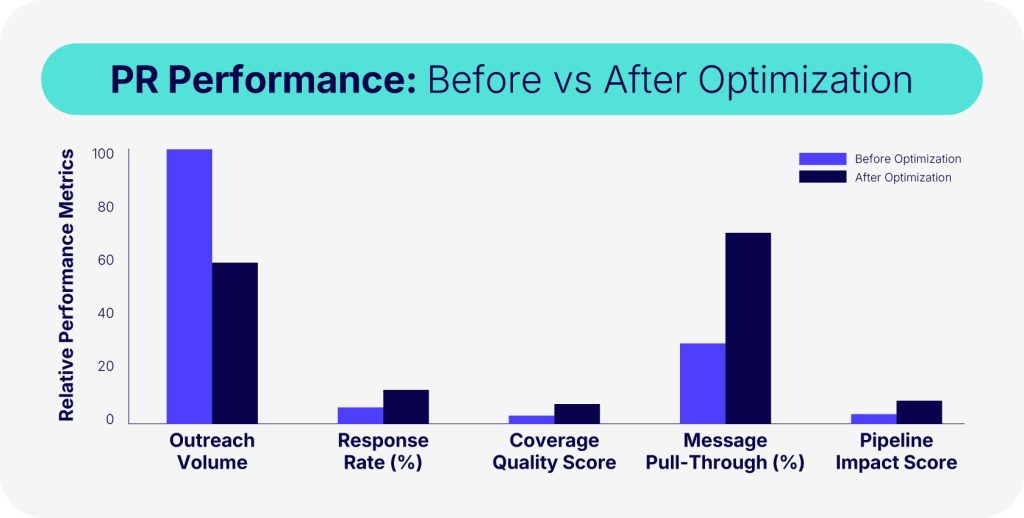
- Outreach Volume: 40% fewer pitches — more relevance and higher response rates.
- Response Rates: 3X higher (4% to 12%) — more conversations and stronger relationships.
- Coverage Quality: 2X higher (2.1 to 4.2) — stronger outlets and better visibility.
- Message Pull-through: 2.3X higher (30% to 69%) — stronger positioning and great impact.
- Pipeline Impact Score: 2X higher (2.0 to 4.0) — stronger influence on the business.
The bottom line: Same budget. Smarter strategy. Better results.

Pro Tip: If you are considering a PR spend increase, ensure your current program is operating efficiently. Otherwise, you’ll be scaling inefficiencies — not results.
Are you a series B–D startup looking to scale your PR budget? Here’s how: PR for Startups: A Scalable Budgeting Blueprint for Series B–D [Examples + Tips]
When to Bring in External Optimization Support
At this point in your PR audit, one thing should be clear — lack of effort is rarely to blame for most gaps in performance.
The usual suspect (and culprit) is misalignment across narrative, targeting, outreach, and measurement. And while internal improvements solve many efficiency issues, having a detailed external perspective accelerates results.
When Internal Optimization Starts to Plateau
Addressing obvious gaps is a common starting point for many teams.
This includes:
- Refining Messaging
- Tightening Up Media Lists
- Improving Outreach Quality
These changes usually drive early performance gains, but that progress tends to slow over time.
This typically signals three important things:
- Internal teams are too close to the narrative.
- Optimization is happening tactically, not systemically.
- There’s no clear benchmark for what “high performance” actually looks like.
When you’re at this stage, small improvements become harder to spot — and harder to prioritize.
When You Need Clear, Objective Diagnosis
One thing that consistently rings true about PR is that it’s uniquely difficult to evaluate from the inside.
- Messaging feels clear internally but doesn’t resonate externally.
- Coverage looks strong but lacks strategic positioning.
- Reports show activity but not impact.
An external audit injects objectivity into evaluation across your entire PR system, benchmarking against high-performing programs and clearly identifying root causes beyond symptoms.
When PR Needs to Prove Business Impact
Expectations increase with budget. Leadership doesn’t want to know if there’s coverage — that should be a given. They want to know if PR is actually driving growth.
If your team is struggling to tie PR to pipeline or revenue, align reporting with business goals, or communicate impact to executives, it’s time to rethink how performance is measured and optimized.
When You Want to Improve (Not Replace) Your Program
External support isn’t an internal agency or team replacement.
In most cases, the goal is to:
- Enhance what’s already in place.
- Identify inefficiencies and unlock performance.
- Provide strategic guidance that complements execution.
This is especially valuable for teams that are already investing significantly in PR. You have strong activity, but inconsistent outcomes, and you want to maximize ROI without starting over.
Where Intelligent Relations Fits
At this stage, teams don’t need more execution — they need smarter optimization.
That’s where Intelligent Relations operates. We’re an augmentation partner, not a replacement. We focus on improving performance across your existing PR system — bringing data, structure, and strategic clarity to how PR is run.
Instead of adding more volume, the focus is on:
- Strengthening Narrative-market Fit
- Improving Targeting Precision
- Increasing Journalist Engagement
- Aligning PR with Measurable Business Outcomes
Final Takeaway
PR isn’t a set of tactics — it’s a system. High-performing PR programs don’t depend on more outreach, campaigns, and spend.
They operate as aligned systems, where:
- Messaging is clear and differentiated.
- Targeting is precise and intentional.
- Outreach is high-quality and data-informed.
- Reporting connects directly to business impact.
That’s what a PR efficiency audit is designed to reveal, and what optimization is designed to improve.
Are you ready to see where your current PR program stands? If you want a clear, objective view of your PR performance and where the biggest opportunities exist, book a free consultation with us today.
You’ll walk away with a structured assessment of your current program, clearly identified performance gaps, and actionable recommendations to improve results without increasing spend.