How to Build a 6-Month Earned Media Plan for Enterprise Growth [Templates, Examples, and Tips]
PR struggles at the enterprise level are rarely due to a lack of ideas. Most commonly, preventable structural issues are to blame. A single month gets packed with: The next month? Teams scramble to fill the pipeline with new stories. This...
- Home
- Intelligent Insights Blog
- How to Build a 6-Month Earned Media Plan for Enterprise Growth [Templates, Examples, and Tips]

PR struggles at the enterprise level are rarely due to a lack of ideas. Most commonly, preventable structural issues are to blame.
A single month gets packed with:
- Product Announcements
- Executive Interviews
- Media Outreach
The next month? Teams scramble to fill the pipeline with new stories.
This is where a solid, six-month earned media plan becomes a must-have.
The biggest B2B brands understand this. They approach PR with long-term visibility and alignment in mind. Messaging, thought leadership, product milestones, industry events, and business objectives don’t operate in isolation. They’re used in conjunction, feeding, amplifying, and informing one another to build momentum rather than chasing coverage quarter to quarter.
In this guide, we’ll break down the practical 6-month earned media plan you need for enterprise growth. We’ve also included planning frameworks, campaign structures, calendar templates, and examples to help you create an earned media PR strategy that’s more consistent, scalable, and measurable.
- What Is an Earned Media Plan?
- Why Enterprise Teams Need a 6-Month Roadmap
- The 6-Month Earned Media Framework
- Quarterly Campaign Planning Structure
- Integrating Product Launches and News Cycles
- Aligning Your PR Roadmap with Business Objectives
- Common Planning Mistakes to Avoid
- 6-Month Earned Media Calendar Template
- How to Adapt Your Plan for Different Growth Stages
What Is an Earned Media Plan?
An earned media plan is the strategic blueprint that details how to become visible, credible, and influential in your industry — without paying for it.
Rather than single announcements or short-term campaigns, an earned media plan focuses on the long-term coordination of:
- Media Outreach
- Executive Thought Leadership
- Product Communications
- Industry Events
- Trend-based Commentary
Together, these previously siloed operations form a cohesive strategy that supports business goals and drives growth.
What Enterprise Earned Media Planning Includes
While there’s no one-size-fits-all playbook, most enterprise earned media plans include:
- Core Messaging and Positioning Themes
- Executive Visibility Initiatives
- Media Outreach Priorities and Target Publications
- Product Launch Communications
- Industry Event and Conference Support
- Thought Leadership Campaigns
- Customer Story and Case Study Promotion
- Reactive Commentary and Newsjacking Opportunities
- Performance Measurement and Reporting Frameworks
These elements all work together to create a sustainable, repeatable system of visibility instead of crutching on irregular outreach.
Earned Media Plan vs. PR Calendar vs. Campaign Plan
These terms get batted around equally, but they actually serve very different purposes.
| Planning Tool | Primary Purpose |
| Earned Media Plan | This is your long-term strategic roadmap that aligns PR efforts with business objectives. |
| PR Calendar | This is your scheduling tool that maps activities, deadlines, and outreach timing. |
| Campaign Plan | This is your tactical plan that focuses on a specific initiative, launch, or announcement. |
Look at your earned media plan as the master plan. Your PR calendar organizes execution, while individual campaign plans act as building blocks within the overall strategy.
Why Strategic Planning Matters
A lot of organizations respond to launches, company news, and industry developments as they arise. While reactive opportunities still have value, purely reactionary PR lacks the consistency required to establish real category leadership.
A solid earned media plan provides the framework needed for sustained visibility.
It helps teams:
- Coordinate messaging across departments.
- Align PR efforts with company objectives.
- Create a steady stream of relevant stories that keeps the brand in front of the right audiences.
The result isn’t just more coverage — it’s coverage with a purpose that supports long-term growth.
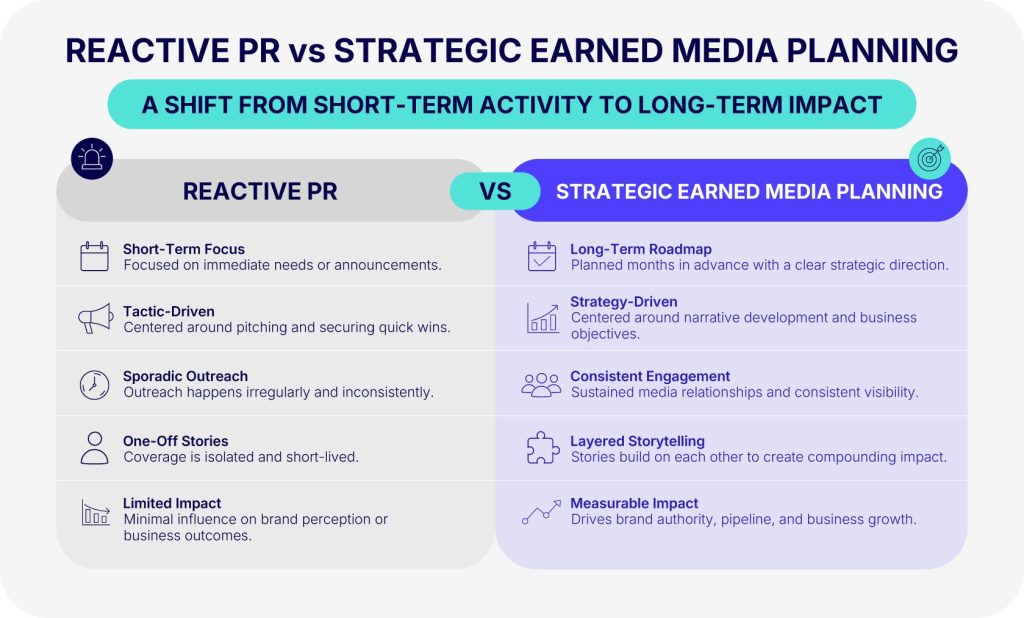
Pro Tip: Try to build your earned media plan around a few core narratives. Consistent messaging across launches, thought leadership, and media outreach is better for long-term visibility than a series of disconnected announcements.
Need to measure the effects of your earned media efforts? Here’s how: Earned Media Measurement: The Executive Playbook for PR ROI in 2026 [Examples + Tips]
Why Enterprise Teams Need a 6-Month Roadmap
Enterprise PR success doesn’t come from singular efforts. It’s the result of sustained visibility built over time.
To be truly effective, earned media needs to operate as a continuous function, especially if your organization has:
- Complex Products
- Multiple Stakeholders
- Long Sales Cycles
- Ambitious Growth Goals
A six-month earned media plan helps you create a unified strategy by coordinating:
- Messaging
- Campaigns
- Executive Visibility
- Product Communications
- Industry Opportunities
Instead of reacting to what’s going on each week, you’re able to proactively build momentum around the narratives that matter most.
Enterprise Buying Cycles Demand Consistency
Unlike consumer brands, the buying journeys that enterprise companies often sell through are quite long. They sometimes span months — or more.
Way before a prospect even enters a sales conversation, they’ve likely encountered your brand in a number of ways:
- Media Coverage
- Executive Commentary
- Analyst Mentions
- Conference Appearances
- Customer Success Stories
- Thought Leadership
So visibility needs to be consistent. A single placement might create awareness, but continuous coverage across trusted publications and industry conversations, in time, establishes unmatched credibility and market authority.
Example: A buyer first learns about your cybersecurity company from an executive quote in a leading industry publication. Then they hear that same executive on a podcast several weeks later, see the brand at a conference, and finally read a customer success story months after initial awareness.
Individually, these encounters seem small. But collectively, they compound trust long before a sales conversation takes place.
Quarterly Planning Alone Creates Gaps
Periods of inactivity between major initiatives is an unintentional but common problem that comes with only planning quarterly. When campaigns and launches end, teams are stuck searching for the next story.
Having a six-month earned media in place fills these gaps with clear sight of upcoming opportunities, including:
- Product Launches and Feature Releases
- Industry Conferences and Trade Events
- Research Reports and Proprietary Data Campaigns
- Executive Thought Leadership Initiatives
- Seasonal Trends and Industry News Cycles
- Customer Stories and Case Studies
It’s the cure for dependency on last-minute outreach. A six-month plan provides you and your teams with the vision needed for strategic campaign sequencing.
Example: Let’s say your cloud infrastructure company launches a major platform update in Q1 and is planning a large conference presence in Q3.
Without a six-month roadmap, Q2 becomes a visibility gap. Long-term planning helps you bridge that gap with:
- Thought Leadership
- Customer Stories
- Trend Commentary
- Research-driven Campaigns
This keeps your brand active in industry conversations.
The Benefits of a 6-Month Earned Media Roadmap
A well-structured roadmap helps enterprise teams:
- Align PR efforts with business objectives.
- Coordinate messaging across departments.
- Create stronger narrative consistency.
- Improve executive visibility planning.
- Build deeper journalist and analyst relationships.
- Better allocate internal and agency resources.
- Measure performance across multiple campaign cycles.
- Generate momentum that compounds over time.
But the most important thing a solid six-month earned plan does is allow PR leaders to shift from activities and outputs to outcomes and business results.
Example: If your fintech company is preparing for geographic expansion, you might use a six-month earned media plan for cross-quarter coordination on:
- Market Research
- Executive Interviews
- Customer Success Stories
- Launch Communications
Instead of one coverage burst, you create continuous visibility that supports awareness through the entire expansion process.
Bonus Enterprise Example: Building Momentum Across Multiple Initiatives
You’re an enterprise AI software company preparing to launch a new governance platform.
- Months 1 and 2: You secure executive commentary around AI regulation and risk management.
- Month 3: You publish proprietary research on enterprise AI adoption trends.
- Month 4: You focus on a major industry conference, where executives participate in speaking engagements and media briefings.
- Months 5 and 6: You introduce customer success stories and product-specific narratives that lead directly into the launch announcement.
By launch day, you’ve already established credibility around the problem your new platform is designed to solve.
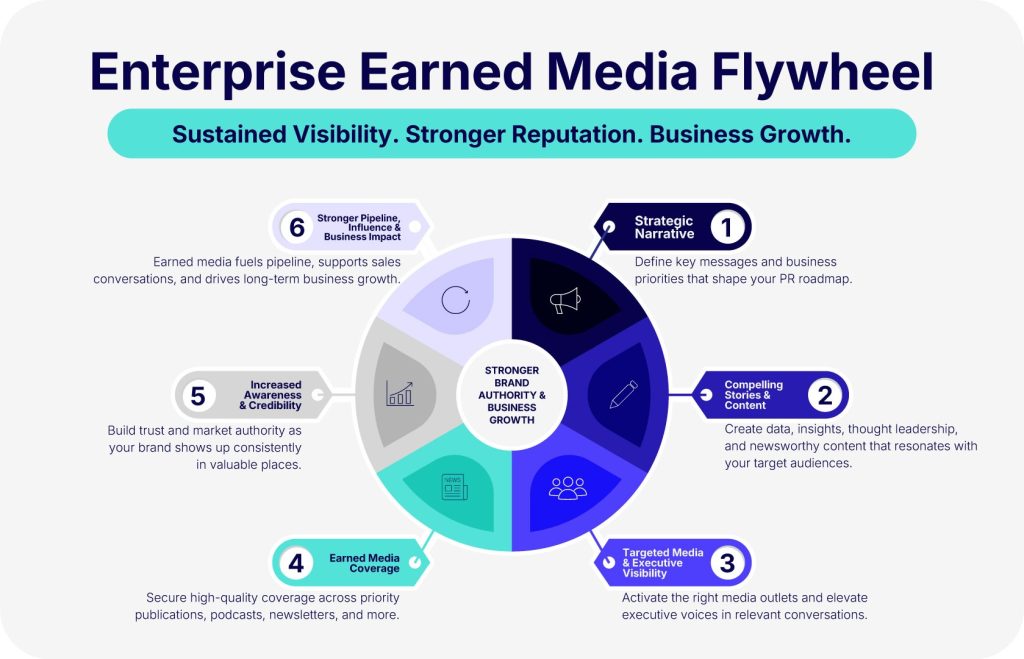
Pro Tip: Plan campaigns as connected chapters of a larger story, not isolated PR moments. Enterprise visibility compounds when each initiative reinforces the narratives that came before it.
For more on PR planning, read our guide: How to Write an Effective PR Plan [Tips + Examples]
The 6-Month Earned Media Framework
A sequence of coordinated initiatives that reinforce each other over time is the foundation of a successful enterprise PR program. Monthly efforts must add to the larger narrative, creating momentum across:
- Media Coverage
- Executive Visibility
- Analyst Engagement
- Industry Events
- Business Objectives
Stop asking, “What story can we pitch this month?”
Start asking, “How do we build authority around our core narratives over the next six months?”
Below is a practical model for doing just that. While every organization will tailor the timeline based on product launches, industry cycles, and internal priorities, the underlying structure remains the same:
- Establish your narrative.
- Identify your audiences.
- Layer campaigns strategically.
- Amplify visibility through events and thought leadership.
- Continuously optimize performance.
Earned Media Roadmap Example
Before diving into the month-to-month breakdown of a six-month earned media plan, here’s a simplified example:
| Month | Primary Focus | Strategic Outcome |
| Month 1 | Narrative and Positioning Audit | Clear messaging foundation |
| Month 2 | Tier Targeting and Segmentation | Prioritized media ecosystem |
| Month 3 | Campaign Layering | Multiple story angles and assets |
| Month 4 | Conference and Event Integration | Expanded visibility opportunities |
| Month 5 | Thought Leadership Push | Increased executive authority |
| Month 6 | Performance Optimization and Reporting | Data driven improvements and future planning |
This framework creates cross-quarter consistency but is also flexible enough to let teams take advantage of new opportunities.
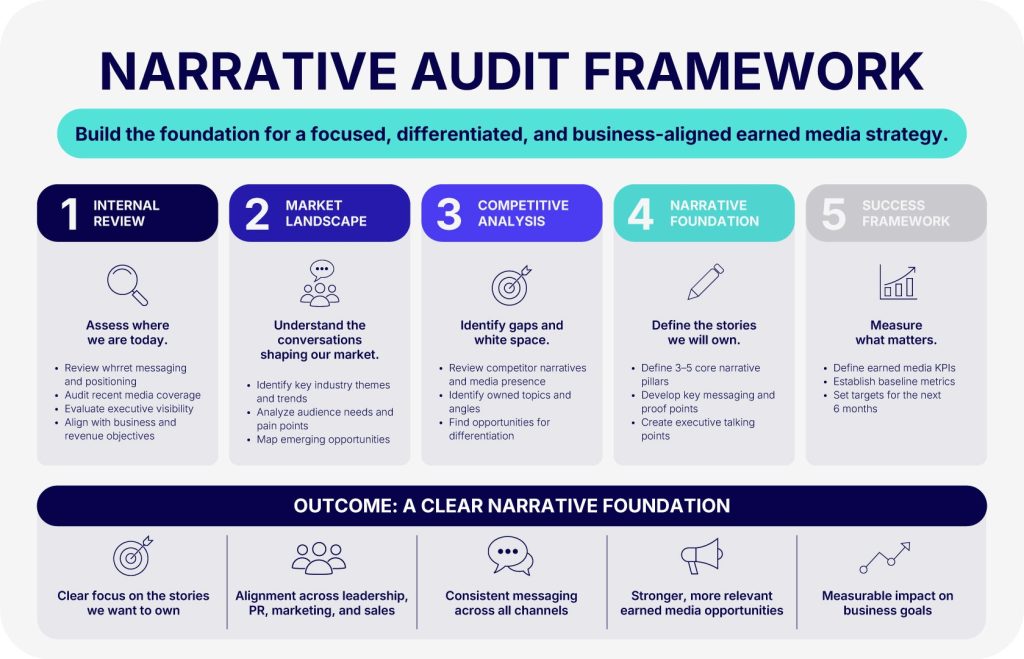
Month 1. Narrative and Positioning Audit
Begin with a clear narrative foundation.
Before you even think about building media lists, planning campaigns, or scheduling executive interviews, you need to know exactly what story you want the market to associate with your brand. This foundation is essential to executing outreach campaigns that support your long-term growth goals.
As you audit your narrative:
- Evaluate existing brand messaging and market positioning.
- Identify the themes currently dominating industry conversations.
- Analyze competitor narratives and media presence.
- Align communications priorities with business and revenue objectives.
- Establish core messaging pillars for the next six months.
Remember, it’s not about more messaging — it’s about more focused messaging.
Core Deliverables
The end of month 1 should look like this:
| Deliverable | Purpose |
| Messaging Framework | Defines Primary narrative and supporting themes |
| Executive Talking Points | Creates consistency across interviews and speaking opportunities |
| Competitive Narrative Analysis | Identifies positioning opportunities and whitespaces |
| Story Angle Inventory | Maps potential media opportunities for future campaigns |
| Success Metrics Framework | Establishes how performance will be measured |
Question to Ask During the Audit
Before you start planning a campaign, you need answer these questions:
- What market problem do we want to be known for solving?
- Which narratives support our current business objectives?
- What topics are competitors owning in the media?
- Where do we have a unique point of view?
- Which executives should be visible and on what topics?
- What proof points can support our claims?
If you can’t answer these, or have weak answers, the more difficult subsequent roadmap phases become.
Enterprise Example
Your cybersecurity company is preparing for a product launch. You discover that most competitors are focused on product features while a few are discussing regulatory readiness.
- Rather than leading with functionality, you build a roadmap around compliance and risk management narratives that support thought leadership and future product announcements.
Pro Tip: If a campaign doesn’t reinforce one of your core narrative pillars, reconsider its priority. Consistency is what turns visibility into authority.
For more info on PR audits: The PR Audit Guide: A Step-by-Step Framework for High-Performance Teams
Month 2. Tier Targeting and Segmentation
Now that your core narratives are defined, the next step is deciding who needs to hear them the most. Since every enterprise media opportunity isn’t equal, you need to start narrowing down a targeted list of:
- Outlets
- Journalists
- Analysts
- Podcasts
- Newsletters
Ask, “Which are most likely to influence key stakeholders?” The goal here is to build a targeted media ecosystem that aligns with your business goals and audience.
Core Deliverables
This phase should include:
- Tiered Media Target List
- Audience and Publication Mapping
- Analyst and Influencer Prioritization
- Executive Spokesperson Alignment
- Outreach Prioritization Framework
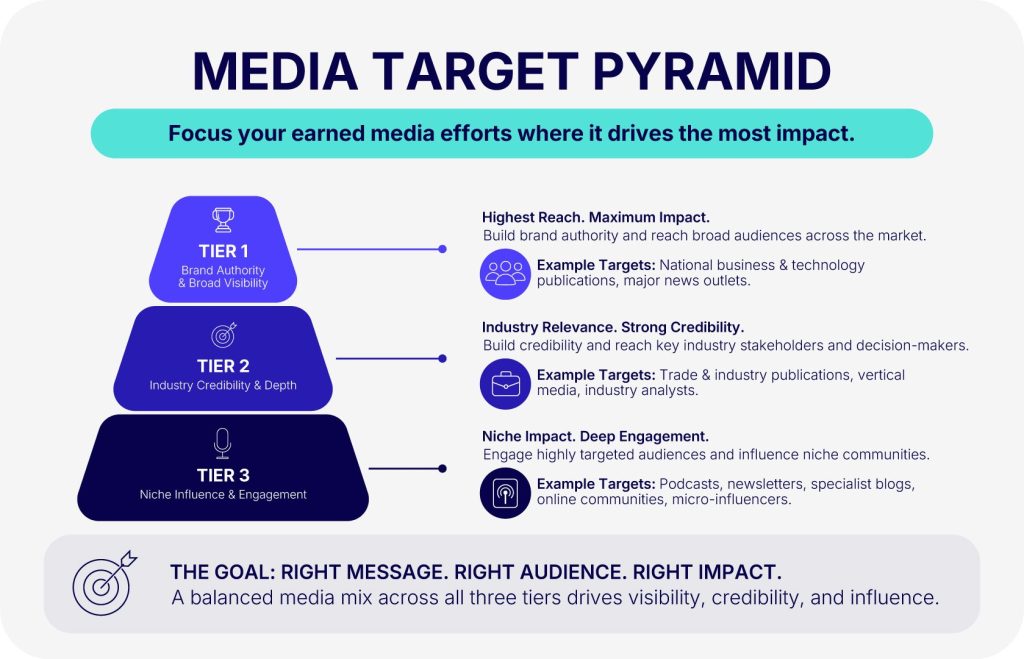
Campaign Tier Model
| Tier | Purpose | Example Targets |
| Tier 1 | Brand authority and broad visibility | National business press and tech publications |
| Tier 2 | Industry depth and credibility | Trade and vertical publications |
| Tier 3 | Niche influence and engagement | Podcasts, newsletters, and specialists communities |
Enterprise Example
Your fintech company is expanding into the enterprise banking market.
You prioritize:
- Tier 1 business publications for executive visibility.
- Tier 2 financial trade outlets for industry credibility.
- Tier 3 fintech newsletters to reach highly engaged decision-makers.
Different purposes. One strategy.
Pro Tip: Don’t prioritize outlets based solely on reach. The most valuable coverage often comes from publications that directly influence your buyers, customers, and industry stakeholders.
Need help building a media list that gets results? We’ve got you covered: How to Build a Media List for Successful Outreach and Impact 2026 [Examples + Tips]
Month 3. Campaign Layering
A major enterprise-level mistake is treating every initiative as a standalone campaign. Earned media programs build momentum through multi-angle layering around an overarching narrative.
By layering campaigns, you create far more visibility and engagement opportunities than just relying on a single announcement.
Core Deliverables
This phase should include:
- Campaign Theme Development
- Supporting Content and Proof Points
- Executive Visibility Opportunities
- Customer Story Integration
- Media Outreach Sequencing
Layered Campaign Model Example
| Campaign Layer | Goal |
| Proprietary Research | Establish industry authority |
| Executive Commentary | Build thought leadership |
| Product Narrative | Connect solutions to business challenges |
| Customer Stories | Provide market validation |
| Industry Trends | Create timely media opportunities |
Enterprise Example
Your AI software company is launching a new platform.
- Start with original research on enterprise AI adoption.
- Follow that with executive commentary on emerging regulations.
- Then highlight customer success stories and introduce product-specific narratives.
Each layer strengthens the same market position while creating multiple avenues of exposure.
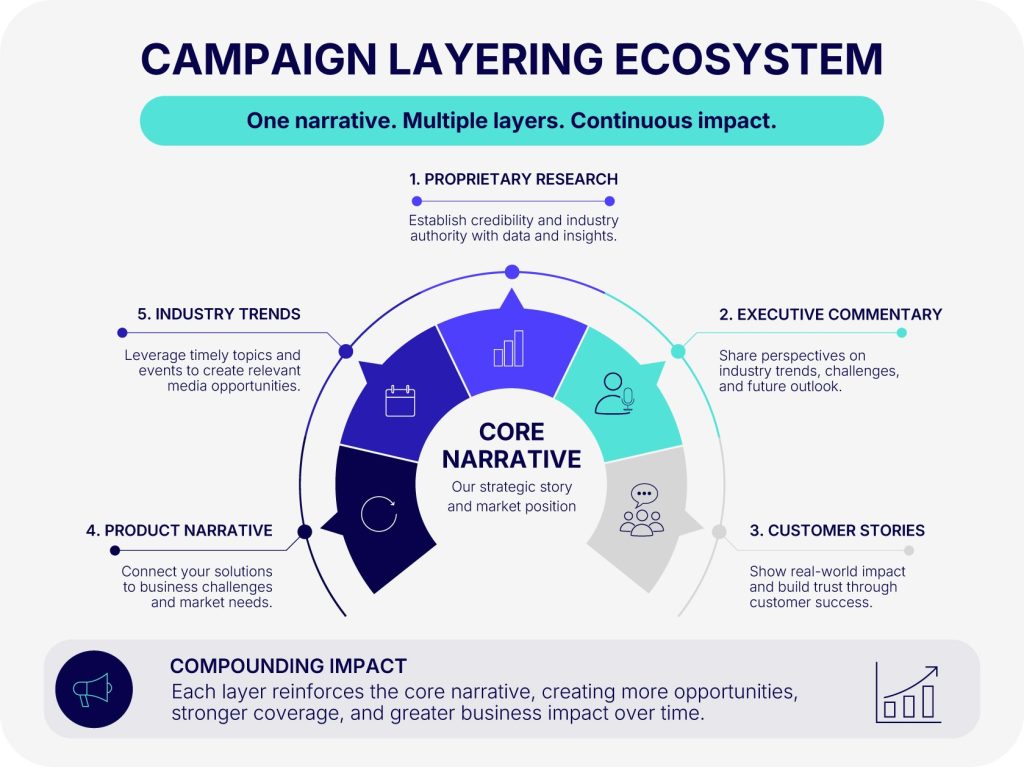
Pro Tip: The strongest campaigns don’t tell one story once — they tell the same strategic story through multiple angles, audiences, and media opportunities.
Learn more about successful PR campaigns here: 4 Successful PR Campaign Examples 2023 and Why They Worked + Tactics
Month 4. Conference and Event Integration
Industry events help amplify earned media strategy only when they’re part of the overall plan. Too many companies view conferences as separate activities and fail to use them as chances to promote existing narratives and campaigns.
Focus on aligning earned media efforts with:
- Upcoming Conferences
- Trade shows
- Customer Events
- Speaking Opportunities
The goal in Month 4 is to maximize visibility before, during, and after the event.
Core Deliverables
This phase should include:
- Event Communications Plan
- Executive Briefing Schedule
- Media Meeting Strategy
- Speaking Opportunity Alignment
- Post-event Content and Outreach Plan
Pre-Event vs During-Event vs Post-Event PR
| Timeline | PR Focus |
| Pre-event | Media outreach, briefings, and announcement planning |
| During Event | Executive interviews, speaking engagements, and live commentary |
| Post-event | Follow-up stories, thought leadership, and content repurposing |
Enterprise Example
Your cybersecurity company is attending the RSA Conference. You start reaching out to targeted media several weeks before the event, schedule executive briefings during the conference, and publish post-event insights afterward.
- Rather than generating a short burst of visibility, your company stretches the event’s value across several weeks.
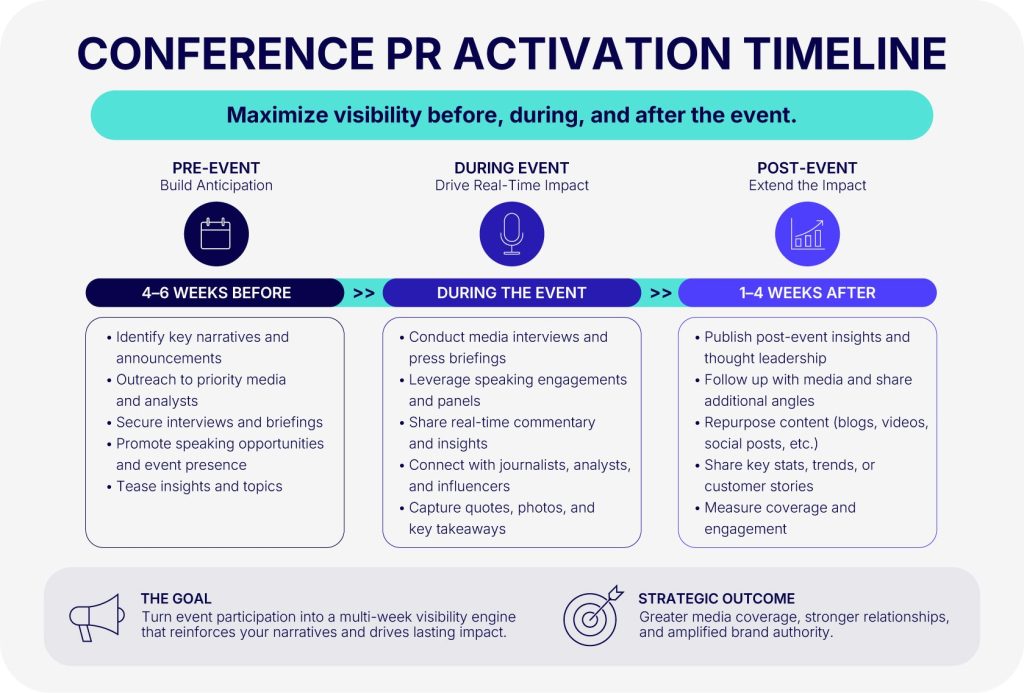
Pro Tip: The most successful event strategies start long before attendees arrive. Build media momentum before the conference begins and continue the conversation after it ends.
Read our guide for more examples and tips on event PR in 2026: Event PR 2026: A How-To Guide + Examples and Tips
Month 5. Thought Leadership Push
After setting your core campaigns in motion, use Month 5 to focus on expanding executive visibility and strengthening market authority.
Product announcements are good for awareness — but thought leadership shapes industry conversations and builds credibility with:
- Buyers
- Analysts
- Investors
- Media
The goal in this phase isn’t simply to publish more content — it’s to establish executives as trusted experts on the most relevant topics in your industry.
Core Deliverables
This phase should include:
- Executive Visibility Strategy
- Byline and Contributed Content Plan
- Podcast and Speaking Opportunity Pipeline
- Commentary and Rapid-response Framework
- Thought Leadership Content Calendar
Executive Visibility Channels
| Channel | Strategic Benefit |
| Bylines | Demonstrate expertise and POV |
| Media Commentary | Increase visibility in industry conversations |
| Podcasts | Reach deeper into targeted audiences |
| Speaking Engagements | Build authority and credibility |
| LinkedIn Thought Leadership | Extend reach and engagement |
Enterprise Example
Your cloud infrastructure company focuses its executives on topics like:
- AI Adoption
- Data Governance
- Digital Transformation
By consistently contributing insights across multiple coverage channels, your company has a solid reputation way before prospects hit the bottom of the funnel.
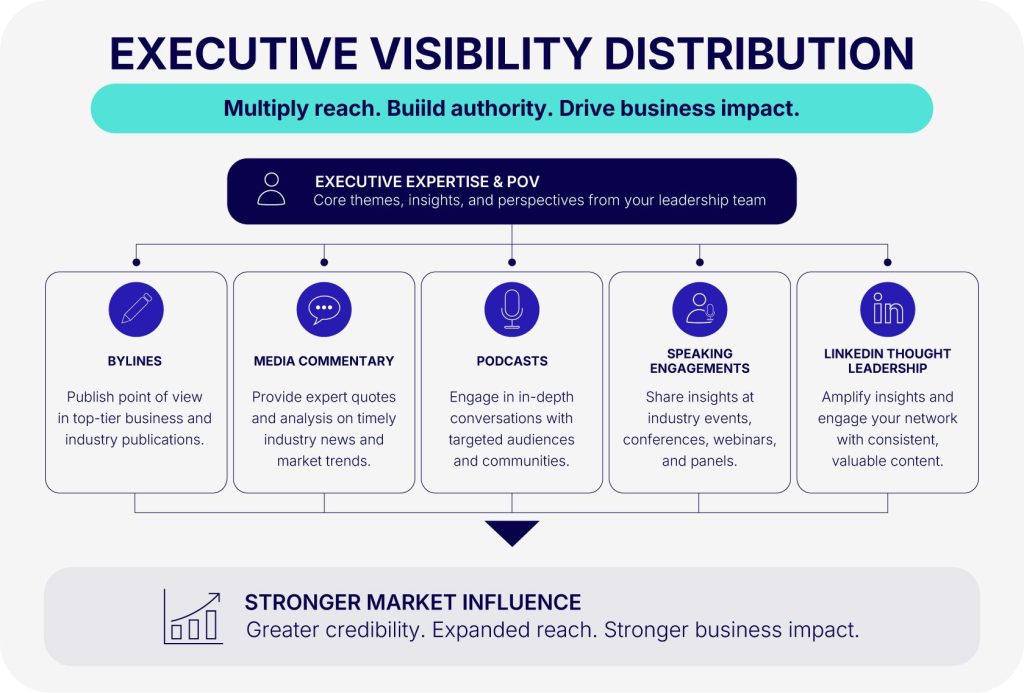
Pro Tip: The most effective thought leadership programs focus on a few strategic themes repeated consistently over time — not a new topic every month.
Need to measure thought leadership? Learn how here: How to Measure Thought Leadership: Metrics, Strategies, and KPIs
Month 6. Performance Optimization and Reporting
Use the last month to:
- Evaluate Results.
- Identify what’s working.
- Use those insights to strengthen future campaigns.
Enterprise PR teams generate huge amounts of data throughout the planning cycle. But if you only review reporting as a performance summary, you miss out on its value as a strategic planning tool.
In this final phase, you need to answer:
- Which narratives gained traction?
- Which media relationships delivered value?
- Where will future investments have the greatest impact?
Core Deliverables
- Campaign Performance Review
- SOV Analysis
- Executive Visibility Assessment
- Media Relationship Evaluation
- Proposals for the Next Planning Cycle
Metrics That Matter for Enterprise PR
| Metric | Strategic Insight |
| SOV | Measures market visibility vs. competitors |
| Tier Placement Quality | Evaluates coverage relevance and authority |
| Executive Visibility | Tracks thought leadership growth |
| Referral Traffic | Identifies audience engagement |
| Pipeline Influence | Connects PR activity to business outcomes |
Enterprise Example
Your SaaS company discovered that executive commentary generated a lot more engagement than product-focused announcements.
- Rather than repeating the same campaign efforts, you adjust future planning to prioritize thought leadership while continuing to support product communications.
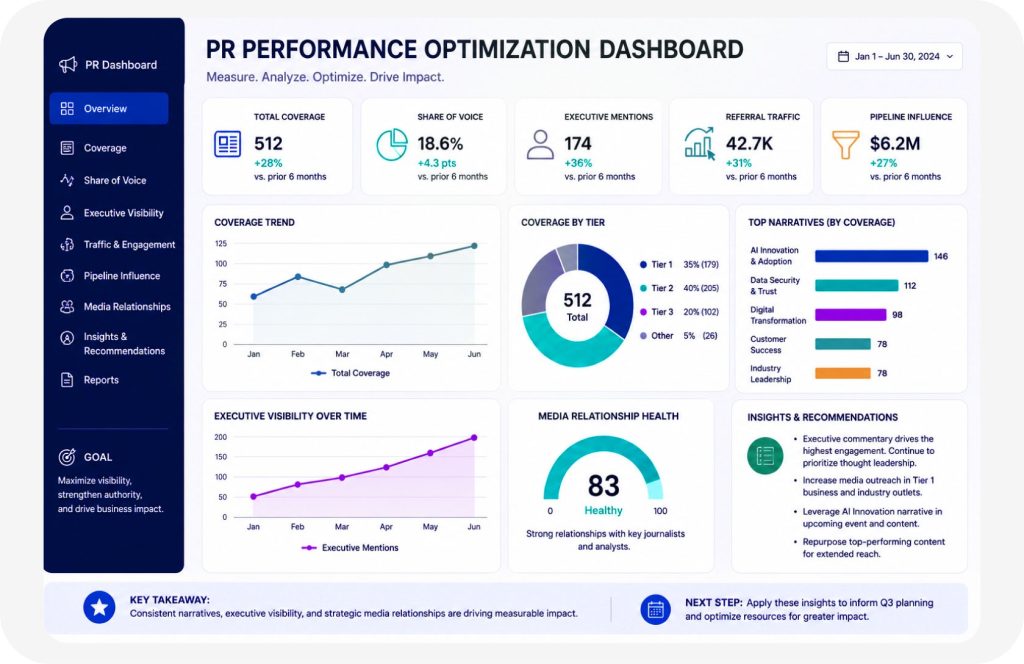
Pro Tip: Don’t only measure coverage volume. Focus on the narratives, channels, and spokespersons that are driving the greatest business impact — then double down on what’s working.
For more on PR reporting, read our guide: PR Reporting – How to Use Data to Get Better Results [+ 3 Examples]
Quarterly Campaign Planning Structure
Monthly activities drive execution, but strategic direction comes from quarterly planning.
Use each quarter to establish overarching themes that align earned media efforts with:
- Business Priorities
- Product Milestones
- Market Opportunities
Campaign planning isn’t an exercise in isolation. Make each quarter a chapter in a larger narrative book.
How to Build Quarterly Themes Around Business Goals
Align PR initiatives with what you’re specifically trying to accomplish.
Establishing quarterly themes ensures every campaign contributes to a larger objective, whether your goal is:
- Category Leadership
- Product Adoption
- Market Expansion
- Executive Visibility
| Quarter | Strategic Theme | Campaign Focus |
|---|---|---|
| Q1 | Category Positioning | Research, thought leadership, market trends |
| Q2 | Product Momentum | Launches, customer stories, executive commentary |
| Q3 | Industry Visibility | Conferences, speaking engagements, media briefings |
| Q4 | Market Authority | Predictions, annual reports, industry insights |
Balancing Planned vs. Reactive Opportunities
Leave room for both long-term campaigns and timely industry conversations.
A modern planning framework should look like this:
- 40% planned campaigns
- 30% executive visibility
- 20% reactive opportunities
- 10% experimentation
Striking a balance between planned and reactive PR provides consistency while remaining flexible enough to seize newsworthy moments as they happen.
Keeping Campaigns Connected
Peak quarterly planning is when campaigns are feeding one another.
- Research feeds thought leadership.
- Thought leadership feeds conference visibility.
- Conference visibility feeds product narratives.
When you have a connected series of initiatives that reinforce the same strategic themes, everybody eats.
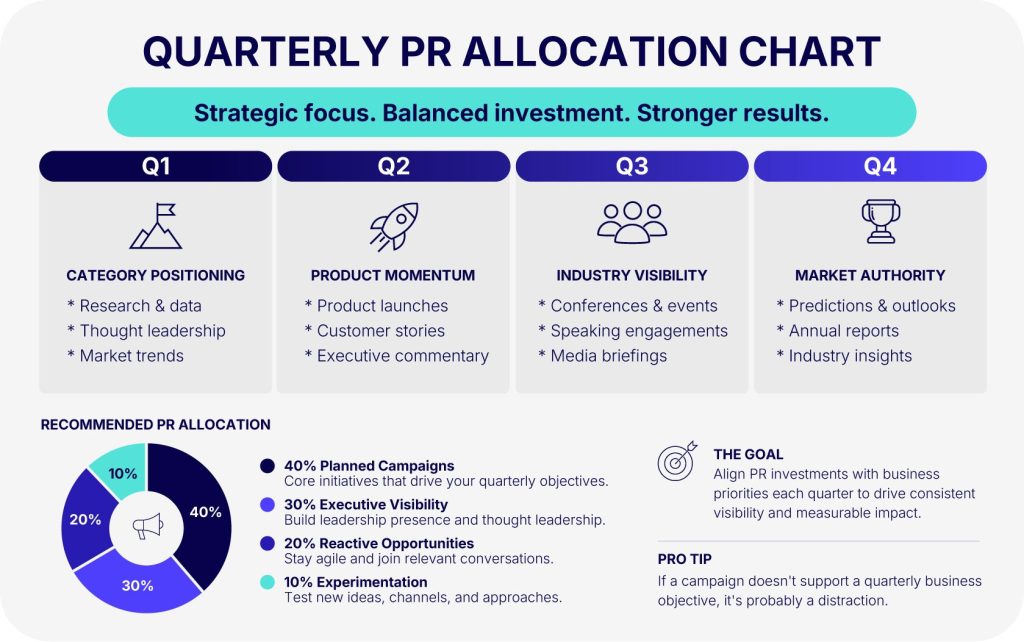
Pro Tip: If a campaign doesn’t support a quarterly business objective, it’s probably a distraction. Prioritize initiatives that contribute to your broader roadmap.
Need help running your entire campaign? Try Preston: Meet Preston: the 2026 AI PR agent that runs your entire campaign
Integrating Product Launches and News Cycles
While product launches are commonly the centerpiece of enterprise-level plans, they shouldn’t be the sole source of visibility.
The best earned media strategies combine planned announcements with continuous participation in industry conversations. This lets you maintain momentum between launches while creating additional opportunities to strengthen narratives.
Product-Led vs Narrative-Led PR
| Product-led PR | Narrative-led PR |
| Feature releases and launches | Industry trends and market insights |
| Company announcements | Executive thought leadership |
| Product-focused messaging | Problem-focused messaging |
| Short visibility spikes | Long-term authority building |
Coverage ebbs and flows if you only rely on product news. Narrative-led PR creates a more consistent market presence.
Build a News Cycle Integration Layer
Your earned media plan should include conversation contribution opportunities throughout the year on things like:
- Emerging Trends
- Regulatory Changes
- Market Shifts
- Economic Developments
- Industry Research and Data
This generates visibility even when there are no major company announcements on the calendar.
Enterprise Example
Your AI software company has only two major product launches scheduled for the year. Between those launches, executives contribute commentary on:
- AI Governance
- Enterprise Adoption Trends
- Regulatory Developments
This keeps the brand in the game while reinforcing its broader market position.
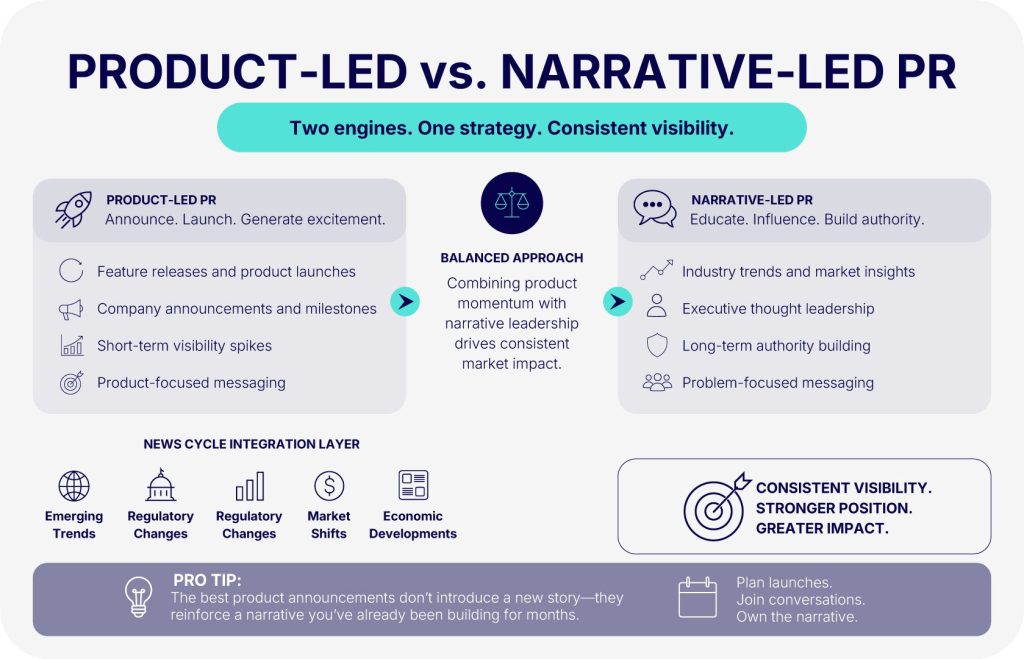
Pro Tip: The best product announcements don’t introduce a new story — they reinforce a narrative you’ve already been building for months.
Find more resources on announcing a new product or website here:
Aligning Your PR Roadmap with Business Objectives
Your PR initiatives and efforts need to support measurable outcomes, whether you’re focused on:
- Market Expansion
- Category Leadership
- Product Adoption
- Customer Acquisition
- Investor Visibility
When strategy aligns with larger company priorities, your six-month earned media plan becomes a perpetual growth machine.
Start with Business Goals
First, you need to identify your primary business objectives — media targets and campaign ideas come later.
| Business Objective | PR Focus |
| Market Expansion | Regional media and executive visibility |
| Category Leadership | Thought leadership and industry commentary |
| Product Adoption | Product narratives and customer stories |
| Customer Acquisition | Buyer-focused messaging and industry influence |
| Investor Visibility | Executive profiling and company milestones |
Connect Narratives to Outcomes
Bridge the gap between messaging and measurable impact.
Example: If your goal is enterprise market expansion, you need to build credibility with prospects in target markets.
Focus on these efforts:
- Executive Thought Leadership
- Customer Success Stories
- Industry Trend Commentary
So you’re not asking, “How much coverage did we get?” — you’re asking, “How did that visibility support our larger goals?”
Additional Questions to Ask
During the planning process, you should also answer the following:
- What narratives support revenue priorities?
- Which executives need visibility?
- Which launches deserve media support?
- What proof points are missing?
- Which markets require authority-building?
Enterprise Example
Your SaaS company is entering a new vertical market. You build an earned media roadmap around:
- Industry-specific Research
- Executive Insights
- Customer Success Stories
The result is a narrative ecosystem that supports awareness and trust way before sales teams start reaching out.
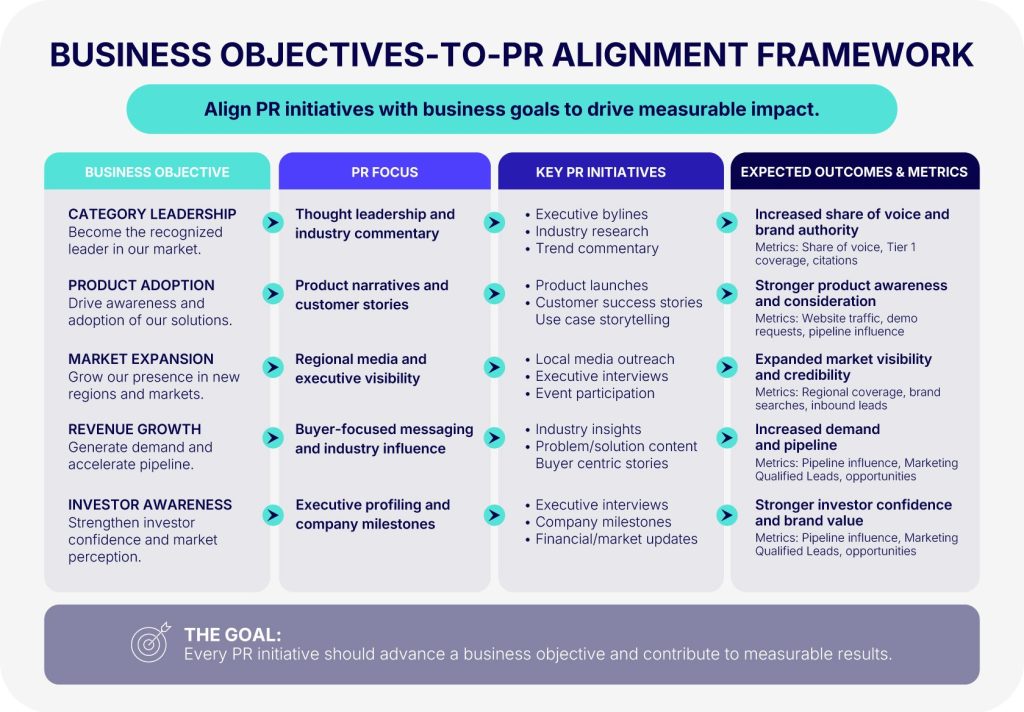
Pro Tip: Every major campaign should be tied to a business objective. If the connection isn’t clear, the initiative may not deserve a place on the roadmap.
Need help knowing where to spend for the best outcomes? Read our guide for more info: PR for Startups: A Scalable Budgeting Blueprint for Series B–D [Examples + Tips]
8 Common Planning Mistakes to Avoid
Sometimes, even planning doesn’t go as planned. Here are eight common mistakes to watch out for while creating your earned media roadmap.
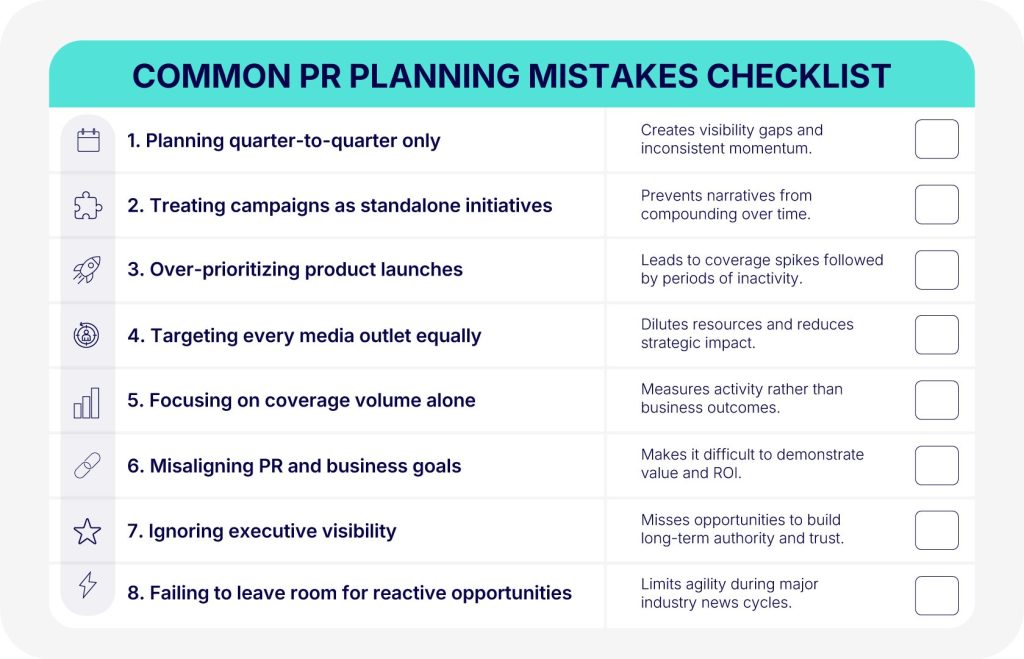
Pro Tip: If your roadmap feels like a collection of disconnected tactics, revisit your core narratives. Strong plans are built around strategic themes, not individual activities.
Find more resources on PR mistakes to avoid here:
6-Month Earned Media Calendar Template
Now that you’ve established your narratives, campaign structure, and quarterly priorities, it’s time to organize activities into a six-month execution calendar.
The sample calendar below illustrates how to distribute earned media initiatives across a six-month planning cycle. While exact timing will vary based on launches, events, and objectives, this structure provides a helpful starting point.
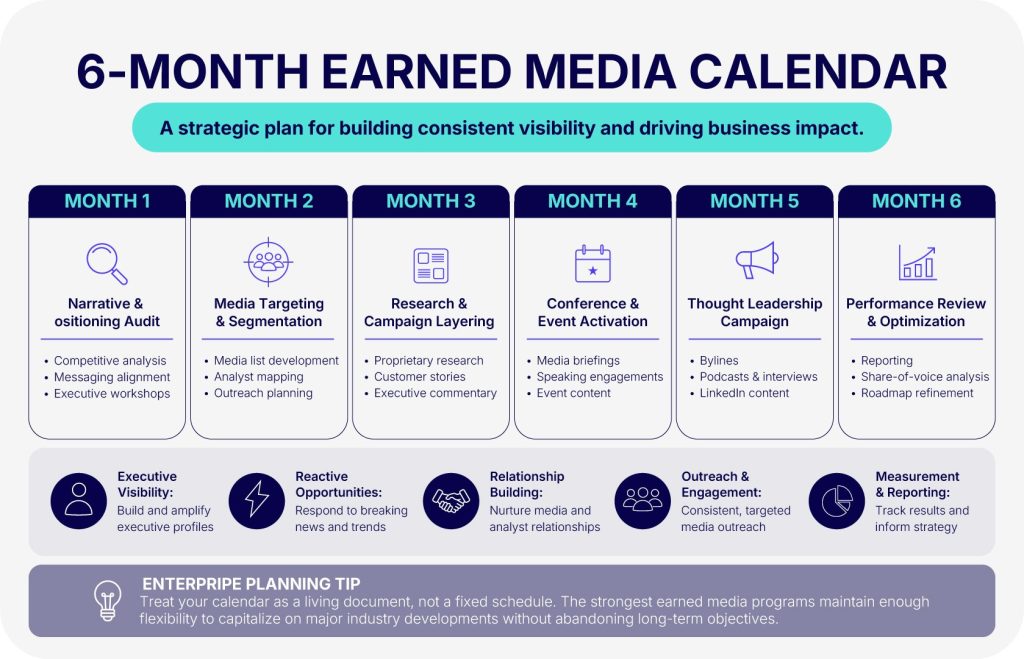
Sample 6-Month Earned Media Calendar
| Month | Primary Focus | Supporting Activities |
| Month 1 | Narrative and Positioning Audit | Competitive analysis, messaging alignment, executive workshops |
| Month 2 | Media Targeting and Segmentation | Media list development, analyst mapping, outreach planning |
| Month 3 | Research and Campaign Layering | Proprietary research, customer stories, executive commentary |
| Month 4 | Conference and Event Activation | Media briefings, speaking engagements, event content |
| Month 5 | Thought Leadership Campaign | Bylines, podcasts, interviews, LinkedIn content |
| Month 6 | Performance Review and Optimization | Reporting, share-of-voice analysis, roadmap refinement |
Recommended Monthly Activity Mix
A well-balanced earned media calendar includes:
- One Primary Campaign Focus
- Ongoing Executive Visibility Initiatives
- Reactive Commentary Opportunities
- Relationship-building Outreach
- Performance Measurement and Reporting
This structure keeps consistent while strategic initiatives move forward.
Enterprise Planning Tip
Your calendar is not etched in stone — it’s a living document. Keep it flexible enough to factor in major industry developments without losing sight of your long-term objectives.
Pro Tip: If multiple initiatives are competing for the same month, prioritize the activities most closely tied to business objectives and core narratives.
Use key metrics to determine what is and isn’t working: 10 Best PR Metrics to Measure for Increased Success
How to Adapt Your Plan for Different Growth Stages
The core principles of earned media planning are your tree trunk. Your priorities are branches of varying lengths and offshoots with leaves of initiatives and efforts that grow and change with the seasons.
If you’re a growth-stage sapling trying to establish market awareness, your branches and leaves will look very different than a mature enterprise oak focused on category leadership.
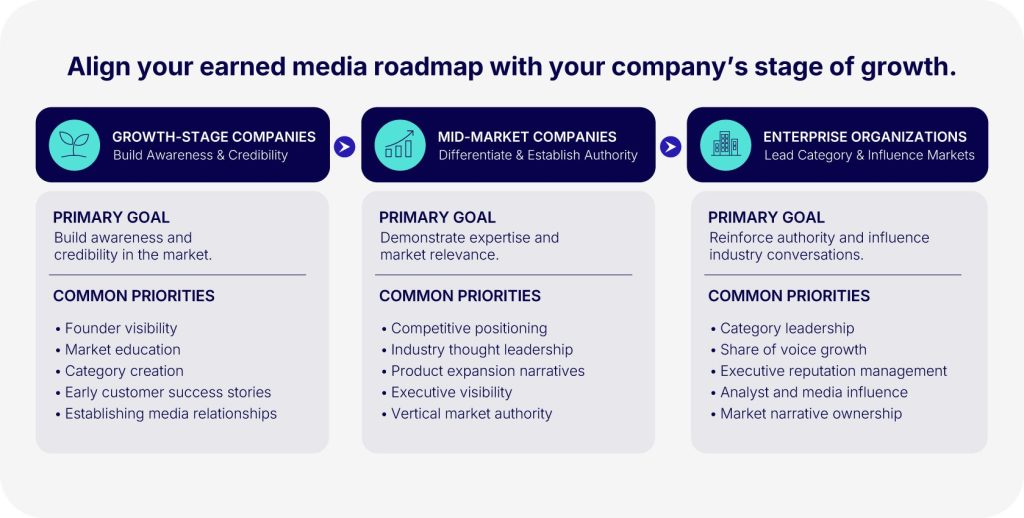
The key is plan-stage alignment.
Growth-Stage Companies
If you’re at the growth-stage, your primary goal is building awareness and credibility.
Common priorities include:
- Founder Visibility
- Market Education
- Category Creation
- Early Customer Success Stories
- Establishing Media Relationships
The market needs to understand the problem, how you solve it, and why it matters.
Example: If you’re a Series B cybersecurity startup, spend six months building founder visibility through:
- Podcast Appearances
- Contributed Articles
- Commentary
Talk about emerging cyber threats while using customer success stories to establish a credible market presence.
Mid-Market Enterprise Brands
As you scale, PR shifts toward differentiation and market positioning.
Common priorities include:
- Competitive Positioning
- Industry Thought Leadership
- Product Expansion Narratives
- Executive Visibility
- Vertical Market Authority
At this stage, you need to demonstrate expertise and market relevance.
Example: You’re a growing fintech company entering the healthcare sector. You should center your earned media roadmap on:
- Industry Research
- Executive Thought Leadership
- Healthcare-specific Customer Stories
This will help establish authority in a new vertical market.
Mature Enterprise Organizations
As an established enterprise, you will use earned media to:
- Reinforce Authority
- Influence Industry Conversations
- Support Long-term Business Objectives
Common priorities include:
- Category Leadership
- SOV Growth
- Executive Reputation Management
- Analyst and Media Influence
- Market Narrative Ownership
This stage is more about consistency and alignment than coverage volume.
Example: You’re an enterprise cloud provider. Your strategic narrative is AI infrastructure leadership.
Around that narrative, you coordinate:
- Executive Visibility
- Analyst Relations
- Proprietary Research
- Major Industry Events
This activity ensures every campaign reinforces the same market position.
Global Enterprise Considerations
A global enterprise will follow the same core principles with an additional layer of considerations. The core narrative must be maintained while adjusting for regional and localized messaging.
Common considerations include:
- Regional Media and Analyst Relationships
- Market-specific Messaging and Localization
- Time Zone and Campaign Coordination
- Regulatory and Compliance Requirements
- Executive Visibility Across Multiple Geographies
- Consistent Reporting and Measurement Frameworks
Example: Your global SaaS company is launching a new AI solution. You promote a unified, global corporate narrative while tailoring messaging for North America, Europe, and APAC based on:
- Regional Regulations
- Customer Priorities
- Media Interests
This approach lets local teams cater to their markets without straying from brand-level consistency.
Pro Tip: Don’t copy another company’s PR roadmap. The most effective earned media plans reflect your organization’s current growth stage, business priorities, and competitive landscape.
Need an update on the latest PR trends? We’ve got you covered: 5 Top PR Trends in 2026: GEO, AI-Native Tools, and the New Rules of Influence
Enterprise Earned Media Requires Infrastructure, Not Just Outreach
To recap, individual pitches, product launches and quarterly campaigns aren’t the path to earned media progress. The best plans are of built around a proven, repeatable system that aligns:
- Narratives
- Executive Visibility
- Media Relationships
- Industry Events
- Business Goals
By implementing the six-month earned media planning approach, you keep visibility consistent while strengthening market authority.
Your campaigns are no longer competing for attention — they’re stoking each other.
Whether you’re tweaking an existing plan or building one from scratch, the key is to create a structure that follows a strategic path but is malleable enough to take advantage of new developments.
If you’re looking to improve campaign performance, optimize resource allocation, or strengthen the connection between PR and business outcomes, we can help. Schedule a Strategic PR Planning Session or PR Efficiency Audit to evaluate your current roadmap, uncover opportunities for improvement, and build a more scalable earned media strategy.